 English


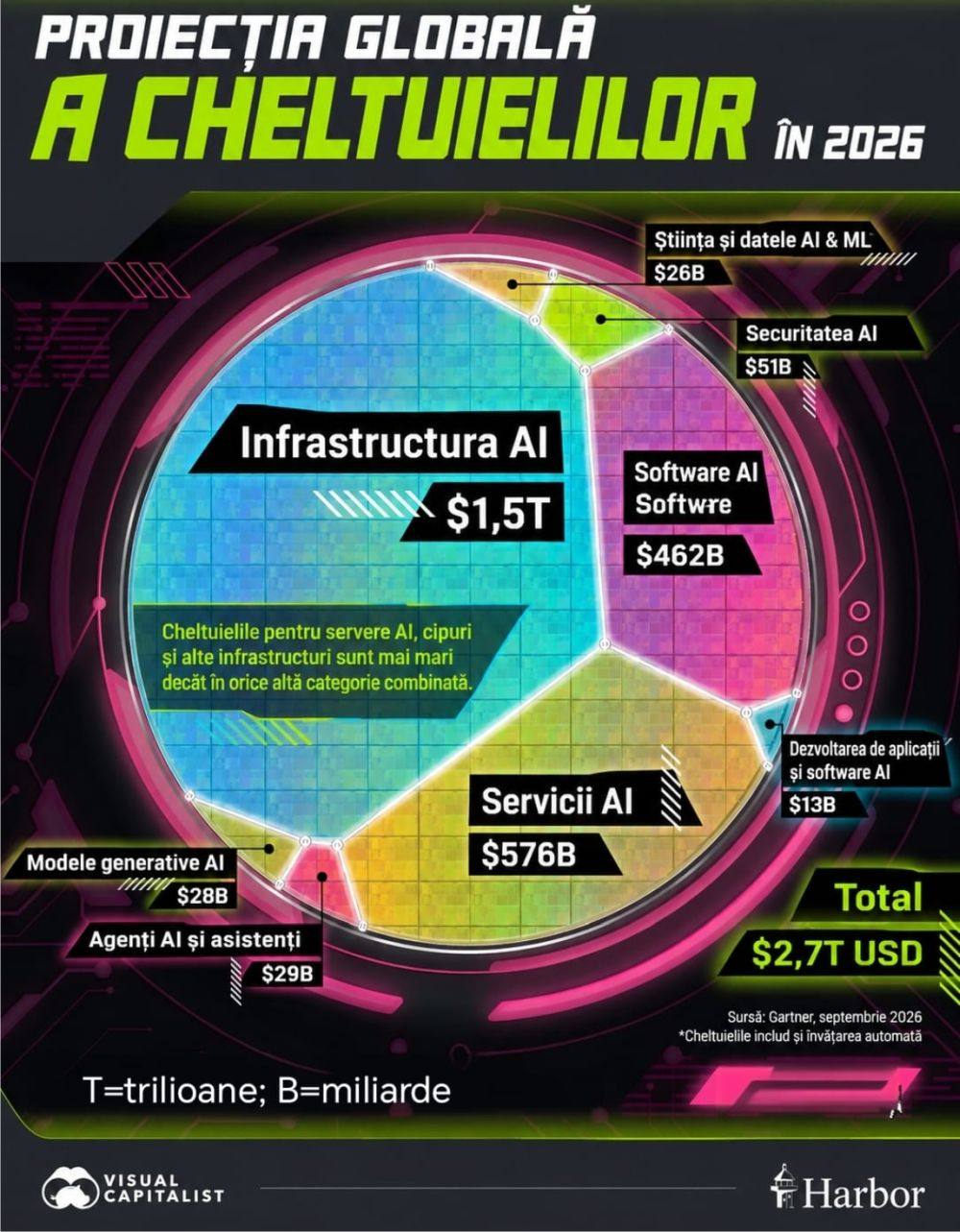
Global spending on artificial intelligence (AI) is expected to surge by a staggering 50% between 2025 and 2026. As expenditure accelerates, a few key categories will capture the lion's share of the investment, according to visualcapitalist.com.
The source, in partnership with Harbor Capital Advisors, provides a detailed breakdown of projected spending for 2026 by category.
• AI infrastructure accounts for 56% of total spending
The American research and consulting firm Gartner estimates that organizations and consumers will spend $2.7 trillion on artificial intelligence in 2026.
Infrastructure-which includes AI servers, chips, networking equipment, and cloud computing services-is set to account for 56% of total AI-related spending, amounting to $1.484 trillion. Demand for infrastructure is high as companies prepare for the future computational requirements of artificial intelligence. This demand has also contributed to substantial increases in the market value of AI giants, such as Microsoft and Broadcom, since the launch of ChatGPT in November 2022.
AI-based services constitute the second-largest category, with spending estimated at $576 billion. Companies are increasingly turning to external providers to integrate AI functionalities into the software they already use, rather than focusing exclusively on large-scale organizational transformations.
Following closely is the category of AI-based software, at $462 billion. To meet the growing demand for AI-powered tools, software companies are rapidly adding new capabilities to their existing products. For instance, Microsoft users can now ask the Copilot assistant to help them summarize documents in Word, analyze data in Excel, or create presentations in PowerPoint.
While the companies behind popular AI models-such as ChatGPT, Gemini, and Claude-dominate the headlines, Gartner estimates that generative AI models will account for only 1% of global AI spending by 2026. Even when including AI agents and assistants, these two categories represent only about 2% of the total. This highlights the opportunities within the broader AI ecosystem, particularly in infrastructure, software, and services.
• EU aims to create a euro50 billion sovereign fund for technology investments
The European Union plans to launch a sovereign investment fund, backed by euro50 billion in public and private capital, to invest in strategic technologies such as artificial intelligence and quantum computing, a European Commission official announced yesterday, as reported by AFP and Agerpres.
This investment fund will provide financing for "all critical technologies necessary for our technological sovereignty and economic security," explained Henna Virkkunen, the Commission's Executive Vice-President for Technological Sovereignty, Security, and Democracy, during a press conference at the European Parliament in Strasbourg.
Concurrently, the European Commission proposed the "Quantum Technologies Regulation" yesterday-a new framework designed to help translate European quantum research into products and services, strengthen supply chains, and prepare Europe's digital systems for post-quantum cryptography. The proposal also lays the groundwork for a Sovereign Tech Equity Fund (STEF).
The "Quantum Act" rests on three main pillars: research excellence, the deployment of quantum technology, and the security of systems and supply chains. These objectives will be pursued through the "Quantum Europe" framework initiative, which will align EU and national programs around shared priorities for research and industry.
The act will bring together European Union and national programs, focusing on common priorities for research, industry, and implementation. This will improve access to funding, shared infrastructure, and specialized support services. It will also support Europe's transition toward post-quantum cryptography, helping to protect data, communications, and critical infrastructure against future cyber risks associated with quantum computing.
The Act will further support the creation of pan-European quantum infrastructures for researchers and businesses across Europe. These include quantum computers, quantum simulators, and quantum-enhanced medical imaging. Quantum technology and innovation hubs will provide specialized knowledge, expertise, and engineering skills to help start-ups and small and medium-sized enterprises (SMEs) develop market-ready products.
The EU and its Member States will also focus on strategic projects to expand essential quantum capabilities, including industrial applications and manufacturing. Furthermore, the Act will assist businesses in accessing finance and connecting with public procurers.
The Act also enables the establishment of a new investment vehicle: the Sovereign Tech Fund. This will provide equity and similar forms of financing to support technologies essential to the Union's technological sovereignty and economic security. It will contribute to funding the "Quantum Europe" framework initiative and the measures outlined in the Commission's package on technological sovereignty. The Commission will work closely with the European Investment Bank Group, Member States, and other key stakeholders to rapidly establish a sovereign equity fund for technology, aimed at providing financial support for technologies that are essential to the Union's technological sovereignty and economic security.
The Commission's proposal will be examined by the European Parliament and the Member States in the coming months, before becoming law.




















 Euro
 Dolar SUA
 Franc elveţian
 Liră sterlină
 Gram de aur

























Reader's Opinion