English



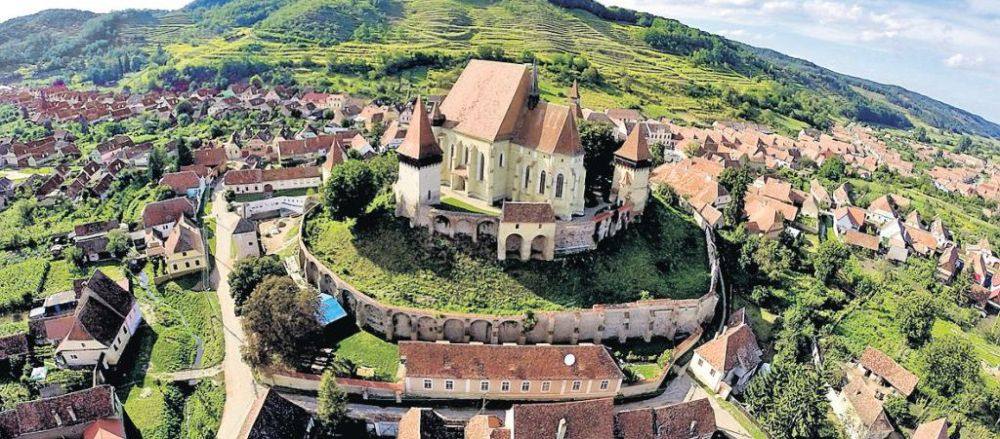
History constantly offers valuable lessons. A narrow room within a fortified church in Transylvania has brought an unusual practice from the history of Saxon communities back to the attention of the international press: the "matrimonial prison" in Biertan, where couples on the verge of separation were locked together in an attempt to resolve their conflicts. Italian journalists have reported on this site in Sibiu County, located between Mediaş and Sighişoara. The story is compelling due to the radical solution devised by the local community some three centuries ago to prevent the breakdown of marriages, as well as the outcome attributed to this method: according to local tradition, only one divorce was recorded during the period when Biertan served as an episcopal seat.
• One room, one bed, and shared belongings
The so-called "matrimonial prison" is located within the fortified church of Biertan, one of the best-known Saxon settlements in Transylvania. Built between the 15th and 16th centuries, the church was designated a UNESCO World Heritage site in 1993, as part of the group of Transylvanian villages with fortified churches. According to local accounts, couples seeking a divorce were sent by the bishop to this room, where they were required to spend a period of time together-lasting up to six weeks. The space was modest, and the couple had at their disposal only one bed, one chair, one spoon, one plate, and one mug. All items had to be shared, and the two were compelled to live together and discuss the issues that had brought them to the brink of separation. Pastor Ulf Ziegler, cited in accounts regarding the history of the site, explained that the decision to confine couples rested with the bishop. The goal was to provide time for the spouses to reconsider their decision and attempt to reach an understanding.
• Only one divorce in nearly 300 years
The detail that brought this story to attention outside of Romania concerns the number of divorces. According to statements attributed to the pastor in Biertan-and cited by various publications-only one divorce was recorded within the community over a span of approximately 300 years.
However, this information must be viewed within the context of local tradition. There is insufficient public data to allow for an independent verification of complete statistics for the entire period, and the figure is presented in accounts about Biertan as an account passed down by the community. The story has also drawn the attention of the international press; the BBC published a report on this "marital prison," describing the chamber and its role in the life of the Saxon community.
• Saxon heritage: between history and tourism
Beyond this unusual story, Biertan is a significant tourist destination, thanks to its fortified church, Saxon architecture, and the atmosphere preserved within the ancient settlement. For nearly three centuries, the fortified complex served as an important religious center for the Evangelical Saxons of Transylvania, housing the seat of the bishopric between 1572 and 1862. Today, the former "matrimonial prison" is presented to visitors as part of the locality's historical heritage. Its history offers an example of how religious norms and community organization influenced family life in a society where maintaining a household and a family also carried an economic dimension. The interest shown by the foreign press in Biertan demonstrates that local heritage can gain international visibility-not merely through its monuments, but also through the stories that accompany them.
























 Euro
 Dolar SUA
 Franc elveţian
 Liră sterlină
 Gram de aur