 English




• Where is October's inflation increase coming from?
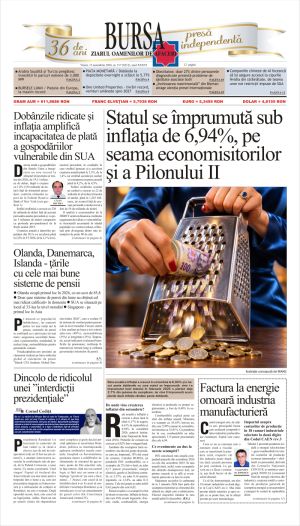
The annual inflation rate rose for the second consecutive month: 6.17% in August, 6.61% in September and 6.94% in October 2026, according to the National Institute of Statistics (INS). Consumer prices increased by 0.82% in a single month.
Half of October's price increase came from three groups of products which together account for 18% of the consumer basket. According to BURSA's calculations, based on INS weightings, fuels, which became 2% more expensive in one month, contributed 0.17 percentage points; electricity, natural gas and central heating, with a 2.15% increase, contributed 0.14 points; and vegetables, with a 3.34% increase, contributed 0.11 points. The three groups thus accounted for 0.42 points out of the total 0.82.
The rest of the consumer basket became more expensive at half that rate. Core inflation, calculated by INS excluding vegetables, fruit, eggs, fuels, electricity and products with regulated prices, stood at 0.48% in October.
Fuels account for more than a quarter of annual inflation. Diesel prices rose by 43.45% in one year, including 2.99% in October alone, while petrol prices increased by 32.91%. Taking their weight in the consumer basket into account, fuels contributed approximately 1.9 percentage points of the total 6.94%.
• What events led to these price increases?
INS calculates the annual rate by comparing prices in October 2026 with those in October 2025. The annual rate therefore includes all price increases over the past twelve months, and some of its causes are events that took place months ago.
The increase in fuel excise duties effective 1 January 2026 is part of the rise in diesel and petrol prices over the past year, as reported by the press. The effect of the increase remains in the annual rate until December.
The conflict in the Middle East has been ongoing since spring, and the Government declared a crisis situation on the fuel market in March 2026. In October, the conflict triggered a new increase in oil prices. Brent crude cost 102.55 dollars per barrel on 1 October, and in the fourth week of the month it exceeded 117 dollars, its highest level since April, following Iranian attacks on oil tankers near the Strait of Hormuz, according to BURSA, citing Reuters.
Diesel prices rose more sharply than crude oil prices because of a shortage of refined diesel on the market. Platts diesel quotations exceeded 1,600 dollars per tonne, while Romania covers part of its consumption through imports, as reported by the press.
The State halted part of the increase in diesel prices. On 15 October, the Ministry of Finance extended the 25% reduction in diesel excise duty for the second half of the month; without the reduction, a litre would have cost approximately 0.85 lei more, as reported by the press.
The political crisis began in May, but its impact on the leu exchange rate only emerged in early October. The Bolojan Government was dismissed on 5 May 2026, and on 30 September Parliament rejected the Mureşan Government, which received 182 votes out of the 233 required. The following day, the NBR exchange rate rose from 5.2777 to 5.3447 lei per euro, an increase of 1.27%, and on 6 October it reached 5.3527 lei, the highest exchange rate in history.
The exchange rate stopped rising after S&P maintained Romania's rating at BBB-, with a negative outlook, on 2 October, according to BURSA. The Niculescu Government was sworn in on 20 October.
The depreciation of the leu feeds through into prices gradually. Retailers continue selling stocks purchased at the old exchange rate for a while, while goods imported after 1 October are paid for at the new rate. The euro rose from 5.0889 lei on 17 October 2025 to 5.3485 lei on 22 October 2026, an increase of 5.1%, according to NBR exchange rates. The NBR lists the exchange rate, alongside fuels and energy, among the factors that will cause inflation to rise by the end of the year.
Electricity became more expensive in October through new contracts. Suppliers renew household customers' contracts when they expire, and Hidroelectrica raised the price of active electricity from 0.45 to 0.515 lei/kWh starting in October, an increase of 13%, which translates into approximately 7% on the final bill, as reported by the press.
• What did the NBR decide?
The NBR kept its monetary policy rate at 6.50% per year at its meeting on 12 November 2026, according to the NBR statement. The lending facility (Lombard) remained at 7.50%, while the deposit facility remained at 5.50%.
The NBR's decision was exactly what analysts had anticipated. All economists surveyed by Bloomberg expected the interest rate to remain unchanged, as reported by the press on the morning of the meeting.
The NBR interest rate is 0.44 percentage points below inflation. Anyone borrowing at this rate pays, in real terms, 0.41% less than they received.
In its statement, the NBR says that the negative output gap in the economy will deepen in the second half of 2026 and then gradually narrow. According to NBR data, gross domestic product stagnated in the second quarter of 2026, following a 0.1% decline in the first quarter.
The NBR identifies electricity prices, oil quotations, fiscal consolidation, the conflict in the Middle East, and decisions by the European Central Bank and the US Federal Reserve as inflation risks.
The NBR did not raise its official interest rate, but money became more expensive on the interbank market. The NBR states that interest rates on the interbank money market remained well above the levels recorded in previous quarters. Ciprian Dascălu, chief economist at BCR, calculated that the effective interest rate rose to 6.07% in October, from 5.50%, as reported by the press.
The NBR's foreign exchange reserves fell by 1.5 billion euros in October, to 58.553 billion euros, according to Agerpres. The decline in reserves and the increase in the cost of money on the interbank market are consistent with BCR's explanation that the NBR is defending the leu through these channels rather than through its monetary policy rate.
• How far has inflation moved away from the NBR's forecast?
The NBR has postponed the return of inflation to its target range by at least one quarter. In its August Inflation Report, the NBR forecast inflation of 6.1% in December 2026 and 3.4% in December 2027. In its November report, the NBR states that inflation will rise in the final months of the year and will only return to the target range in the first quarter of 2028.
October inflation already exceeds the NBR's forecast for December by 0.84 percentage points, and the NBR expects inflation to rise further by then.
• Who loses when interest rates are below inflation?
Anyone buying one-year Tezaur government bonds loses purchasing power at the current rate of inflation. The Ministry of Finance maintained the same interest rates as in October for the 9 November - 4 December issue: 6.50% for one year, 7% for three years and 7.50% for five years, as reported by the press. With 10,000 lei invested in one-year Tezaur bonds, the buyer receives 10,650 lei, which, at an inflation rate of 6.94%, has the purchasing power of 9,959 lei a year ago, or 41 lei less.
The Ministry of Finance did not raise Fidelis interest rates either, although inflation increased for the second consecutive month. In the 6-13 November issue, leu-denominated bonds offer 6.60% for two years, 7.15% for four years and 7.75% for ten years. The two-year series remains below the current inflation rate, while the four-year and ten-year series exceed it by 0.2 and 0.8 percentage points, respectively.
The State also borrows from banks at rates below inflation. On 12 November, the Ministry of Finance sold Treasury bills maturing on 24 May 2027 at an average yield of 6.18%, and bonds maturing on 27 July 2033 at 6.89%, according to official statements from the NBR and the Ministry of Finance, analysed by BURSA in the article "Pillar II Loses 12.92 Lei per Participant, but Still Records a Gain of 20.54 Lei in November". For November, the ministry has scheduled borrowings of at least 9 billion lei, 3.2 billion more than in October, according to Agerpres.
Pillar II pension funds are losing purchasing power on government securities purchased at current yields. At the end of September, the funds held government securities worth 153.66 billion lei, representing 64.9% of the 236.8 billion lei in assets held on behalf of 8.57 million participants, according to the Financial Supervisory Authority (ASF). If inflation were to remain at 6.94%, a fund buying bonds maturing in 2033 at 6.89% would lose approximately 0.5 million lei in the first year for every billion lei invested, while a fund buying Treasury bills at 6.18% would lose approximately 3.7 million lei for every billion lei invested over the 189 days until maturity, according to BURSA's calculations.
The loss in purchasing power is different from the change in the price of securities already held by the funds. When the yields demanded by buyers fall, the price of securities in the portfolio rises. The funds have therefore gained approximately 176.1 million lei since 30 October, although on 12 November they lost 110.8 million lei, because yields on three-, five- and ten-year securities rose by 0.01-0.02 percentage points, according to BURSA's calculations.
Employees are also losing out because wages are rising more slowly than prices. The average net wage was 5,717 lei in September 2026, 5% higher than in September 2025, while real earnings fell by 1.5%, according to INS. To buy the same amount of goods and services as a year ago, the average employee would have needed approximately 5,805 lei, or 88 lei more per month.
• Who gains?
Anyone who owes money in lei gains when inflation exceeds the interest rate they pay, because their debt decreases in real terms. The largest debtor in lei is the State: the budget deficit reached 78.52 billion lei after the first nine months of 2026, or 3.82% of gross domestic product, according to data from the Ministry of Finance.
The State has already gained at the expense of those who bought one-year Tezaur bonds in February 2025. The Ministry of Finance issued the bonds on 11 March 2025, at an interest rate of 6.95%, and repaid them on 11 March 2026, while prices increased by 9.87% over this period, according to INS. Buyers lost 2.7% of their purchasing power, or approximately 266 lei for every 10,000 lei invested.
The loss resulted from inflation far exceeding the NBR's forecast: in February 2025, the NBR forecast inflation of 3.8% for December 2025, while the actual rate was 9.69%.
For securities purchased now, the State's gain depends on inflation up to maturity. The State gains if inflation remains above the interest rates of 6.18%-6.89% paid in November, while the NBR itself expects inflation to rise until December.
The Ministry of Finance preferred to borrow less rather than pay a higher yield. At the Treasury bill auction on 12 November, the ministry offered securities worth one billion lei, while primary dealers submitted bids totalling 684.7 million lei. The ministry rejected bids with yields above 6.20%, below the NBR's 6.50% interest rate, and raised only 600.67 million lei.
• What comes next
The Ministry of Finance has scheduled a 600 million lei bond auction for Monday, 16 November. Also on 16 November, at 11:00 a.m., the NBR will present its Inflation Report at a press conference, while the minutes of the meeting will be published on 24 November. INS will publish October wage data on 11 December and November inflation data on 14 December. The NBR's next monetary policy meeting is scheduled for 19 January 2027.
Inflation is rising, the NBR is postponing its target until 2028, and the State is keeping interest rates below inflation. Those buying short-term government securities now are losing out at the current inflation rate, while four- and ten-year Fidelis bonds preserve purchasing power only if inflation falls as forecast by the NBR, even though inflation has exceeded the NBR's forecast since August.
Editor's Note
This text was prepared with the assistance of artificial intelligence; responsibility for the analysis rests entirely with the author.
























 Euro
 Dolar SUA
 Franc elveţian
 Liră sterlină
 Gram de aur





























Reader's Opinion