 English


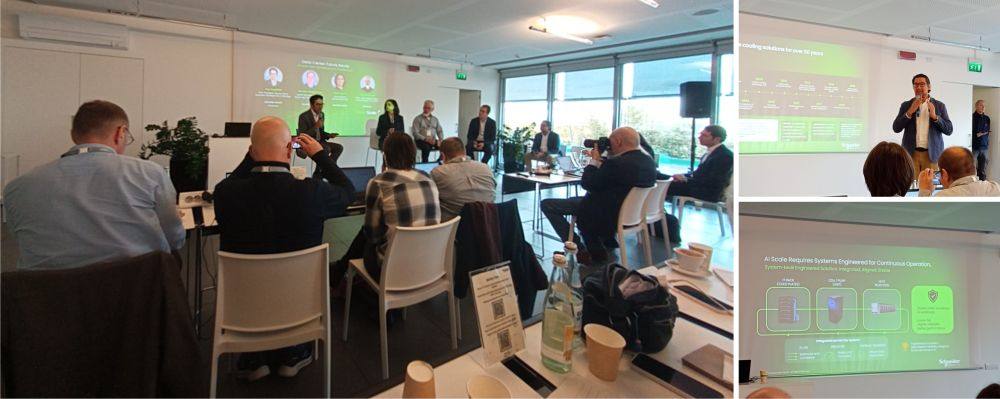
Schneider Electric will double its production capacity for coolant distribution units (CDUs) at its plant in Conselve, near Padua, starting in January 2027, company representatives announced at a press conference at the Italian technology site. They said chiller manufacturing capacity would increase by 50% by the end of 2026 and a new cooling laboratory would triple current testing capacity by December 2027.
The expansion comes as artificial intelligence servers pack more than ten times as much power into a single equipment cabinet, known as a rack, as is typical in many conventional data centers. Heat must be captured close to the chip and carried out of the building. CDUs distribute coolant to the equipment, while chillers cool the fluid in the system. In practice, the same data center may use liquid cooling loops for its most demanding processors and air cooling for networking, storage, and other equipment.
The Conselve hub has 28,000 square meters of manufacturing space and houses both product development teams and the group's training center for service personnel, according to Andrew Bradner, senior vice president of Schneider Electric's cooling division. Davide Zardo, president of Schneider Electric Italy, said the group has about 3,400 employees.
"Half of them work at our five manufacturing plants, which produce for both Italy and the global market and develop products and innovations for the group. The other half support customers in the field, from design and specifications through project delivery, services, and infrastructure lifecycle management,” Zardo said.
Conselve is part of Schneider Electric's global manufacturing and engineering network, which also includes a liquid cooling center of excellence in Buffalo, New York, manufacturing and engineering operations in India and China, and a planned plant in Mexico.
In Italy alone, Zardo said, the company has five innovation centers working on everything from cooling and industrial refrigeration to automation and power systems.
"One important issue, particularly in a multipolar world, is how to optimize the supply chain so it can withstand disruption in such a fast-moving market. That is also why Schneider Electric decided to regionalize its supply chain, bringing the ecosystem closer to the market and making it more resilient in the current environment,” Zardo said.
• Investors' first question is when they can get power
Before deciding how to cool its servers, a data center operator needs to know when power will be available and how much it can get. Damien Dhellemmes, Schneider Electric's senior vice president for Secure Power in Europe, said that as data center campuses scale to hundreds of megawatts, the timeline for connecting to the grid can dictate the schedule for the entire investment.
"We used to talk about a large data center when you reached 30 megawatts. At 50 megawatts, you were already looking at a big beast in the traditional data center world. Now, with AI data centers, with these AI factories, we are talking about hundreds of megawatts. We are talking about gigawatt-scale campuses. [...] When you meet customers, when you meet investors, I would say, that is their very first question: OK, can I get power, yes or no? And if I can, how soon can I power up my data center?” Dhellemmes said.
In practice, the operator may need its own substation, along with grid connection work that has to be coordinated with the building design. Dhellemmes pointed to Schneider Electric's Barcelona plant, where the company manufactures and tests modules before they are installed on site. In northern regions, where outdoor work is more difficult in winter, prefabrication can shorten the installation schedule.
"A bottleneck that comes up very often when you meet customers today is getting power to the site. I need to build a substation on my site. How long will it take to get power there? And of course, if you keep building your facility and infrastructure the traditional way, it simply takes too long. One thing we promote at Schneider Electric is the modular data center. It is the only way to keep up with the accelerating pace and move quickly, including when you are building data centers in remote locations,” Dhellemmes said.
• Power availability is reshaping where investment goes
Liam Newcombe, vice president of energy strategy and innovation at GreenScale, said major European markets will continue to host cloud services that need to stay close to customers, while large AI projects are looking for sites with available power and a viable path to securing permits.
"So computing moves to where power is available. We start with the power map. Once you find power, you check connectivity,” the GreenScale executive said.
In discussing site selection, Newcombe compared two GreenScale projects. In Norway, he said, the company's site benefits from a grid mix that is about 99% renewable and has 1 gigawatt (GW) of hydroelectric capacity nearby. In Derry, Northern Ireland, the company is developing a project on a brownfield site. There, the output profile of wind farms and the cost of electricity mean the operator must find additional sources of power.
"Derry in Northern Ireland bills itself as something of a "Saudi Arabia of wind power,' but we only get a 40-45% capacity factor from wind there. So for the rest of the year, we have to find something else. Unfortunately, much of the power on that grid currently comes from gas. We do not yet have enough storage capacity. The other problem in Great Britain, Northern Ireland, and across central Europe, where we rely heavily on wind, is that power is very expensive. When you tell a US tenant they will be paying more than $200 per megawatt-hour (MWh), they look confused, because they are used to paying $20, $40, or $60 per MWh in their own markets. So the big challenge for us in Derry is to bring additional renewables onto the site, put them behind the meter, and bring the price down to a competitive level,” Newcombe said.
Dhellemmes cited Start Campus in Sines, Portugal, where the developer made use of existing power infrastructure and access to seawater for cooling. In Italy, Silvia Olchini, Schneider Electric's vice president for Secure Power in the country, put operational capacity at about 500 MW and cited a projection that available capacity could reach 2.3 GW by 2031.
• What will power cost over the life of the facility?
Olchini said long-term power purchase agreements, known as PPAs, can make costs more predictable and help finance new generating capacity. "As an example of what Schneider has done to support customers, we facilitate PPAs lasting 7 to 20 years for a total capacity of 100 MW across 11 data centers. These agreements account for 300 GWh of renewable energy per year and support seven wind projects,” she said.
In discussing Italian projects, Olchini also cited a study showing that 53% of operators face a shortage of skilled workers. In response to that challenge, Schneider Electric hired more than 300 people in Barcelona over a period of 18 to 24 months, Dhellemmes said.
Newcombe said factory production can also help train teams by giving them continuity between projects.
"First, we can build on an industrial scale and pretest equipment at our original equipment manufacturer (OEM) partners' plants, as in Barcelona. That allows us to offer stable, long-term jobs instead of moving people every two to five years. Second, we can hire bright young people for entry-level roles and train them in-house instead of complaining about a shortage of experts with 15 to 20 years of experience. Third, we need new skills to design complex grid connections,” Newcombe said.
Dhellemmes explained how the company views the relationship between data centers and the power grid. As part of the DCFlex initiative, operators and suppliers are examining whether some computing workloads can be shifted to times when power is more readily available and under what conditions backup batteries can support the grid.
"Think, for example, about running AI workloads at night, when more power is available. Also think about the backup power you have in the data center through UPS systems and batteries. You can feed that power back into the grid at certain times of day, in real time. The data center can thus play a role in balancing the grid and electricity distribution, avoiding cascading effects,” Dhellemmes said.
• From 8-12 kW to more than 100 kW per rack
The shift behind Schneider Electric's expansion in Conselve can be seen in a single rack. Bradner said actual average power density at conventional data centers had long hovered around 8-12 kilowatts (kW) per rack. Systems based on NVIDIA H100 accelerators pushed some configurations to 40-80 kW, while the GB200 platform took density above 100 kW per rack, a level at which liquid cooling adoption accelerated, according to Bradner.
"IBM used liquid cooling in many of its mainframes more than 30 years ago. What has changed is the scale of deployment. That is what is new, and it has yet to be proven at this scale. We have talked about moving from a 20- or 30-megawatt data center to these gigawatt-scale campuses. On top of that, our IT OEM partners are now integrating liquid cooling and cold plates directly into their servers. Ten years ago, that did not exist. People had to remove the heat sinks and put cold plates into servers to make liquid cooling possible,” Bradner said.
Dhellemmes presented an 800-volt direct-current architecture with a power module next to the rack, known as a sidecar, for configurations in the 200-500 kW range. On the cooling side, Olchini described how the acquisition of Motivair changed Schneider Electric's equipment offering.
"Cooling architecture requirements are changing completely, and hybrid air and liquid cooling solutions are the most widely adopted by our cloud customers. By acquiring Motivair, Schneider Electric expanded its portfolio to cover all these needs, from chillers to CDUs and fans. One important innovation is the 2D CDU, the MCDU 70, which delivers up to 2.45 MW of cooling capacity in a single compact unit. The WCU is also fully connected to the fans, providing an integrated air and liquid cooling architecture,” Olchini said.
Tuan Hoang, who oversees cooling technology and product development at Schneider Electric, said direct-to-chip liquid cooling can support configurations exceeding 1 MW per rack. He explained why the temperatures at which chips can operate also matter for cooling equipment outside the server room.
"Raising the design temperature allows us to explore new opportunities, such as using water efficiently and sustainably. As we reduce energy consumption, the equation changes, opening up significant opportunities to improve reliability and reduce dependence,” Hoang said.
For colocation operators, which lease space to multiple customers, the challenge is to accommodate equipment with different requirements in the same building. Mauro Leuce, Senior Director, Global Design & Engineering Standards SME at Digital Realty, explained why hybrid solutions remain important.
"As colocation providers, we always have to preserve flexibility. We have customers who need different mixes of air and liquid cooling. The most demanding customers ask for 80% liquid and 20% air. There is no such thing as an entirely liquid-cooled AI factory, because even when the rack is liquid-cooled, some heat is dissipated through radiation. Customers also need networking, storage, and so on, which rely on conventional air cooling. A more sensible balance between liquid and air cooling today would be around 50/50. That is still the right ratio. If I have 100 MW of IT load, 50 MW is liquid-cooled and 50 MW is air-cooled. Power usage effectiveness, or PUE, will be lower on the liquid-cooled side, but the overall average will be around 1.2-1.3,” Leuce said.
• Building flexibility matters even after the lease is signed
Liam Newcombe cited configurations that accept coolant at an inlet temperature of 40-45°C, while others require temperatures below 30°C. With differences of that magnitude, the cooling system must be designed to accommodate equipment changes over the life of the facility.
"The question is how much longer tenants will ask for such high kilowatt densities per rack. We need to design buildings so we can completely reconfigure the usable space, probably every five years. It would not surprise me if we did that twice in 15 years as NVIDIA and others introduce changes such as the shift to direct current and two-phase cooling. At the same time, the market is diverging. NVIDIA accepts warm inlet water at 40-45°C, which is fantastic for heat recovery. But we also see many members still constrained to temperatures below 30°C for their AI chips. That makes it very difficult to design a standardized building,” Newcombe said.
"The most important thing is giving investors confidence that you can build a facility flexible enough to accommodate any customer. Second, we have to win the race to secure building permits, find power, and work with communities so they do not block our projects. The technical aspects are the easy part. We have suppliers and partners who share technical information. The hard part is actually building the data center,” Mauri Leuce added.
• How much water and energy can a data center save?
Water use depends on how heat is removed from the building. The liquid that absorbs heat from the chip can recirculate in a closed loop. Outside the building, the system can reject heat to the air or use a cooling tower, where some of the water evaporates. When IT equipment can accept warmer coolant, outside air can be used for more hours each year to cool the fluid in the loop, reducing compressor runtime.
"DLR is very focused on accommodating a mix of customers in its buildings, but there is a different opportunity for those building dedicated sites, which can have an 80/20 or even 90/10 split between liquid and air cooling. Higher water temperatures bring the same benefits by allowing more free cooling. In some US markets where water is an issue, cooling towers pose a challenge. But higher water temperatures and AI workloads allow you to change how you use these technologies. Both we and DLR agree that eliminating water use in data center construction is the right approach. When you work with higher water temperatures, you can limit water consumption, generally cutting water use by about 80% compared with a traditional cooling tower and water-cooled chiller setup,” Liam Newcombe said.
Mauro Leuce described how this approach works in practice. In his example, the compressors can stay off for most of the year, as long as the outdoor air temperature is low enough to allow heat to be rejected.
"Because customer requirements vary so widely, we cannot design a data center solely for extreme performance from day one. We have to keep enough flexibility to offer the facility to customers with conventional requirements as well. We see a lot of hybrid approaches. One advantage is that customers using air cooling are also asking for higher temperatures, which lets us use free cooling. Free cooling is about how many days or months a year you can use outside air to cool the warm return water. We use free cooling for most of the year and only need to switch on the compressors for two to three weeks in summer,” said Leuce of Digital Realty.
Hoang also presented findings from company studies in Europe and the United States, where liquid cooling for accelerators, higher operating temperatures, and more hours of outside-air cooling cut auxiliary infrastructure energy consumption by up to 60%. That figure covers the energy used by systems that support data center operations, including cooling, and accounts for only part of total energy use.
"The trade-off between water and energy consumption depends on location, costs, sustainability, and the reliability of utility networks,” Hoang said.
Bradner linked infrastructure efficiency to the cost of delivering AI services. He listed metrics such as tokens processed per unit of power, time to first token, and cost per token. In a language model, a token is a unit of text that the model processes or generates.
"If you get it wrong and you do not have an architecture and a design that you can deploy and operate reliably, you end up using more energy and operating less efficiently. Your cost per token goes up because you are using more energy. And that is the measure of how you achieve profitability,” Bradner said.
• Factory testing can shorten on-site installation
The planned threefold increase in testing capacity at the Conselve technology hub also addresses a scheduling issue. Equipment needs to be tested together before it reaches construction sites, where operators are already dealing with grid connection timelines and a shortage of skilled workers.
"We are bringing more validation and integration testing directly into our factories to speed up field installation. We use AI tools and digital twins so customers can simulate and optimize their thermal networks, shortening the time to first token and to monetization,” Bradner said.
For customers buying equipment from the Conselve technology hub, the goal is to shorten the time between the equipment's arrival on site and the moment the data center starts processing commercial workloads.





















 Euro
 Dolar SUA
 Franc elveţian
 Liră sterlină
 Gram de aur
























Reader's Opinion