 English


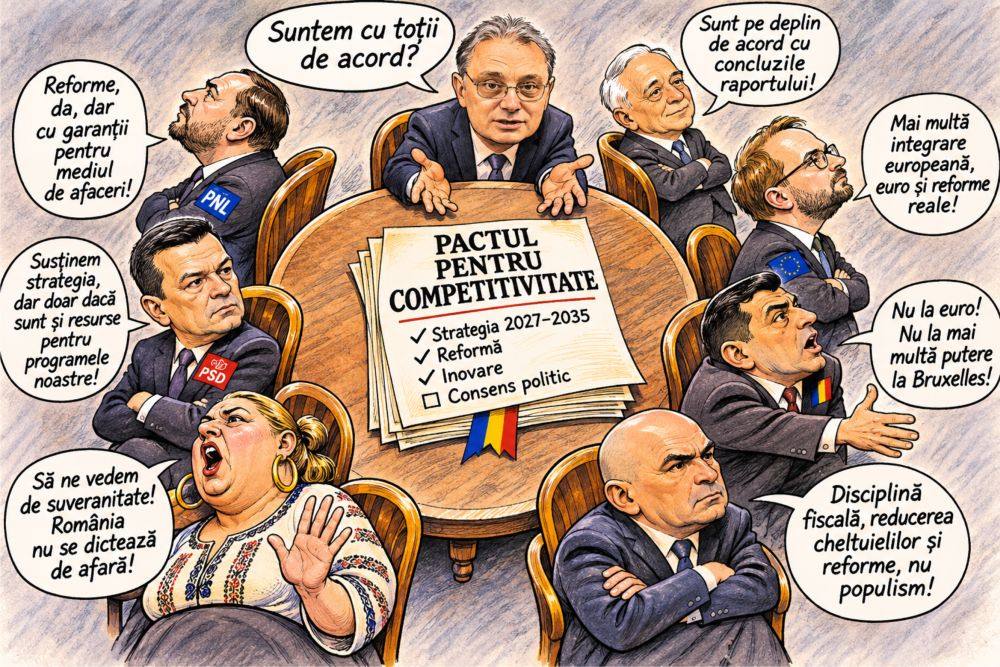

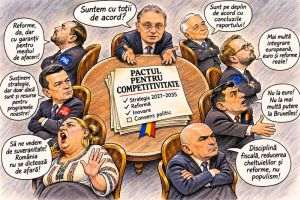
Can anyone imagine a consensus between Diana Şoşoacă and Ilie Bolojan on Romania's competitiveness strategy?
Or between George Simion and Dominic Fritz on taxation, euro adoption and deeper European integration?
The Jacques Delors Institute report, "Assessing Romania's Competitiveness - A 2027-2035 Strategic Outlook”, recommends establishing a national coalition for reform and innovation to ensure the continuity of the economic strategy beyond electoral cycles, through 2035.
On the occasion of the report's launch, Prime Minister Luca Niculescu announced that he was working on establishing a team of economists from various institutions to draft Romania's competitiveness strategy, starting from the Jacques Delors Institute study, according to the statement issued by the organisers on November 24.
The event, held at the National Bank of Romania, was attended by Prime Minister Luca Niculescu, former Italian Prime Minister Enrico Letta, Finance Minister Alexandru Nazare, NBR Governor Mugur Isărescu and DDD Foundation President Dan Stratan, CEO of RCI Holding.

According to AGERPRES, on November 24, the NBR Governor stated: "I fully agree with the conclusions of the report prepared by the Jacques Delors Institute”.
The Prime Minister proposed that political parties, employers' associations and trade unions conclude a competitiveness pact, invoking the precedent of the political agreement on Romania's accession to the Organisation for Economic Co-operation and Development (OECD).
"We had such a consensus for joining the OECD. We can have it again”, Luca Niculescu said, according to AGERPRES, on November 24.
The scale of the event and the support expressed by Romanian state representatives contrast with the absence of any demonstration that the proposed strategy is politically feasible.
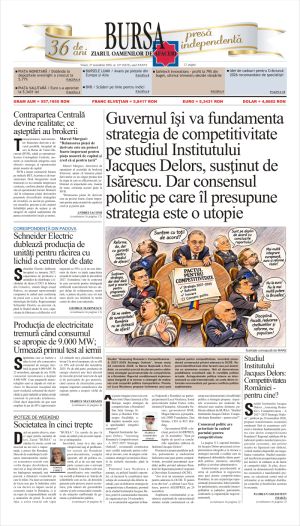
The economic aspects of the study are the subject of a separate analysis published alongside this article by BURSA: "The Jacques Delors Institute Study: Romania's Competitiveness - For Whom?”.
• Political consensus takes priority within the competitiveness pact
On page 113, the Jacques Delors Institute report states that the full and timely implementation of the strategy requires a coalition that transcends divisions between political parties, ministries, public authorities and administrative levels.
The Presidential Administration is expected to contribute to negotiating a pact for Romania's competitiveness, involving representatives of the Prime Minister, leaders of parliamentary parties, associations of municipalities and counties, employers' organisations, trade unions and non-governmental organisations.
However, the participants in the pact do not have the same decision-making power, nor are they always politically independent of one another.
Local administration leaders generally have political affiliations. Employers' organisations, trade unions and non-governmental organisations represent economic and social interests and can influence political decisions, while some of them maintain ties with political parties.
One example is the Bucharest Metro trade union, whose former president, Ion Rădoi, was a PDSR-PSD deputy between 2000 and 2004 and a PSD senator between 2004 and 2008.
The institutional diversity of the pact's participants therefore does not guarantee their mutual political independence. Antagonisms between parties may also be reproduced in relations between the other participants in the pact.
Furthermore, parliamentary parties, through their representatives, hold the power to adopt, amend or repeal the legislation required to implement the strategy and to approve the budgets that provide its funding.
Even if all the other participants in the pact were to reach an agreement, it could not compensate for the absence of an agreement between the parties that will successively form parliamentary majorities through 2035.
Political consensus therefore has functional priority over consensus among the other participants in the pact.
Under the regular electoral calendar, Romania will hold two parliamentary elections before the strategy's implementation period ends, in 2028 and 2032.
The report recommends that the strategy and its management mechanisms be agreed upon by mid-2027 and become operational in the autumn of the same year.
In his speech, Prime Minister Luca Niculescu referred to the succession of 11 prime ministers over ten years and the difficulty of making decisions that can withstand electoral cycles and political crises.
He announced his intention to establish a Committee for Romania's Competitiveness, with the participation of independent economists, the Fiscal Council, the NBR and the Presidential Administration.
The Prime Minister is allocating six months for drafting the first version of the strategy and twelve months for preparing its final version.
Luca Niculescu: from a six-month agreement to an eight-year one
The Prime Minister's initiative must also be examined in the context of the circumstances in which he came to lead the Government.
Politically independent, Luca Niculescu secured parliamentary approval for his Government on October 20, 2026, with 280 votes, following approximately five months of political crisis and three failed attempts to form an executive.
He managed to secure the support of a parliamentary majority where previous attempts to form a government had failed.
When appointing him on October 6, 2026, President Nicuşor Dan invoked Luca Niculescu's diplomatic experience and his contribution to drafting 100 legislative acts with the agreement of parliamentary parties as part of the OECD accession process.
The Prime Minister's personal experience in achieving political agreements constitutes an argument in favour of his initiative.
However, it should be noted that, after five months of political crisis, the parties agreed on a governing arrangement whose initial political support has a six-month horizon.
The same Prime Minister is now proposing a political agreement that would last eight years and span two parliamentary elections.
The consensus required to form a government responds to an immediate political necessity. The consensus required to transform the economy entails assuming common policy commitments, including after changes in parliamentary majorities.
The difference between the duration of the agreement secured and that of the agreement being proposed illustrates the scale of the political challenge that the Jacques Delors Institute should have examined.
Can the OECD accession consensus be replicated?
The precedent invoked by the Prime Minister is real.
On March 28, 2023, the Romanian Parliament adopted Decision No. 5/2023 establishing a joint special committee of the Chamber of Deputies and the Senate to support Romania's accession to the OECD.
The document explicitly refers to "the strong domestic political consensus on joining this organisation”, according to AGERPRES, on March 28, 2023.
Representatives of opposition parties were also involved in the work of the parliamentary committee.
However, there are fundamental differences between the objectives of the two consensus-building efforts.
The OECD Council decided to open accession negotiations with Romania on January 25, 2022. On June 10, 2022, the organisation adopted the roadmap for Romania's accession, setting out the conditions and procedures for membership.
The alignment of Romanian legislation and policies with the organisation's standards is assessed by technical committees. The OECD Council decides on Romania's admission based on the results of these assessments.
Romanian parties can support OECD accession while maintaining their differences over economic policies, provided those policies remain compatible with the organisation's standards.
In the case of the competitiveness strategy, the parties must negotiate the very content of the economic policies they are expected to implement.
The subject of the consensus includes, among other things, taxation, the distribution of budgetary resources, the regulation of financial activities and the organisation of public administration.
These are issues on which parties build their political identities and differentiate their electoral platforms.
The OECD precedent demonstrates that cross-party cooperation on a specific objective is possible. Replicating this cooperation across a range of economic and social policies, over several electoral cycles, requires a separate demonstration.
• The causes of the consensus breaking down already exist before it is established
The Jacques Delors Institute report examines four scenarios for Romania's development through 2035.
In the constrained development scenario, on page 72, the author describes the deterioration of a political consensus initially established around a pact for security and stability.
Factors contributing to this deterioration include regional insecurity, budgetary constraints, declining public trust in institutions and controversies over measures to combat foreign interference and disinformation.
These factors are already at work in Romania.
Russia's full-scale invasion of Ukraine began in February 2022. Romania has been subject to the excessive deficit procedure since 2020. The annulment of the presidential election in December 2024 generated controversy over the legitimacy of institutional decisions and foreign interference in the electoral process.
The OSCE's final report on Romania's presidential elections, published on October 28, 2025, documents problems with transparency and oversight of electoral campaigns, including in the digital environment.
The security and stability pact in the aforementioned scenario differs from the competitiveness pact. However, both require cross-party political cooperation and are vulnerable to common destabilising factors.
The Jacques Delors Institute attributes to phenomena already present in Romanian society the power to undermine a hypothetical political consensus in the future.
The report does not demonstrate how a consensus on competitiveness could be established under conditions in which factors capable of breaking it down have already been at work for years.
Political antagonisms have changed in nature
The Snagov Declaration of June 21, 1995, constitutes a precedent for national political consensus. Romanian parties then agreed on the strategic objective of Romania's accession to the European Union.
However, domestic and international political conditions have changed fundamentally over the three decades since then.
In 1995, Romanian political consensus benefited from the prospect of integration into an international system supported by the major Western powers.
Today, the future of that very system has itself become the subject of international political disagreements.
The United States National Security Strategy, published by the White House in December 2025, explicitly criticises European institutions and their policies, including from the perspective of national sovereignty.
Issues that are the subject of domestic political conflicts in EU member states have thus become explicit components of American foreign policy.
In Romania, traditional disagreements over taxation, income redistribution, property and state intervention in the economy overlap with disagreements over national sovereignty, European integration and the country's geopolitical orientation.
Conflicts over the legitimacy of institutions and the decisions they adopt have been added to these issues.
A compromise on taxation presupposes acceptance of a common institutional framework within which negotiations take place. However, challenging the legitimacy of that framework can undermine the very possibility of negotiation.
The transformation of the parliamentary representation structure illustrates the scale of political changes.
In the 2020 parliamentary elections, AUR obtained 9.08% of the votes for the Chamber of Deputies, according to the OSCE report.
In the 2024 elections, AUR obtained 18.01%, S.O.S. România 7.36%, and POT 6.46%, according to the results compiled by the Permanent Electoral Authority and published by AGERPRES on December 2, 2024.
The combined electoral share of the three formations, at 31.83%, is 3.51 times the result obtained by AUR in 2020.
This comparison illustrates the change in the structure of political representation. It does not, in itself, constitute a measurement of social polarisation.
Political nationalism also existed in the Romanian Parliament in the 1990s. The novelty of the contemporary situation should be sought in the subject matter of political conflicts, the scale of parliamentary representation enjoyed by sovereigntist formations and the interdependence between domestic conflicts and international antagonisms.
• The internationalisation of domestic political conflicts
The development of transnational digital platforms has changed the conditions under which political opinions are formed and electoral competition takes place.
On December 17, 2024, the European Commission opened a formal investigation into TikTok's handling of electoral risks in the context of Romania's presidential elections.
The opening of the investigation does not definitively establish the responsibility of external actors. However, it illustrates the existence of electoral risks associated with transnational communication infrastructures, whose control lies beyond the capabilities of Romanian authorities.
In its report of March 14, 2025, on foreign interference, the Parliamentary Assembly of the Council of Europe identifies the exploitation of internal vulnerabilities within European societies as one of the ways in which external political influence is exercised.
International antagonisms can fuel domestic political antagonisms. Domestic political conflicts, in turn, can create opportunities for external actors to intervene.
The phenomenon, however, extends beyond electoral interference.
Romanian parties participate in European political competition through their membership of transnational political families. Disagreements between these political families concern the distribution of powers between European institutions and member states, as well as energy, industrial, trade and security policies.
The Jacques Delors Institute strategy assumes that European integration will be leveraged. However, the evolution of this integration depends on the political decisions of all member states and European institutions.
Even if Romanian parties were to agree on industrial policy, they could not guarantee the international trade conditions under which it would operate through 2035.
The tariff disputes between the United States and the European Union illustrate this limitation.
On July 14, 2025, the Council of the European Union described the announced 30% US tariffs as unjustified and unacceptable.
Changes in international trade conditions may require a revision of industrial policies, investment priorities and budgetary estimates agreed upon within a national pact.
Revising these policies would require new negotiations and new compromises.
The establishment and preservation of Romanian political consensus therefore also depend on the evolution of international antagonisms over which the signatories of a potential national pact have no authority.
The strategy may generate its own political antagonisms
The Jacques Delors Institute treats political antagonisms as factors that may affect Romania's competitiveness.
However, the competitiveness strategy itself may become a source of political antagonisms.
The recommendation to move from a flat tax to progressive taxation, formulated on page 89 of the report, conflicts with the liberal commitment to maintaining the flat tax.
In its 2026-2028 Government Programme, published on September 26, 2026, the National Liberal Party states: "The flat tax remains. Income tax and corporate profit tax will not change during the term of office.”
Reaching an agreement would require revising the PNL's tax commitment, removing the Jacques Delors Institute recommendation or postponing its implementation.
The report does not examine the economic consequences of successively removing or postponing, through political negotiations, certain measures from the package of reforms it proposes.
Other recommendations, such as fiscal consolidation, relaxing certain macroprudential lending rules, expanding private pension funds' investment opportunities and reducing the number of political appointments in public administration, involve redistributing costs, risks or decision-making power.
Some of these measures already enjoy political support. At point 7.10, the PNL programme supports expanding pension funds' investment opportunities in the economy and infrastructure.
However, the existence of specific areas of policy convergence does not demonstrate that an agreement on the entire strategy can be achieved.
On page 114, the author acknowledges that certain reforms may produce negative effects concentrated on particular social and economic groups. He recommends compensation mechanisms, including through the use of benefits resulting from economic growth.
However, the costs of reforms may materialise before the economic benefits from which compensation is supposed to be financed.
During this interval, opposition from the affected groups may alter the electoral support enjoyed by the parties implementing the strategy.
Parties would have to accept the possibility of losing elections as a result of measures whose economic benefits would materialise during the tenure of their political opponents.
The absence of a consolidated financial plan for the strategy and of an assessment of the distribution of costs and benefits, discussed in the economic article published alongside this one, also prevents an assessment of the political and social conflicts that implementing the reforms could generate.
Can conditionality attached to European funding preserve political consensus?
Prime Minister Luca Niculescu proposes including the strategy's objectives in the European Union Partnership Plan for the 2028-2034 period.
Access to European funding would be conditional on meeting the agreed objectives and milestones.
The mechanism has an institutional foundation.
The proposal concerning national and regional partnership plans for the 2028-2034 period provides for the financing of reforms and investments depending on the fulfilment of milestones and targets, according to the European Parliamentary Research Service.
Conditionality attached to European funding can encourage continuity in reforms and increase the political and economic costs of abandoning the strategy.
However, experience with the National Recovery and Resilience Plan (NRRP) shows that commitments agreed with European institutions can be renegotiated.
Romania secured amendments to its NRRP, including in December 2023 and November 2025, according to documents published by the European Commission.
Including the competitiveness strategy in the European Union Partnership Plan does not guarantee that its original content will be preserved through 2035.
Furthermore, the effectiveness of the mechanism depends on maintaining political interest in accessing European funding under the conditions established by EU institutions.
Yet the Jacques Delors Institute itself examines the possibility of a deterioration in political relations between Romania and the European Union.
In the regression scenario, presented on pages 72-73, the report describes a hypothetical development in which fiscal consolidation in 2026-2027 affects household incomes, public services and local budgets.
Disputes over European funding and reform commitments become, in this scenario, components of a political conflict over national autonomy.
The report even examines the possibility of Romania leaving the European Union by 2035.
The author does not present this scenario as a forecast. However, he acknowledges the possibility of a political evolution in which the mechanism proposed by the Prime Minister to preserve consensus could itself become a source of political antagonisms.
Conditionality attached to European funding could be interpreted by some parties as a restriction on Romania's decision-making independence.
• The proposed solutions do not match the nature of all conflicts
The Jacques Delors Institute recommends presidential mediation, consultation with the participants in the pact, identification of common interests and compensation for groups disadvantaged by reforms.
These mechanisms may help resolve certain economic and social disagreements.
However, their applicability to conflicts concerning Romania's geopolitical orientation, national sovereignty or the legitimacy of state institutions remains unproven.
What economic compensation could resolve a political conflict over the distribution of powers between the Romanian state and European Union institutions?
How could the Presidential Administration mediate a conflict in which the legitimacy of the presidential institution itself is the subject of the dispute?
How could national consensus be preserved if strategic disagreements between the United States and the European Union were to intensify?
The report proposes mechanisms for administrative coordination, monitoring and adaptation of the strategy. However, it does not present an alternative for fully implementing the strategy on schedule if cross-party cooperation fails to materialise or breaks down.
On what grounds is the Government committing itself to the strategy?
The Jacques Delors Institute identifies political instability as one of the structural obstacles to Romania's development.
To solve the structural problems of the Romanian economy, the report presupposes that one of the structural problems it itself identifies - political discontinuity - must first be overcome.
Prime Minister Luca Niculescu proposes establishing a team of economists to draft the national competitiveness strategy.
But the main prerequisite for the strategy's full implementation is political in nature.
Has the Government examined whether the study's recommendations are compatible with the programmes of parliamentary parties?
Has it assessed the possibility of maintaining such a pact after the parliamentary elections in 2028 and 2032?
Has it assessed the consequences of removing some of the reforms recommended by the Jacques Delors Institute from the strategy through political negotiations?
Does the Government have an alternative in the event that political consensus cannot be achieved?
The support expressed by the NBR Governor for the report's conclusions does not answer these questions. The economic expertise of the institutions involved in drafting the strategy cannot substitute for demonstrating its political feasibility.
Nor does Prime Minister Luca Niculescu's personal success in securing a parliamentary majority demonstrate that a consensus on transforming the Romanian economy through 2035 can be achieved.
The need for a national competitiveness strategy is justified. It is precisely this need that makes it essential to base the strategy on Romania's actual political conditions.
In the absence of adequate mechanisms for overcoming domestic and international political antagonisms, the assumption that Romanian parties will establish and preserve, through 2035, the consensus required for the strategy's full implementation is utopian.
A strategy that makes its full applicability conditional on achieving a political consensus whose feasibility remains unproven risks remaining an exercise in academic pretension.
The Government must demonstrate that the strategy it intends to draft can function under Romania's actual political conditions.
• Author's note
Artificial intelligence assisted in the preparation of this text; full responsibility for the article rests with me.
















 Euro
 Dolar SUA
 Franc elveţian
 Liră sterlină
 Gram de aur























Reader's Opinion