 English
ALRO Slatina, one of the most important aluminium producers in Europe and a strategic player for Romanian industry, has been at the intersection of international economic interests for more than two decades.
The privatisation of the plant, the control historically exercised by a Russian businessman through companies registered in other countries, commercial ties with Chinese industry and dependence on energy markets have turned the company into an example of how foreign capital can influence an industry essential to the national economy.
Russia's invasion of Ukraine has brought renewed attention to the shareholding structure and the geopolitical risks associated with it, while the entry of major Romanian investors has changed the balance of shareholdings without eliminating the majority control exercised through the Vimetco group.

• From the 2002 privatisation to Russian capital control
The history of foreign influences on ALRO Slatina is closely linked to the company's privatisation, carried out in 2002, when the Romanian aluminium producer was taken over by an investment structure controlled by Russian businessman Vitali Machitski.
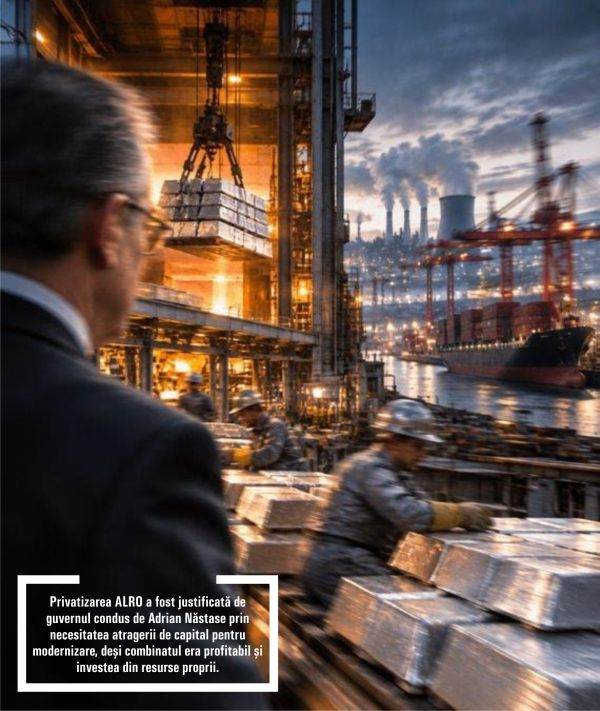
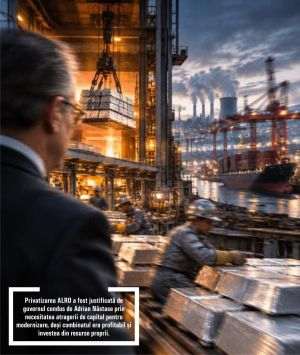
The privatization of ALRO was justified by the government led by Adrian Năstase on the grounds that capital needed to be attracted for modernization-even though the industrial complex was profitable and was already investing using its own resources. According to articles published at the time by the newspaper BURSA, the privatization of ALRO involved a mechanism whereby the accumulation of shares, a change in decision-making rules, and the sale of a mere 10% stake enabled the transfer of control to the Marco Group.
ALRO Slatina was not in the position of those enterprises that required an investor to avoid closure. At the start of the privatization process, the company had no outstanding debts to the state budget or to banks, and its technological upgrading was being financed from its own funds. According to a retrospective published by BURSA on March 18, 2019, the company's net profit reached $53 million in 2000 and $43 million in 2001. In the year following 2000, $39.5 million in investments were financed using the profit generated that year.
It is precisely this capacity for self-financing that calls into question the justification for the privatization method promoted by the authorities. Why was it necessary to relinquish control in exchange for investment capital, when the enterprise had already demonstrated that it could sustain a substantial modernization program on its own?
In the spring of 2001, the approach advocated by the leadership of APAPS (the Authority for Privatization and Management of State Ownership) involved a $60 million capital increase. The investor would have received newly issued shares, while the state would have lost its majority stake without any funds flowing into the state budget-as the capital contribution would have gone directly into the company. Ovidiu Muşetescu, the Minister of Privatization and head of APAPS, cited the need for urgent investments and a decline in the price of aluminum as justifications. BURSA challenged this explanation, pointing out that ALRO could have financed its investments out of its own profits, just as it had done previously. Following public opposition, the initial plan was postponed.
In the meantime, the Marco Group strengthened its position by purchasing shares on the market. According to a 2019 retrospective by BURSA, by the end of 2001, it had acquired-directly and indirectly-approximately 41.77% of ALRO. The state still held 54.72%. Under these circumstances, acquiring the state's entire stake was no longer necessary to secure a majority; an additional 10% stake would suffice to shift control.
Another decisive moment, detailed in BURSA's investigations, was a change to the voting rules. On July 23, 2001, a threshold of three-quarters of the share capital was established for certain general assembly resolutions. The stake accumulated by Marco gave it the power to block such decisions.
As the newspaper interpreted it, this veto power discouraged other potential investors: any party looking to acquire the state's stake would have to contend with a private shareholder capable of blocking key corporate decisions. Consequently, competition for the privatization was undermined even before the transaction was concluded.
The contract, signed on April 30, 2002, brought the state approximately $11.4 million in exchange for a 10% stake in ALRO. The stake complemented the consortium's existing holdings and secured a majority position for it. In the article "Disadvantageous Privatizations," published on October 14, 2010, BURSA pointed out that consultants' valuations had placed the worth of the entire company between $450 million and $550 million. However, the price paid for the 10% stake implied-by extrapolation-a total value of approximately $114 million. This distinction is important: the $11.4 million represented the proceeds received by the state for the decisive stake, not the total cost of all acquisitions made by Marco. The same article cited a figure of around $160 million for the takeover as a whole.
In 2009, BURSA noted that, at the time of the sale, the company held net current assets of approximately $45 million. This figure included inventories and receivables, net of relevant liabilities; it does not represent a cash balance in a bank account. Nevertheless, these data underscore the central economic question: to what extent were the company's financial position and the value of control reflected in the price accepted by the state? The criticism raised by BURSA focused precisely on the surrender of a majority stake in an enterprise capable of generating profit and investing from its own resources-a move justified by the alleged need for urgent capitalization.
According to an analysis published by BURSA in March 2019, the company was taken over through Vimetco NV, a company registered in the Netherlands, which came to hold 84.19% of ALRO's shares. This ownership structure allowed control over the plant to be exercised through a European legal entity, while the investor controlling the group was of Russian origin.
The privatisation marked the beginning of a period in which strategic decisions concerning one of Romania's most important industrial assets were influenced by the interests of an international group.
ALRO was integrated into a broader industrial structure, with activities in several countries, from raw material production to aluminium processing. This integration gave the company access to resources, markets and investments, but also created dependence on the decisions of the majority shareholder.
At present, according to official reports for the first half of 2026, Vimetco PLC, a company registered in Cyprus, continues to control ALRO, with a 54.19% stake. Pavăl Holding, a Romanian company associated with entrepreneurs Dragoş and Adrian Pavăl, holds 23.21%, while Fondul Proprietatea has a 10.21% stake. The remaining shares are distributed among other investors.
An important distinction, however, appears in recent official documents. ALRO states that the beneficial owner of Vimetco PLC's funds is an individual of Israeli nationality, according to beneficial ownership records updated as recently as 2026.
Therefore, although the historical control exercised by Russian businessman Vitali Machitski is documented in the financial press, it would not be correct to automatically present the current control structure as Russian without verifying the identity of the beneficial owner and any changes that may have occurred in the ownership chain.
• The war in Ukraine and the resignation of Russian board members
ALRO's historical ties with Russian investors became a matter of public interest in February 2022, following the launch of Russia's invasion of Ukraine and the introduction of Western economic sanctions against Moscow.
In March 2022, three Russian ALRO board members, Aleksandr Barabanov, Pavel Primakov and Pavel Machitski, submitted their resignations from the company's Board of Directors. Pavel Machitski is the son of Vitali Machitski, the businessman previously identified as the owner of the group controlling the plant.
According to BURSA, the departure of the three board members came at a time when Romanian authorities were beginning to examine local companies' exposure to Russian capital.
At that time, Senate President Florin Cîţu had asked the Ministry of Finance to investigate companies with Russian shareholders to determine whether their beneficial owners appeared on European Union sanctions lists and whether those companies were receiving state aid.
The resignations were followed by the appointment of new board members, including Genoveva Năstase, Igor Higer and Dragoş Adrian Voncu. The changes altered the composition of the management but did not, in themselves, represent a change in the majority shareholder.
The episode highlighted the reputational and geopolitical vulnerability of strategic Romanian companies whose ownership structures are connected to investors from countries targeted by international sanctions.
However, the existence of historical ties with Russian businessmen does not automatically amount to a violation of European sanctions, nor does it demonstrate interference by Russian authorities in the management of the plant.
• China and Africa, components of the international production network
External influences on ALRO were not limited to its shareholding structure. During the period when the Vimetco group expanded its international operations, the Romanian producer was part of an industrial system that included aluminium plants in China and mining operations in Africa.
According to the analysis published by BURSA in 2019, the Vimetco group's primary and processed aluminium division included, alongside ALRO, two industrial facilities located in Gongyi and Linzhou, China.
This organisation reflected the strategy of internationally integrating production in an industry where access to raw materials, energy and sales markets directly influences competitiveness.
The presence of Chinese operations within the same group represented an important economic connection, but does not, in itself, constitute evidence of political control exercised by Beijing over the Slatina plant.
Another component of the international expansion was access to bauxite from Sierra Leone, an essential raw material for the production of alumina and, subsequently, aluminium.
In an article published in October 2012, BURSA explained that the Sierra Minerals mining operation, acquired in 2010, had an annual production of approximately 1.25 million tonnes of bauxite. The raw material was transported to the Alum Tulcea refinery, and the resulting alumina was used in ALRO's industrial process.
This supply chain illustrated the advantages of vertical integration, but also the exposure of Romanian industry to economic, political and logistical developments in countries outside the European Union.
• Contracts with affiliated companies and the issue of financial transparency
Another important dimension of the influence exercised by international structures over ALRO is represented by commercial relations between companies belonging to the same group.
In December 2016, BURSA reported that ALRO had concluded two contracts with Vimetco Extrusion and Conef Gaz, with a combined value exceeding 218 million lei.
One of the contracts, worth approximately 198.2 million lei, concerned the supply of aluminium products, while the other, worth approximately 19.94 million lei, was related to natural gas deliveries.
Conef Gaz was described as a company controlled by Vitali Machitski, the investor who also controlled the ALRO plant.
Transactions between affiliated entities are common in integrated industrial groups, but they raise legitimate questions regarding transparency, commercial terms and the protection of minority shareholders' interests.
In the case of a strategic company such as ALRO, the relevance of these relationships goes beyond the strictly accounting dimension, because energy supply, product sales and pricing within the group can influence the profitability of the Romanian producer.
However, the existence of these contracts does not constitute evidence that the transactions were concluded on disadvantageous terms or that they were used for unjustified profit transfers. Such a conclusion would require an examination of the contracts, transfer prices and audit documents.
• Energy, the plant's strategic vulnerability
Beyond the origin of capital, one of the most important forms of external influence on ALRO is exercised through energy and raw material markets.
Aluminium production is one of the most electricity-intensive industrial activities, which means that developments in energy prices have direct consequences for production costs.
This vulnerability became evident at the end of 2021, when ALRO decided to reduce its electrolysis operations amid rapidly rising energy prices.
According to BURSA, the plant reduced primary aluminium production from five electrolysis halls to two. The measure highlighted the difficulties faced by an industrial producer dependent on energy supplies at competitive prices.
The issue is all the more relevant given that the European energy market has been affected in recent years by geopolitical tensions and changes in natural gas supply flows.
For ALRO, reducing dependence on energy market fluctuations is therefore not only a matter of economic efficiency, but also one of industrial security.
In 2026, the company continues to invest in equipment modernisation and projects aimed at strengthening energy independence, according to information published by BURSA based on half-yearly reports.
• Romanian investors and the changing balance of capital
The entry of Pavăl Holding into ALRO's shareholding structure represented an important change in the ownership of the plant, strengthening the presence of Romanian private capital in a major industrial company.
The 23.21% stake held by the company associated with the founders of Dedeman gives Romanian investors a significant position in the shareholding structure, without, however, providing them with majority control.
From this perspective, ALRO illustrates a situation frequently encountered in the Romanian economy: the existence of important industrial assets in which local capital participates alongside international investors, while corporate decisions remain influenced by the majority shareholder.
At the same time, Fondul Proprietatea, with a 10.21% stake, represents another important shareholder, while the presence of institutional investors and pension funds contributes to the diversification of the capital base.
This diversification does not eliminate Vimetco's influence, but creates a framework in which the interests of several categories of investors must be taken into account.
• ALRO, between investors' interests and European industrial strategy
ALRO's importance to the Romanian economy is amplified by the role of aluminium in sectors such as the automotive industry, aerospace industry, construction, energy infrastructure and defence industry.
According to official reports from 2026, the company has an installed annual capacity of 265,000 tonnes for electrolytic aluminium production, a recycling capacity of 124,000 tonnes and processing facilities for high-value-added products.
Its main sales markets are located in the European Union, but the company also exports to the United States and Asia.
In this context, ALRO's competitiveness is influenced not only by its shareholding structure, but also by European industrial policies, carbon emissions regulations, international aluminium prices and developments in demand from strategic sectors.
In the first half of 2026, the group reported a net profit of approximately 101 million lei and a turnover of 2.4 billion lei, according to data presented by BURSA. The results show that the company continues to carry out significant economic activity, despite pressures from energy costs and volatility in international markets.
At the same time, the repositioning of European industry in the context of the energy transition and rising defence spending may create new opportunities for aluminium producers with developed industrial capacities.
A Swiss Capital analysis presented by BURSA in July 2025 highlighted the company's potential to benefit from European policies on low-emission production and from demand associated with reindustrialisation processes.














 Euro
 Dolar SUA
 Franc elveţian
 Liră sterlină
 Gram de aur












Reader's Opinion