English


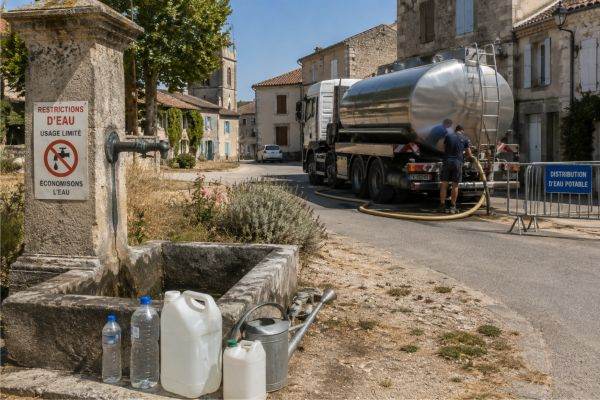
Almost 70% of the territory of France is affected by water restrictions, amid a drought that has intensified after repeated heat waves in the last three months. The French government has called a crisis meeting for today to assess the hydrological situation and its impact on the population, agriculture and ecosystems, AFP reports. The Ministry for the Ecological Transition warns that the drought is "particularly intense", and the effects of climate change continue to increase pressure on water resources. According to French authorities, on August 9, all 99 departments of metropolitan France were at least at the alert level. Of these, 76 departments have been placed in a state of crisis, the highest level of restriction, while another 21 are on heightened alert.
• Water, reserved with priority for essential consumption
In a state of crisis, water use is limited to priority needs, such as drinking water supply, public health, civil security and sanitation. Starting from the alert and heightened alert levels, restrictions are introduced for activities such as watering gardens and green spaces, filling swimming pools, washing cars and irrigating crops. The measures reflect the rapid deterioration of the hydrological situation, after a period characterized by high temperatures and successive episodes of heatwaves.
• Problems with drinking water supply
The situation is all the more difficult as the effects of the drought have begun to be felt directly on the population's drinking water supply. On July 27, the Minister of Ecological Transition, Monique Barbut, warned that the supply of drinking water had become problematic in 47 French departments. At that time, 62 departments were already in a crisis situation. The minister stated that the interruptions in the supply of tap water affected over 30,000 people in 80 communes. For these localities, the authorities resorted to supplying drinking water via tanker trucks or water bottles. The evolution of the situation in the last two weeks indicates an expansion of the phenomenon and an intensification of the pressure on the available resources.
• The government is preparing a new assessment of the situation
Monique Barbut has summoned the members of the Hydrological Forecasting and Monitoring Committee (CASH) as well as the regional prefectures. The meeting aims to carry out an updated assessment of the hydrological situation throughout the country and to analyse the consequences of the drought on the different categories of water users.
The French government announced that the discussions will also cover the impact of the phenomenon on fauna and flora. "Against the backdrop of a particularly intense drought that has befallen France, the effects of climate change continue to increase pressure on water resources,” the Ministry for Ecological Transition said.
• Pressure on water resources is increasing
The extension of restrictions to almost 70% of French territory and the placement of most departments in alert or crisis mode highlight the scale of the phenomenon. Authorities are thus forced to simultaneously manage the water needs of the population, agriculture and economic activities, in a context in which available resources are affected by prolonged periods of high temperatures and lack of precipitation.



















 Euro
Euro Dolar SUA
 Franc elveţian
 Liră sterlină
 Gram de aur