English


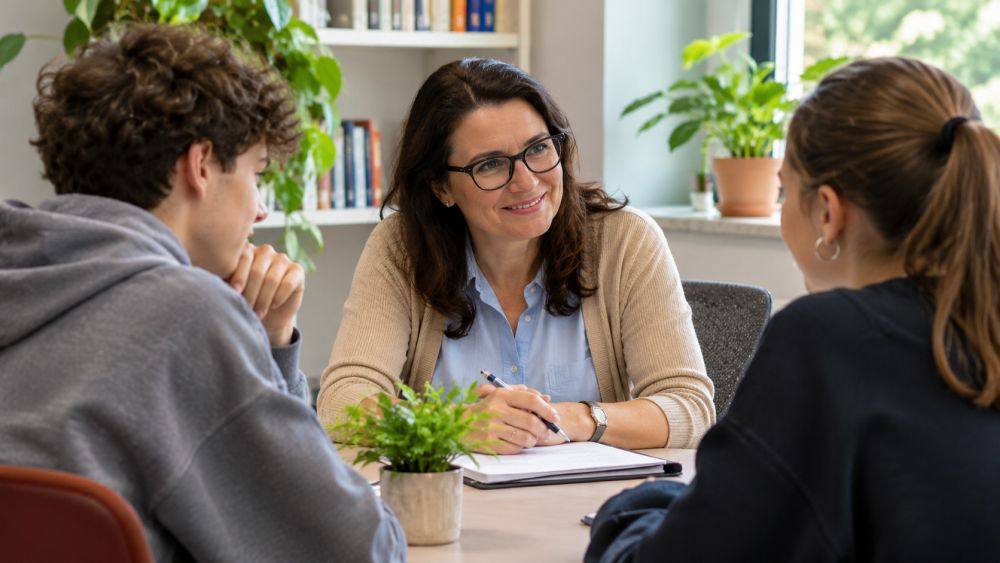
Only 17% of students in Romania use the services of school counselors, and many young people do not even know who holds this position at their school, according to studies presented by the Minister of Education, Sorin Costreie. The official believes it is necessary to change the perception of school counseling so that it is no longer associated exclusively with the existence of a problem, but also with career guidance, personal development, and violence prevention.
"They are viewed the same way psychologists and psychiatrists are viewed in our society-that is, if you go for counseling as a student, it means you have a problem. They are not seen as mentors or guides," stated Sorin Costreie on TVR. The Minister pointed out that school counseling services could play an important role in identifying students' aptitudes and interests, and in guiding them toward suitable professions. In his view, Romania loses a great deal of creativity and inventiveness because many people end up working in fields that do not align with their passions and skills.
Costreie argued that discussions between school counselors, students, and parents could also contribute to reducing violence in schools. A lack of attention toward young people, combined with the feeling that they are not being heard, can lead to frustrations that later manifest as bullying or more serious forms of aggression.
• Minister Proposes Changing Teaching Methods in the Age of Artificial Intelligence
Sorin Costreie argues that the development of artificial intelligence necessitates a shift in the educational paradigm-moving away from a model where the teacher transmits information to students, toward one rooted in questioning, reflection, and critical thinking. The minister, who is also a professor, stated that the traditional model-in which an educator delivers a lesson and subsequently checks for memorization-no longer aligns with current realities. While the primary challenge 30 to 40 years ago was limited access to information, the challenge today lies in the ability to select, interpret, and verify that information. "Transitioning to a reflective model is crucial. Why? Because otherwise, we become the tools of the tool itself. In other words, it uses us to train itself more effectively. And if we are not cognitively trained, we will fail to derive from this encounter with artificial intelligence the elements that could help us become smarter, more creative, more innovative, and more human," the minister declared. He explained that while artificial intelligence can be useful for synthesizing and gathering information, it can also produce errors or misleading responses. Without critical thinking, students risk accepting incorrect information as the truth. "The truth must always be questioned, always sought after, and always verified. This is the Socratic model-the foundation for a type of learning and education based on questioning, which is something that rarely happens," Sorin Costreie stated. The Minister announced that a digital transformation team is being formed within the Ministry of Education to address robotics, artificial intelligence, and information technology, with the goal of integrating these tools for the benefit of the educational process.
• "Socrates' Oath” proposed to restore the prestige of the teaching profession
The Minister of Education also discussed the reactions received following the proposal of a "Socrates' Oath”-a pledge for teachers to take upon completing their pedagogical training or entering the profession. Sorin Costreie noted that he received numerous ironic comments, as well as messages of support.
According to the Minister, the proposal-announced in the context of World Philosophy Day-aims to restore the dignity of and respect for the teaching profession. He explained that the concept is inspired by the Hippocratic Oath, drawing an analogy between a doctor's responsibility toward a patient and a teacher's responsibility toward a student. "My primary intention was to regain respect for the profession; to do that, we must first regain respect for ourselves. One way to achieve this is by pledging to uphold certain fundamental benchmarks-core values that we commit to preserving. It is, in a sense, symmetrical: just as a doctor takes an oath toward a patient, a teacher would take an oath toward a student,” stated Sorin Costreie.
The Minister also mentioned receiving criticism, with some arguing that the focus should be on education funding rather than on symbolic initiatives. He rejected the idea that the two themes were mutually exclusive, arguing that his proposal concerns professional responsibility and respect for the teaching profession. The text proposed for the oath includes commitments regarding responsibility for the act of teaching, the avoidance of turning education into indoctrination, and the prioritization of reasoned argument over personal conviction and understanding. of memorization.
Through the three approaches mentioned-strengthening school counseling, adapting education to artificial intelligence, and reaffirming the values of the teaching profession-the minister advocates for a school system that is more student-centered, focused on developing students' thinking skills and preparing them for their professional lives.




















 Euro
 Dolar SUA
 Franc elveţian
 Liră sterlină
 Gram de aur