 English
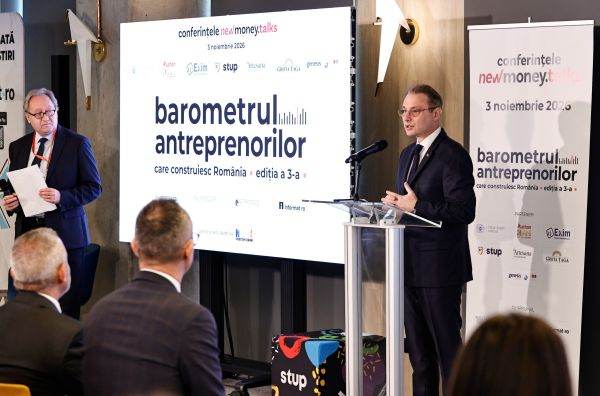
Tax increases are the main obstacle to business development for 53.4% of Romanian entrepreneurs, according to the third edition of the NewMoney-INSCOP Entrepreneurs' Barometer, released on Tuesday, November 3, 2026. The tax burden tops the list of difficulties reported by the business community, ahead of domestic political instability, cited by 40.3% of respondents, and high inflation, mentioned by 30.9%. The findings depict a climate in which costs and uncertainty weigh on business expansion decisions, while Prime Minister Luca Niculescu promises to revive investment, protect jobs and restore entrepreneurs' confidence.
Rising energy prices are an obstacle for 22.8% of survey participants, frequent legislative changes are mentioned by 22.3%, and bureaucracy by 20.1%. Labour costs are cited by 16.3%, declining domestic demand by 13.8%, the exchange rate by 13.5%, and staff shortages by 10.2%. International tensions are mentioned by 9.9%, while competition from large foreign companies is cited by 9.2%. Against this backdrop, the business community's call for predictability concerns both the level of tax obligations and the stability of the rules on which companies base their cost calculations and investment plans.
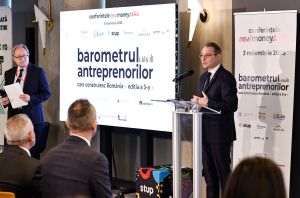
Speaking yesterday at the launch of the Barometer, INSCOP Research Director Remus Ştefureac said: "This year's edition of the barometer highlights the heightened state of alert amid overlapping crises, as well as the prospects for rebuilding confidence in Romania's economy. It underlines investment priorities and the need for a strong partnership between major foreign investors and local entrepreneurs, who need predictable public policies as much as they need air.”
The difficulties reported by companies are accompanied by declining investment intentions, a trend also acknowledged by the Prime Minister. In his address, Luca Niculescu said that restoring business confidence was a government responsibility: "The proportion of companies planning to invest in expansion has fallen from more than half in 2024 to just one-third today. We would like to see a somewhat better situation, and it is my responsibility, and that of the government I lead, to restore entrepreneurs' confidence and appetite for growth. In fact, I believe you have never lacked that appetite. At times, other factors have prevented growth from materialising as we had hoped. Some were domestic, while others were international, and you know them very well. However, economic recovery and increased investment are at the top of my government's agenda.”
The Prime Minister also said that the authorities must pursue the creation of new, better-paid jobs, particularly for young people, and announced discussions with the ministers of Labour and Finance, as well as other Cabinet members, to address the issue. Employment is directly linked to one of the clearest preferences expressed by entrepreneurs regarding medium-term development: education and vocational training rank first among the areas in which Romania should invest over the next five years, cited by 39.3% of respondents.
Support for SMEs and small entrepreneurs follows closely, cited by 38.2%, ahead of energy and energy security, at 29.6%. Road and rail infrastructure is considered a priority by 26.1%, while agriculture and agricultural processing are cited by 25.8%. Cutting bureaucracy and digitalising public administration are mentioned by 24.2%, while industry and local production account for 20% of responses. Healthcare is identified as a priority by 18.4% of entrepreneurs, digitalisation and digital infrastructure by 17%, and research, innovation and technological development by 12.7%. Tourism is mentioned by 7.5%, the green transition and environmental protection by 1.7%, and other areas by 2.6%. Those who do not know or do not answer account for 0.6%.
Responding to these expectations, Prime Minister Luca Niculescu emphasised political and fiscal stability, presenting them as prerequisites for an investment recovery: "Fiscal predictability and political stability are also essential conditions for development. Now, after almost six months of political instability, we have a government with full powers that will work to regain confidence. Speaking of regaining confidence, I would like to share some good news: yesterday, Romania raised euro4.5 billion on the international capital markets, in its first Eurobond issue since the new government took office. Investor demand was twice the amount borrowed, so interest in Romania was very strong. In short, this is an important signal of confidence in Romania and in our ability to honour our commitments.”
The financing operation announced by the Prime Minister concerns government borrowing, while the barometer highlights the difficulties and expectations of companies that must make their own investment decisions. For these businesses, the commitment to predictability is particularly important, given that tax increases top the list of obstacles, while legislative changes and bureaucracy are also sources of pressure.
The survey, conducted by INSCOP Research on behalf of New Money magazine through telephone interviews between October 19 and 26, 2026, involved 1,100 entrepreneurs, forming a representative sample of the community of entrepreneurs operating businesses in Romania. The margin of error stated in the study presentation is ±2.9%.

















 Euro
 Dolar SUA
 Franc elveţian
 Liră sterlină
 Gram de aur






























Reader's Opinion