 English



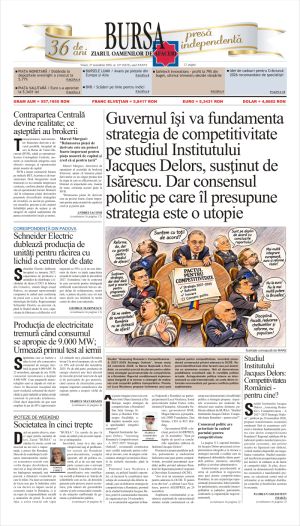
The report "Assessing Romania's Competitiveness - A 2027-2035 Strategic Outlook” was authored by Andreas Eisl, Senior Research Fellow in European Economic Policy at the Jacques Delors Institute.
The study was commissioned by the Dialogue for Democracy and Development Southeast Europe Foundation, in collaboration with HorizonX for the foresight analysis component. The foreword is signed by Enrico Letta.
The document draws on an extensive body of research, comprising more than 200 studies and 47 interviews with representatives of public institutions, the business community, trade unions, international organisations and academia.
The political feasibility of the strategy and the implications of using the study as the basis for the Government's competitiveness strategy are examined in the analysis published alongside this article by BURSA.
The report's main strength lies in identifying the limitations of Romania's economic development model, which is largely based on foreign investment, relatively low labour costs, integration into European production chains and European financial transfers.
Rising labour costs, demographic decline, limited innovation capacity and institutional shortcomings constrain the prospects for continuing development on the same foundations.

The report proposes a transition to an economic model based on innovation, productivity and an increase in the added value generated in Romania.
But what exactly do we want to achieve by increasing the competitiveness of the Romanian economy?
• For whom do we want competitiveness?
Competitiveness can refer to companies' ability to win markets, the efficiency with which production factors are used, the attractiveness of the economy to investors or its ability to generate prosperity for the population.
These objectives do not always coincide.
Low wages can favour the competitiveness of exporters, but they can also encourage emigration and limit the development of the domestic market. Tax incentives granted to investors can increase the economy's attractiveness, but may reduce the resources available for education, healthcare and infrastructure.
Higher wages may reduce the competitive advantage of some companies, but they can support consumption, savings and household investment in education.
The report examines Romania's population primarily from the perspective of labour supply, professional skills, demographics and the capacity to adapt to technological change. It pays less attention to the population as consumers and beneficiaries of economic development.
Insufficient incomes for a significant part of the population limit the effective size of the domestic market. They restrict saving opportunities, access to credit and households' ability to invest in education and healthcare.
According to BURSA's calculations based on Eurostat data, approximately five million Romanians, representing more than a quarter of the country's population, are poor in terms of income or live in severe material deprivation.
For businesses, the demographic size of the domestic market has limited relevance in the absence of information on the population's purchasing power and its distribution.
A large population with insufficient incomes can constitute a restricted market for products and services with high added value.
Poverty can thus contribute to perpetuating the human capital deficit, low productivity and economic dependence.
The report treats the population's prosperity primarily as an expected outcome of increased competitiveness. However, the relationship works both ways.
The population's poverty can itself be a cause of the economy's lack of competitiveness. A development strategy based on innovation must also examine the domestic market's capacity to absorb the products and services resulting from the proposed investments.
From this perspective, reducing poverty is an economic necessity for increasing Romania's competitiveness.
• How do we measure competitiveness?
According to the Eurostat data presented in the report, Romania's GDP per capita, expressed in purchasing power standards, increased from 26% of the European Union average in 2000 to 78% in 2025.
The report interprets this development as a threefold relative increase in the average standard of living of Romanians.
GDP per capita, however, measures economic output relative to the population. It does not directly measure households' disposable incomes or their distribution.
For example, in an economy with a GDP of 100 billion euros, a reduction in the population from 20 million to 18 million increases GDP per capita from 5,000 to approximately 5,556 euros, or 11.1%, while output remains at the same level.
The example illustrates the limitations of the indicator, without describing Romania's actual development.
Assessing convergence in living standards would have required examining actual individual consumption, households' disposable incomes and their distribution.
The strategy's 68 quantitative indicators do not include the poverty rate, median disposable income, the Gini coefficient of income inequality, severe material and social deprivation, or changes in purchasing power by income category.
Surprisingly, the strategy does not include any general indicator of labour productivity or total factor productivity either, although productivity is one of the foundations of the proposed future economic model.
Increased spending on research, a higher number of patents or greater adoption of digital technologies can contribute to higher productivity. However, these indicators do not directly measure the economic outcome being pursued.
The selection of indicators reflects the report's conception of development: the document predominantly measures the economy's capacity to produce, invest, attract capital and adopt technologies, but insufficiently measures the population's capacity to benefit from these achievements.
In the absence of appropriate indicators, the strategy could record that its quantitative targets have been met without being able to establish the extent to which the population's prosperity has increased and how the benefits of economic growth have been distributed.
• Who benefits from competitiveness?
One of the report's important findings is that integration into international production chains can generate economic growth without a corresponding development of domestic innovation and economic decision-making capabilities.
Nevertheless, the report does not examine to the same extent the advantages and risks of deeper European integration for the Romanian economy.
European financial integration can facilitate Romanian companies' access to capital. It can also facilitate the channelling of savings accumulated in Romania towards investments in more developed European economies.
Energy integration can improve security of supply, but it does not guarantee that the economic advantages of Romania's energy resources will be fully reflected in the costs borne by businesses and households in Romania.
The free movement of labour offers opportunities to Romanian citizens, but it can also contribute to the loss of human capital developed at the expense of Romanian society.
The report identifies the economy's structural dependence on external decision-making centres, without establishing with sufficient precision the mechanisms through which deeper European integration would reduce this dependence.
The strategy would have required indicators concerning capital ownership, gross national income, primary income flows abroad, intellectual property and the domestic added value of exports.
These indicators would have made it possible to assess Romania's capacity to benefit from the economic value produced on its territory.
A similar problem arises in the recommendation to adopt the euro by 2035, presented on page 89 as a political anchor for fiscal consolidation and economic convergence.
The report does not sufficiently analyse the economic costs and benefits of joining the euro area, the consequences of relinquishing independent monetary policy and the Romanian economy's ability to absorb asymmetric shocks.
The political desirability of adopting the euro does not, in itself, establish the economic desirability of joining at a particular time.
• Who pays for competitiveness?
The report simultaneously proposes reducing the budget deficit, increasing spending on education and research, protecting public investment, modernising energy infrastructure, developing the defence industry and capitalising development finance institutions.
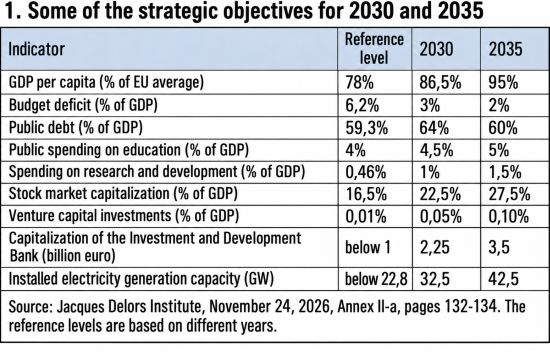
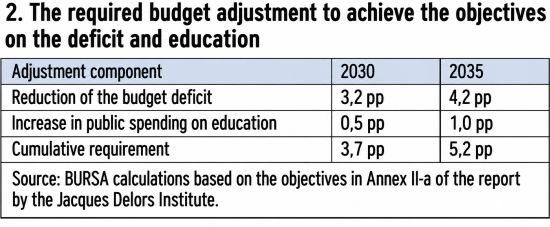
Reducing the budget deficit from 6.2% to 3% of GDP by 2030 requires an adjustment of 3.2 percentage points. Increasing public spending on education from 4% to 4.5% of GDP adds another 0.5 percentage points.
Assuming that other budget revenues and expenditures remain unchanged as a share of GDP, achieving these two objectives requires identifying additional revenues or budget savings equivalent to 3.7% of GDP.
For 2035, the corresponding requirement for these two objectives reaches 5.2% of GDP.
This is in addition to the public component of the additional spending on research and the state's other financial commitments.
The report identifies potential sources of funding: improving tax collection, combating the informal economy, making public spending more efficient and using European financial instruments.
On page 88, the document estimates that additional tax revenues equivalent to 3-4% of GDP could be obtained over a period of five to six years by improving tax compliance in the areas of VAT and corporate income tax.
If this estimate were fully realised, the additional revenues would be comparable to the requirement calculated by BURSA for reducing the deficit and increasing public spending on education by 2030.
The report does not, however, demonstrate to what extent these revenues could be obtained by that deadline and how the strategy's other commitments would be financed simultaneously.
On page 89, the report proposes moving from a flat tax to progressive taxation, so that the loss of tax revenues resulting from a lower tax burden on low-income earners could be offset by higher taxation of high incomes.
The purpose of this measure is to redistribute the tax burden, without generating additional tax revenues. The report does not, however, provide a calculation demonstrating that the tax revenue losses could be fully offset.
The document does not present a consolidated budget for the strategy and does not establish how the costs of the reforms would be distributed among different categories of the population and businesses.
This omission also affects the assessment of whether groups disadvantaged by the reforms could be compensated, a mechanism that the report recommends in order to secure political and social support for the strategy.
• The population's savings, a source of funding for competitiveness
The funding issue also concerns savings earmarked for pensions.
On page 91, the report recommends facilitating private pension funds' investments in private equity and venture capital funds.
The document examines these funds primarily from the perspective of the economy's capital requirements. It does not develop an equally thorough analysis of the risks and benefits for pension fund participants.
The need to finance an economic sector does not, in itself, constitute sufficient justification for investing pension savings in that sector.
Such a recommendation would require an assessment of expected returns relative to risk, investment liquidity, asset valuation methods and the compatibility of these investments with pension funds' liabilities.
The report also proposes relaxing certain lending conditions, explicitly mentioning mortgage lending on page 90, and recommends revising macroprudential rules in Annex I, without sufficiently assessing the effects on household indebtedness, housing prices and borrowers' vulnerability.
The low level of lending may reflect borrowers' insufficient incomes or their inability to service debt. Expanding lending does not automatically solve these problems.
Increased lending and the mobilisation of pension savings can contribute to financing investment. However, the effects on the population's financial security depend on the nature of the investments, the risks assumed and borrowers' ability to meet their obligations.
Assessing these measures exclusively in terms of their contribution to financing the economy would be insufficient.
• Is the proposed competitiveness achievable?
On page 25, the report presents a European Commission projection according to which Romania's public debt is expected to reach 86% of GDP in 2035 under the baseline scenario.
The strategy sets a target of 60% of GDP for the same year.
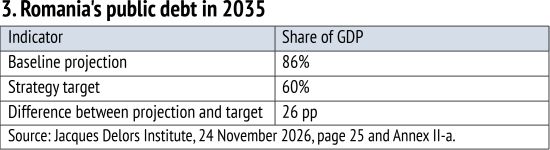
The report does not quantitatively demonstrate how the proposed measures could reduce public debt by 26 percentage points of GDP compared with the baseline projection.
Such a demonstration would require a macroeconomic and budgetary trajectory linking nominal economic growth, the primary budget balance, the cost of financing public debt and the other transactions that influence its evolution.
Other targets entail large-scale economic transformations: venture capital investment would have to increase tenfold as a share of GDP, research and development spending more than threefold, and the number of international patent applications relative to the population twentyfold.
The report describes these targets as indicative. Their indicative nature justifies flexibility in the numerical values, but does not eliminate the need to demonstrate the economic feasibility of the strategy.
Moreover, an examination of the report reveals contradictions between the quantitative targets in its annexes.
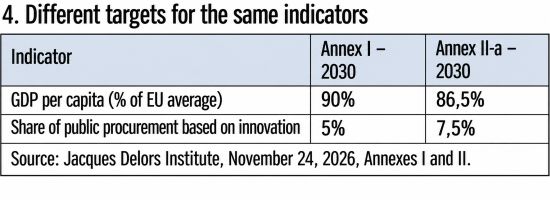
These contradictions affect the use of the strategy as a tool for planning and monitoring economic progress.
The foresight component of the report constructs four scenarios for Romania's development up to 2035. These have the merit of highlighting the interdependencies between economic, political, technological and demographic developments.
The favourable scenario even includes the reforms that the report subsequently recommends. Under these circumstances, the favourable outcomes described in the scenario do not constitute independent proof of the effectiveness of the proposed reforms.
The "Constrained” scenario ("The guarded plateau”) examines the prospect of Romania's economic stagnation within the European Union. However, the report does not develop a separate scenario of severe economic decline while Romania remains an EU member.
It would have been useful to examine the strategy's effectiveness also under conditions of a prolonged European industrial crisis, reduced European financial transfers or an international financial crisis.
An additional difficulty concerns the implementation of reforms.
The report identifies the state's weak administrative capacity as one of the fundamental causes of the lack of competitiveness. At the same time, it assigns the state responsibility for implementing an extensive programme of economic transformation.
The implementation of the strategy thus presupposes the existence of institutional capacities that the strategy itself seeks to create.
The report should have established the sequence of administrative and economic reforms, the resources required to develop institutional capacity and the consequences of possible delays for achieving the strategy's objectives.
• The population's prosperity, a condition for competitiveness
The Jacques Delors Institute report constitutes an extensive and useful inventory of the vulnerabilities of the Romanian economy. The document proposes numerous measures that deserve examination and provides a basis for debate on the future economic model of Romania.
The need to move beyond a development model based on the advantages of low labour costs justifies the preparation of a national competitiveness strategy.
For the Jacques Delors Institute's proposal to become an operational economic strategy, it requires a macroeconomic foundation, a multiannual financial plan, a comparative analysis of investment priorities and an assessment of how the costs and benefits of reforms would be distributed throughout society.
But, above all, the strategy needs to clarify its ultimate purpose.
An economy can become more attractive to capital, perform better in exports and become more internationally integrated without the population's prosperity increasing to the same extent.
At the same time, insufficient household incomes can limit the development of the domestic market, the accumulation of domestic capital, vocational training and the economy's capacity to innovate.
Reducing poverty and increasing the population's real incomes must also be examined as factors of economic development.
The population's prosperity is both the ultimate purpose of economic competitiveness and one of its conditions.
A strategy that insufficiently examines this relationship risks confusing the performance of the economy with the development of society.
• Author's note
The preparation of this text was assisted by artificial intelligence; full responsibility for the article rests with me.





















 Euro
 Dolar SUA
 Franc elveţian
 Liră sterlină
 Gram de aur

























Reader's Opinion