English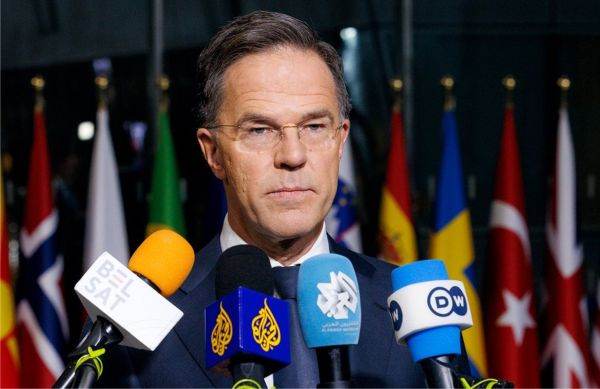
European states that are members of NATO are obliged to prepare for a possible armed conflict with the Russian Federation, is the message launched at the end of last week by Mark Rutte, the NATO Secretary General who declared nonchalantly in Berlin: "We are Russia's next target and we are already in danger.”
The senior NATO official warned that everything that happens today in Ukraine could happen tomorrow in other allied states and that "the time for action is now,” not after the first blow has been struck on a European capital. At the center of his speech, Mark Rutte unabashedly placed three axes of the new strategic reality: Russia as a direct and imminent threat, China as "Russia's lifeline,” which keeps its military machine alive, and the political and moral obligation for NATO states to switch to a wartime mentality.
"We must all act now to defend our way of life,” said the NATO Secretary General, explicitly linking the fate of Ukraine to the future of Europe. The formula is clear, without ambiguity for Mark Rutte: "Ukraine's security is our security.” If Ukraine falls, the strategic, military and economic bill will be paid in Warsaw, Vilnius, Bucharest, Berlin or even Paris. Mark Rutte described a Russia that is not tired, is not on the verge of collapse, but has completely entered the logic of the war economy: almost 40% of the Russian Federation's budget is directed towards armaments and aggression, about 70% of industrial equipment is converted for military production, thousands of attack drones and decoys delivered monthly, approximately 2,000 cruise and ballistic missiles produced in 2025 alone. This year alone, Russia has launched over 46,000 drones and missiles against Ukraine. These figures do not describe a depleted power, but a regime that has subordinated its entire economy to the objective of waging war against a neighboring country and, implicitly, against the European order. And the price is being paid in the blood of its own citizens. "There have been over 1.1 million Russian casualties since Putin started his war in 2022, and this year Russia has lost an average of 1,200 soldiers per day,” said the NATO Secretary General, who also asked the question that many are running away from: if a dictator is willing to sacrifice 1.1 million of his own people, "what is he willing to do to us?”
• Russian Kaliningrad zone - possible target for NATO, in the event of an attack launched by Moscow
In this context, Polish General Jaroslaw Gromadzinski, former commander of Eurocorps, stated that NATO must be prepared to act not only defensively on its own territory, but also offensively in Russian enclaves, including Kaliningrad, if Poland were attacked.
"If Russia launches an offensive, we have the right to intervene there and eliminate the threat,” Jaroslaw Gromadzinski told the Warsaw press, deliberately calling the region "Königsberg,” its historical German name. This means, translated into strategic language, that an attack on Poland would no longer end at the NATO border, but could trigger strikes on Russian territory, and the Kremlin would be faced with major dilemmas regarding its own military apparatus. In Gromadzinski's logic, Russia can no longer count on the advantage of militarized enclaves as "intangible bastions,” but must know that they can quickly become legitimate targets for an allied response. Both Rutte and Gromadzinski dismantle the myth of Russian invincibility, but without replacing it with a false sense of security. The Polish general speaks of "hundreds of thousands of soldiers” and "tens of thousands of armored vehicles and artillery pieces” lost by Russia in Ukraine, losses that, in his assessment, significantly reduce Moscow's ability to launch a major offensive against NATO in the next five to six years. Mark Rutte, in turn, warns that precisely because Russia has transformed its economy into a war economy and makes decisions quickly, without bureaucracy, it could be ready "to use military force against NATO in five years.”
The two messages do not contradict each other, but describe the same critical interval: a short window of time, a few years, in which NATO must strengthen its defenses and consolidate its military credibility, taking advantage of temporary weaknesses in Russia, which, however, "adapts quickly.” "We are in a state of permanent hybrid warfare and we must see this as the new reality,” Gromadzinski warns, and this is exactly the reality that Mark Rutte also describes when he talks about sabotage, drones violating the airspace of Poland and Romania, attacks on warehouses, rail networks and critical infrastructure inside NATO.
This new reality means that the front line is no longer just in the Donbas, but in every power plant, in every submarine cable, in every logistics hub, in every railway network in Eastern Europe. Hybrid attacks and sabotage are no longer isolated incidents, but elements of strategy. That is why the Polish general insists on "a clear strategic communication”: Poland and NATO must convey to Moscow that any attack will have "direct consequences for Kaliningrad”. That is why Rutte says unequivocally that we must be prepared for "the scale of the war that our grandparents or great-grandparents experienced”, with "mass mobilization, millions of displaced persons, widespread suffering, extreme losses”, if we do not invest now in deterrence.
• European Commission is considering a new loan under the SAFE mechanism
The response cannot be only military, but also financial and industrial. In this scenario, political decisions in Brussels become an inseparable part of the security strategy. The European Commission is already considering a second round of the billion-euro SAFE loan scheme for defence projects, as the bloc seeks to bolster its defences amid "growing fears about Russia and doubts about US security commitments”, two EU officials told Euractiv.
The first euro150bn scheme was oversubscribed - "the Commission has received requests for loans worth around euro190bn” - in a clear sign that European governments are under pressure to quickly make up for the defence deficits accumulated over decades of underfunding.
Ursula von der Leyen has openly acknowledged the pressure: the SAFE instrument "has been in such high demand that some EU members are now calling for a second version”. One of the officials quoted by Euractiv admits that "we will have to develop this instrument; the question is when”, suggesting that next year is the ideal time.
The SAFE scheme is not a technical detail, but the financial infrastructure of European rearmament: the EU jointly borrows money from the markets, using its AAA rating, and redirects it as credit to member states for defense projects, for terms of up to 45 years and with a 10-year grace period for repayment of the principal. For many states, this is the only realistic way to quickly finance significant increases in military budgets to the level of 3.5% or even 5% of GDP, as stipulated by the new NATO target.
What Mark Rutte is demanding from Berlin, Warsaw, Bucharest or Paris, i.e. massive investments in defense, accelerated, without hesitation, is exactly what Brussels is trying to make possible through SAFE: to transform defense rhetoric into firm orders for shells, missiles, drones, armored vehicles, military infrastructure.
• Mark Rutte: Increasing arms production in NATO countries - a matter of survival
The NATO Secretary General also provided concrete examples in Berlin: European production of 155-millimeter artillery shells has increased sixfold compared to two years ago, Germany is building a factory in Unterluß that will produce 350,000 shells per year, and Berlin has decided to increase defense spending to 3.5% of GDP by 2029, with total investments of around 152 billion euros in its armed forces.
"Germany is a leading power in Europe and a driving force in NATO. Its leadership is essential for our collective defense," said Mark Rutte.
In the east, Poland is building its own offensive-defensive doctrine, ready to put Kaliningrad (Königsberg) on the table as a legitimate target if Russia were to touch even an inch of its territory. The Baltic states are demanding a larger Allied troop presence. All of this points to the same conclusion: the five- or six-year window in which Russia is weakened but dangerous must be used to transform NATO from a convenient, routine alliance into a real, strengthened shield, ready to act.
Against this backdrop, the transatlantic link is not a diplomatic fad, but the backbone of Europe's defense. NATO's secretary general insists that the United States remains "fully committed” to European security, but at the same time he is calling on Europe to "do more, carry more of the burden,” as Washington must divide its attention between the Euro-Atlantic region and the Indo-Pacific. That is why he sees the Hague decision, in which the allies committed to spending 5 percent of GDP on defense by 2035 and increasing weapons production across the NATO space, as not just an accounting goal, but an act of survival.
Behind all these decisions, figures and plans lies a simple truth, spoken by Mark Rutte: "What stands between what happens to them and what could happen to us? Only NATO.”
Not the European Union alone, not the illusions of ambiguous "security arrangements” with Moscow, not the vague hope that Russia will stop on its own, but a military alliance that works, that bears the costs, that prepares its populations for the sacrifices and which transform the generals' warnings into political decisions, approved budgets, opened factories, deployed troops.
"We have a plan, we know what we have to do, so let's act", said Mark Rutte. And the real question, in every European capital, is no longer whether the threat is real, but whether there is the will to pay the price to stop it before the sirens we hear today in Ukraine become the background sound of our own cities.
















 Euro
Euro Dolar SUA
 Franc elveţian
 Liră sterlină
 Gram de aur