English


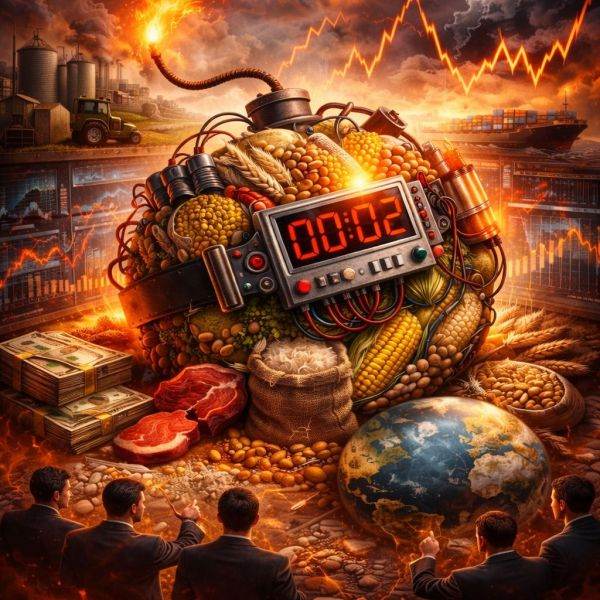
Amid wars, environmental crises and geopolitical tensions that are shaking the global food supply, agricultural commodity traders are increasingly turning to financial markets, which increases the risk of the global food system becoming unsustainable, a top UN trade expert has warned, who claims that a new food crisis could soon break out, according to an investigation published yesterday by the European website Follow the Money.
According to the cited source, this view is shared by other experts, who warn that the global food system has become too dependent on traders. According to them, the global food trade is dominated by a few traders, who control the entire supply chain for some essential products, including soybeans, rice and cereals, as they buy, store, transport and sell food.
If just one of these companies were to fail and go bankrupt, food prices could skyrocket worldwide and even lead to global famine, experts warn, according to the cited source, who adds that the problem is that food traders are not regulated as strictly as banks, which opens the door to dangerous levels of financial speculation.
In carrying out the global investigation, Follow the Money interviewed a wide range of food experts, analyzed scientific studies and reports, and contacted major food traders.
A new global food crisis could be just around the corner - and large food trading companies could be partly to blame, a senior United Nations official warns.
"We are on the brink of a possible systemic change and a systemic crisis. And I warn you: my personal opinion is that a financial correction is overdue. I don't even want to imagine how painful such a crisis could be,” Anastasia Nesvetailova, director at the United Nations Organization for Trade and Development (UNCTAD), told Follow the Money.
She argued that the global food market, in its current form, is unsustainable because it is largely dominated by a small number of large corporations, which increasingly rely on financial activities as a source of income, instead of the physical trade in food. This makes them, she said, more vulnerable to financial collapses: a new war or a climate disaster could generate financial insecurity, for example, or a speculative bubble around food prices could burst, leaving companies without liquidity. If funding were to stop, large traders could find it difficult to buy and transport crops on a large scale, potentially disrupting global supply chains.
The UN official said such a crisis could be comparable to the 2008 financial crisis, when millions lost their jobs and homes, "if not sometimes more dangerous, because it is about food itself.”
As early as 2022, shortly after Russia's invasion of Ukraine, suspicions of speculative profits came to the fore. There were also fears that famine in poorer countries would be exacerbated by price speculation by traders and investors. In this context, a small number of food trading companies play a key role, the source said, because they buy, store, transport and sell food and dominate the entire chain for some essential products, including soybeans, rice and cereals.
"States are increasingly concerned about food, without explicitly recognizing that food sovereignty has long been in the hands of huge corporate giants. This entire system has not yet been tested by a crisis. I don't even want to imagine how painful such a crisis could be: it could cause a huge collapse, and the [2008 financial] crisis would seem like a breeze in comparison,” Anastasia Nesvetailova told the cited source.
• Five giants lead global food trade
Follow the Money's journalistic investigation also took the opinions of experts in the field, who argue that, in the current times of geopolitical instability, climate change and increased volatility in food prices, traders should not be allowed to speculate without any control over prices.
"A country that wants to combat a food crisis is at the mercy of giants like Cargill. They might say: we are willing to help you, but the price has just tripled,” Sophie van Huellen, a senior lecturer at the Institute for Economic and Global Development at the University of Manchester, told the source.
The investigation cited shows that one of the biggest players in the food trade is the Cargill family, which includes no less than 14 billionaires. In 2023, the family business recorded record sales of $177 billion, claim the journalists from Follow the Money, which also shows that, together with the American companies Archer Daniels Midland (ADM) and Bunge, as well as the Franco-Dutch company Louis Dreyfus and China Oil and Foodstuffs Corporation (COFCO) - known as the "Big Five” - Cargill dominates the global trade in grains and oilseeds by their market share.
Bunge and ADM supply farmers with fertilizers, seeds and pesticides, while Cargill supplies animal feed and owns hundreds of subsidiaries and global transportation infrastructure: from silos and ports to trucks and ships, processing some of the raw materials - such as beets, corn and grains - in its own factories, which it transforms into products such as ethanol and biodiesel.
"Corporations control and capture more and more industries and markets... You have a giant that controls both physical production, technology, certain climatic aspects, the financial infrastructure of trade and, probably, the physical transportation of goods. It is not only vertical integration, but also horizontal expansion,” Anastasia Nesvetailova said, for the cited source.
When contacted by journalists from the cited source, the companies ADM, Bunge, Cargill, COFCO International and Louis Dreyfus refused to comment on the above issues.
• UNCTAD: 75% of the income of agricultural giants comes from financial activities
The cited source also claims that large companies can influence prices by storing non-perishable food in warehouses and on ships, if they anticipate a price increase, which, in turn, leads to further increases, as the product becomes even rarer. Moreover, the investigative journalist claims that such things would have happened in 2022, when grain prices exploded after Russia's invasion of Ukraine. With the outbreak of war, food traders, such as the Big Five, "stimulated the retention of stocks until prices were perceived to have peaked," the non-profit organization International Panel of Experts on Sustainable Food Systems (IPES FOOD) wrote in mid-2022, information taken from the cited source. It also shows that, as a result of this maneuver, the profits of billions of euros of the big five food traders reached an "historical maximum" between 2021 and 2022 and that the grain hoarding and commodity speculation contributed to a "full-fledged food crisis," as those at IPES FOOD also stated.
The cited source recalls that in 2024, UNCTAD criticized the largest food trading companies, including the Big Five, for adopting speculative positions by "strategically capitalizing” on the wave of market volatility. The problem, according to UNCTAD, is that these companies use their superior market intelligence and control to speculate, not just to hedge their commercial risks, and this allows them to profit from price fluctuations, while farmers and consumers bear the costs. In its 2025 report, UNCTAD showed that about 75% of the revenues of agricultural giants now come from financial activities, based on their financial reports for the period 2018-2024. The source cited states that, in addition to protecting against price volatility - through hedging operations on the so-called futures markets, these companies also speculate on these prices and act like banks, granting loans, for example, to farmers and later selling these loans in the form of investment packages.
The journalistic investigation carried out by the source cited mentions that there is growing evidence of the existence of speculation in the international food trade, which is also confirmed by Bart de Steenhuijsen Piters, a senior researcher in food systems at Wageningen University in the Netherlands. "It is plausible that it influences food prices, but it is very difficult to demonstrate due to the opaque nature of the market. For outsiders, it is a black box,” he told Follow the Money.
In addition, British economist Sophie van Huellen stated: "Global food security should not rest on four multinational companies that have no obligation to report on their inventories, at least in times of crisis.”
Essentially, the investigation raises a fundamental problem: a global food system concentrated in the hands of a few giants and increasingly dependent on financial logic is becoming vulnerable to major shocks. In the absence of clearer rules, increased transparency and a balance between profit and public interest, the risk that the next crisis will be not only economic but also humanitarian remains a real one.













 Euro
Euro Dolar SUA
 Franc elveţian
 Liră sterlină
 Gram de aur