 English


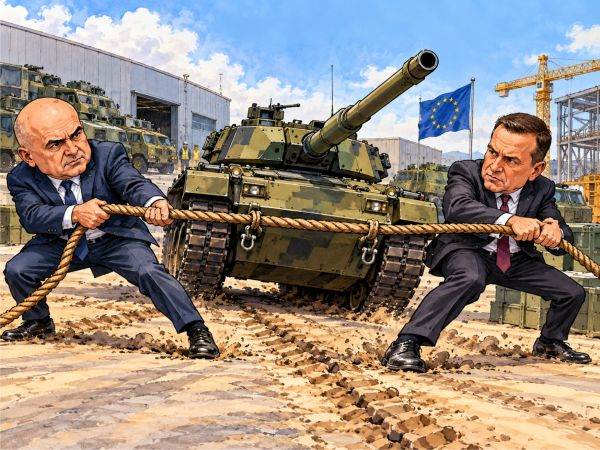
The implementation of projects funded via the SAFE mechanism in Romania is now at risk due to the constitutional conflict identified yesterday by the Constitutional Court of Romania (CCR) and the prospect of a ruling of unconstitutionality regarding OUG 38/2026. This ordinance was initially adopted on May 4 by the Bolojan government, which held full executive powers, and was subsequently amended on May 5, the very day the administration was dismissed. Under these circumstances, euro16.68 billion earmarked for defense and strategic infrastructure faces a risk fueled by the PNL and PSD through legislative improvisation, political confrontation, and parliamentary gridlock. Under the SAFE mechanism, Romania is required to convert this funding into completed projects by the end of 2030; every month spent fixing the legislation reduces the time available for procurement, production, and delivery.
The European deadline will not shift just because of a dispute in Bucharest. The SAFE regulation sets December 31, 2030, as the deadline for approving payments to beneficiary states, while the European Commission's roadmap aims for the receipt of acquisitions funded through this mechanism by the end of that same year. Although funding and delivery are governed by separate rules, both require authorities to operate within a tight schedule. No political victory at the Constitutional Court (CCR) can add extra months to this European deadline.
For the PNL (National Liberal Party), the issue originates at Victoria Palace, during the final days of the Bolojan Government's full-mandate term. An ordinance originally intended for expropriations and investments in strategic assets was expanded by an additional 12 articles. This amended version was resubmitted to the Legislative Council on May 5, the very day of the motion of no confidence, and was subsequently published on May 8. In doing so, the Government linked provisions critical to the defense industry to a procedural path that was ultimately invalidated due to a constitutional conflict. Invoking urgency does not absolve the Executive of its responsibilities. When preparing investments worth billions and negotiating the delivery of military equipment, ensuring the robustness of legal acts is an inherent part of the duty to govern. Any legal vulnerability can subsequently translate into a contractual delay. The Bolojan Government claimed it was accelerating investments, yet the manner in which it finalized the ordinance created the conditions for a dispute that has now persisted for over five-six months.
At the heart of this confrontation lies Article III, which allows for the justification of advance payments made within the defense industry over a period of up to 60 months. The provision allowed for the delivery of components that could be accepted separately, including non-functional, partially completed goods, and it also applied to ongoing contracts. Consequently, the dispute also concerns the mechanism through which the state makes payments and the supplier justifies the funds received.
The PSD challenged the ordinance and secured a victory against the former prime minister. Now, they must demonstrate how they intend to proceed. The right to refer a matter to the Constitutional Court (CCR) is indisputable, and the Constitution must be upheld even when the Government invokes national security. However, the political responsibility of the Social Democrats begins where the satisfaction of the verdict ends: with finding a solution that allows investments to continue on a sound legal basis. Proving that an opponent was in the wrong is not enough when the consequences could jeopardize the country's defense procurement projects.
The Social Democrats had been aware of the scale of the issue for months. On May 26, the Senate adopted a bill to approve Emergency Government Ordinance (OUG) 38/2026, which included the repeal of Articles III through XIV. All 12 additional articles, including the one concerning 60-month advance payments, were removed from the version passed by the first chamber. In other words, a legislative intervention regarding this controversial package was already before Parliament. However, it still required finalization in the Chamber of Deputies.
It was there that the bill (PL-x no. 429/2026) stalled. On June 30, the final vote resulted in 110 votes in favor, 16 against, and 107 abstentions, falling short of the absolute majority required. The text has been sent back to the Defense Committee for a new report, leaving the legislative solution in a state of political limbo, caught between parties that are now trading accusations. By abstaining, the Liberals contributed to blocking its adoption, while the PSD pressed on with its constitutional offensive, all the while Parliament has failed to provide a definitive resolution.
Now, each side is trying to emerge from this in a favorable light, a snapshot taken before the full bill became apparent. PNL spokesperson Ionel Bogdan shifts the responsibility for finding solutions onto the current Prime Minister and the Minister of Defense. The Niculescu government must, of course, intervene; however, this obligation does not absolve the Bolojan government, which issued the ordinance, of its responsibility, nor does it erase the votes cast by the Liberals in Parliament. The PNL cannot frame the task of salvaging the funding as the sole burden of its successors, especially since its own administration contributed to weakening the legislative framework.
Similarly, the PSD cannot close the discussion by simply stating, "The Constitutional Court (CCR) ruled in our favor." Regarding the SAFE projects, this constitutional victory must be followed by functional legislation and a realistic timeline. Otherwise, the party risks turning its success against Bolojan into a political gain, one achieved at the cost of delays that the state itself must bear. While constitutional review serves to protect the legal order, exploiting it for political ends, without providing a swift solution for investments, may only prolong the deadlock.
The danger is most evident in the scenario where procurement processes must be restarted. Redrafting documentation, obtaining necessary approvals, renegotiating terms, evaluating bids, and handling potential appeals could take months. Only then can production begin or be reconfigured. Meanwhile, a supplier might have taken on other orders, faced different costs, or have different availability timelines. Consequently, Romania risks returning to the negotiating table with less time and a weaker position than it held before the crisis.
Nearly two months prior to the Constitutional Court's ruling, the European Commission had already begun making payments. On August 26, Romania received euro2.5 billion in SAFE pre-financing, with the European Commission specifying that subsequent tranches are contingent upon meeting milestones and successful implementation. These funds are loans earmarked for investments, and the results must be tangible in the form of defense capabilities and actual deliveries.
The euro16.68 billion is not automatically lost as a result of yesterday's Constitutional Court (CCR) ruling; however, it is now exposed to implementation risks, risks that the PNL and PSD will only exacerbate if they choose to trade accusations rather than enact the necessary legislative fixes. The Niculescu government must identify the affected contracts, Parliament must act swiftly to establish the legal framework, and the political parties must clarify which deadlines can still be met. In the meantime, every day spent on triumphalism or finger-pointing is a day subtracted from the time remaining for production.
By 2030, Romania will not be able to "take delivery" of a victory for Grindeanu, a justification from Bolojan, or a press release from the PNL. It will need to take delivery of the equipment for which it borrowed the funds. If that equipment fails to arrive on time due to this political infighting, the state will be left to foot the bill, and the nation will face a major deficit in its defense capabilities.


















 Euro
 Dolar SUA
 Franc elveţian
 Liră sterlină
 Gram de aur
































Reader's Opinion