 English

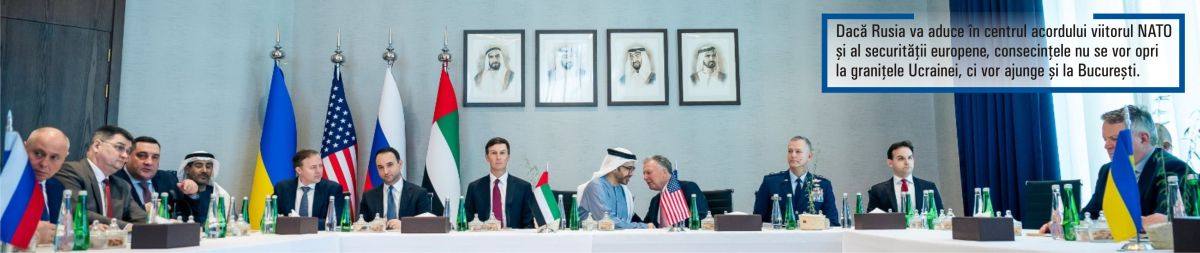
The United States, Russia, and Ukraine concluded their peace talks in Abu Dhabi with a promise of a massive prisoner exchange, but without a ceasefire, a compromise over Donbas, or security guarantees for Kyiv. As Washington prepares for further discussions with Vladimir Putin and Volodymyr Zelensky, Moscow is attempting to turn the war in Ukraine into a negotiation over Europe's entire security architecture. For Romania, the stakes are enormous: not only ending the war on NATO's doorstep, but also determining the conditions under which Russia might seek to restrict the Western military presence on the Alliance's eastern flank.
The peace negotiations between Russia, Ukraine, and the United States, held over the past two days in Abu Dhabi, produced one tangible result but left unresolved the question that could determine the continent's future: who sets the rules for European security, and how much influence will Moscow wield over the military decisions of neighboring countries?
After two days of talks, Vladimir Medinsky, head of the Russian delegation, announced, according to TASS, an agreement in principle on a large-scale prisoner exchange. This is an important development for captured soldiers and their families. Beyond this humanitarian understanding, however, no ceasefire agreement, territorial concession, or definitive mechanism to prevent the resumption of hostilities was announced.
Instead, according to Politico and Ukrinform, Moscow brought to the forefront a demand extending far beyond control of Ukrainian territory: negotiations over a new European security architecture. In other words, Russia is seeking not merely an outcome in Ukraine, but also a say in the rules governing how NATO and European countries organize their defense.
In practical terms, this was Russia's strategic objective at the Abu Dhabi negotiations. The prisoner exchange may be the first visible outcome of the talks, but the real diplomatic confrontation concerns Ukrainian territory, security guarantees, and the future relationship between Russia and the West.
• A Prisoners exchange while the war continues
Vladimir Medinsky announced that Russia and Ukraine had agreed in principle to organize a massive prisoner exchange. Jared Kushner, one of the principal American negotiators, confirmed the understanding and raised the prospect of the largest humanitarian exchange of its kind, while noting that the number of people to be released had yet to be determined. Before the meeting, proposals involving exchanges of 1,000 prisoners for 1,000, and even 1,500 for 1,500, had circulated. Neither figure was definitively established in the public statements issued at the conclusion of the negotiations. Russian General Aleksandr Zorin suggested that the exchange could take place within two to three weeks, once the procedures had been clarified.
This is an outcome that should not be underestimated. For those held captive, such an agreement could mean the difference between returning home and remaining in detention. At the same time, its political significance should not be overstated. Prisoner exchanges have taken place before, even when peace negotiations were completely deadlocked.
Moreover, the Abu Dhabi meeting took place without even a temporary suspension of hostilities. According to information published by ABC News, during the night between the two days of negotiations, Russia and Ukraine continued launching drone attacks against each other's territory. Russian authorities reported an attack on the port of Ust-Luga, a major hub for Russian energy exports on the Baltic Sea. In Ukraine, Russian strikes caused further destruction and civilian casualties.
The contrast could hardly have been more striking: in Abu Dhabi, negotiators were discussing prisoner releases and security guarantees, while thousands of kilometers away, drones continued to strike infrastructure and cities.
• Where did the two sides stand at the start of negotiations?
This contradiction reveals much about the positions from which the two sides entered the negotiations. Russia controlled approximately one-fifth of Ukrainian territory, including Crimea and extensive areas in the east and south of the country, according to data published by TAS and the Institute for the Study of War (ISW). The Russian Federation held an undeniable territorial advantage, but had failed to translate its superior resources into a decisive military victory. Its ground advances had slowed, while the offensive continued to consume substantial manpower, equipment, and financial resources.
According to ISW and the Kyiv-based press, Ukraine had managed to prevent a collapse of the front line and had developed the capability to strike energy and logistics facilities deep inside Russia. Yet Kyiv, too, lacked a realistic prospect of rapidly recapturing all occupied territories. Furthermore, Ukraine's energy infrastructure remained under repeated bombardment, while its ability to sustain resistance depended heavily on Western military and financial assistance.
Neither side had reached a position from which it could dictate the terms of peace. Russia held occupied territories that it was attempting to convert into permanent political gains. Ukraine retained the ability to continue resisting, but lacked the means to force a unilateral withdrawal of Russian troops.
Under these circumstances, the negotiations did not necessarily represent an acknowledgment by the leaders of the two countries that continuing the war had become pointless. Rather, they marked another attempt to determine whether diplomacy could deliver results that continued fighting was unlikely to produce in the near future.
• Donbas is the immediate prize. NATO and European security are Russia's strategic objectives
At the heart of the negotiating deadlock lies Donbas. Vladimir Putin continues to demand control over the entire region, including territories that Russian forces have not captured. Kyiv rejects surrendering these areas, not least because they contain defensive positions and military infrastructure essential to protecting the rest of the country.
According to reports in the Ukrainian press citing The Telegraph, Kyiv reportedly rejected an American proposal to modify regional borders in an effort to break the negotiating impasse. The details of this initiative have not been fully confirmed by the parties involved, meaning that it cannot be described as a definitive territorial offer or a negotiated compromise.
Russia's publicly stated position, by contrast, is considerably clearer. According to TASS, Sergei Lavrov argued before the peace negotiations that establishing the parameters of a new European security architecture should precede the settlement of the Russia-Ukraine conflict. Following the talks, Vladimir Medinsky confirmed that the future European security system had been central to the negotiations and that Russia and the United States had identified both areas of agreement and points of disagreement.
This formulation fundamentally changes the scale of the issue. If Ukraine were the only subject, the negotiations would focus on borders, a ceasefire, and guarantees against another invasion. But introducing the European security architecture opens the discussion to relations between Russia and NATO, Ukraine's military status, and potentially the deployment of Western forces in Eastern Europe.
The Institute for the Study of War (ISW) has warned that Moscow's language revives the demands presented by the Kremlin in December 2021, before the full-scale invasion. At that time, Russia demanded, among other things, restrictions on the deployment of allied weapons and military personnel in NATO member states admitted after 1997.
Romania falls squarely into this category. For Bucharest, therefore, discussions about a new security architecture are far from an abstract diplomatic matter. If the demands made in 2021 were effectively brought back to the negotiating table, they could also affect the American and allied military presence in Romania, missile defense facilities, deterrence capabilities, and NATO's military posture in the Black Sea region.
There is no information indicating that such restrictions were accepted in Abu Dhabi. Nevertheless, Moscow's very attempt to turn European security into the subject of a broader negotiation explains why countries on NATO's eastern flank have good reason to monitor every stage of the process closely. This is particularly important because Russia is simultaneously attempting to diminish the Europeans' role in the negotiations.
According to TASS and Ajansi Agency, Medinsky stated that the Russian delegation had no contact with the European representatives present in Abu Dhabi and questioned the usefulness of their participation. By contrast, he praised the realism and commitment of American envoys Steve Witkoff and Jared Kushner.
Moscow's diplomatic message is unmistakable: it prefers to negotiate with Washington and remains reluctant to involve European capitals directly.
The problem is that an agreement concerning Europe's security cannot be sustainable if the countries directly affected are excluded from determining its terms. For Romania and the other countries on NATO's eastern flank, the Alliance's security guarantees are not bargaining chips to be negotiated away on their behalf without the consent of the allies.
• Diplomats, Generals, and Intelligence Officers at the negotiating table
The composition of the delegations in Abu Dhabi illustrates the complexity of the issues under discussion. According to TASS, Russia appointed Vladimir Medinsky, a presidential adviser who had participated in previous rounds of negotiations with Ukraine, to lead its team. He was joined by Deputy Foreign Ministers Sergei Ryabkov and Mikhail Galuzin, Igor Kostyukov, head of Russian military intelligence, and Yuri Zhigarlovsky, an official responsible for operational matters within the General Staff. The expert group also included security service officials, among them Dmitry Minaev of the FSB and General Aleksandr Zorin, who was involved in discussions concerning prisoner exchanges.
The Kyiv Independent reported that Ukraine was represented by Rustem Umerov, head of the Foreign Intelligence Service; Kyrylo Budanov, head of the Presidential Office; Serhii Kyslytsia; David Arakhamia; and Vadym Skibitskyi, deputy head of military intelligence.
The United States was represented by Steve Witkoff and Jared Kushner, while reports on the meeting also mentioned General Alexus Grynkewich, NATO's Supreme Allied Commander Europe. The United Arab Emirates provided the diplomatic setting for the meeting, including through the involvement of Foreign Minister Abdullah bin Zayed Al Nahyan.
The presence of such senior military and intelligence officials suggests that the discussions went beyond political declarations. Prisoner exchanges, verification of potential agreements, and security guarantees also require operational expertise.
One particularly notable aspect was the participation of Dmitry Minaev, an FSB official whom Ukraine News has linked to structures allegedly involved in an assassination attempt against Kyrylo Budanov. The allegations have also been reported by the international press, but Minaev's personal responsibility has not been established by publicly available documents. Beyond this controversy, their presence in opposing delegations illustrates the difficulty of negotiations between two countries whose intelligence services remain locked in confrontation during an ongoing war.
Although European representatives were present in Abu Dhabi, they did not participate in the same negotiating format as Russia. Rustem Umerov explicitly announced that the trilateral meeting would be followed by separate consultations with European partners. These involved representatives of France, Germany, the United Kingdom, Italy, NATO, and the European Union.
This institutional separation is significant: Europe is being consulted about the future of its own security, but Russia is not yet willing to accept it as a direct negotiating partner within the same framework.
• Donald Trump sends envoys to Putin. Romania must watch what is being negotiated beyond Ukraine
The Abu Dhabi negotiations did not emerge out of nowhere. On October 9, Donald Trump and Vladimir Putin discussed the war in Ukraine by telephone, according to Kremlin statements cited by TASS. Moscow subsequently claimed that the Russian president had shown an understanding of certain American proposals for de-escalation, without specifying their content.
On November 10, Putin also discussed the negotiations with Belarusian President Alexander Lukashenko. During the meeting in the United Arab Emirates, the Kremlin announced that the Russian leader was being kept continuously informed about the progress of the talks.
Following the conclusion of the negotiations, Jared Kushner and Steve Witkoff announced that they would be in Moscow today for direct talks with President Vladimir Putin, after which they were expected to meet his Ukrainian counterpart, Volodymyr Zelensky, in Ireland, according to reports by TASS and The Moscow Times.
This sequence of official meetings could mark a transition from identifying disagreements to attempting to secure political decisions at the highest level. There is, however, no guarantee that the Ukrainian and Russian leaders will accept compromises that their delegations were unable to reach.
At this point, Washington faces a difficult challenge. Russia is seeking an agreement that also addresses its demands concerning continental security. Ukraine is demanding guarantees that would prevent another invasion and refuses to make the territories it still controls the price of peace. Europeans insist that the continent's security cannot be negotiated without their participation.
The United States is attempting to bridge these positions, but any arrangement that offered Russia concessions concerning NATO without the consent of European allies would trigger a new strategic dispute within the West.
For Romania, the danger does not lie in the negotiations themselves. On the contrary, ending the war and reducing military risks in the Black Sea region would represent major gains. The issue is what any eventual agreement would contain. A peace settlement that provided Ukraine with credible guarantees, reduced military threats, and respected the freedom of European countries to determine their own defense policies could strengthen regional stability. Conversely, an arrangement that restricted NATO's ability to defend its eastern members would shift part of the cost of the compromise onto countries that did not start the war.
For now, there is no evidence that such a compromise has been reached. There are, however, sufficient official statements to establish that Russia wants to discuss far more than Ukraine's borders.
Peace in Ukraine is being negotiated in Abu Dhabi, Moscow, and possibly Dublin. But if Russia succeeds in placing the future of NATO and European security at the heart of the agreement, the consequences will not stop at Ukraine's borders. They will reach Bucharest as well.

















 Euro
 Dolar SUA
 Franc elveţian
 Liră sterlină
 Gram de aur





























Reader's Opinion