 English
Arms manufacturers face a range of potentially overlapping pressures, including overly optimistic stock market valuations, delayed contracts, production costs that are difficult to control, and shifting technological priorities, according to an analysis published on CNBC's website. The authors argue that large budgets create opportunities but eliminate neither competition nor industrial risk, and that rearmament does not guarantee uninterrupted profits.
According to CNBC, major South Korean arms manufacturers are suffering steep losses in market value amid disappointing results and questions about their adaptation to drone warfare. Meanwhile, Germany's Rheinmetall is cutting its forecasts even as its business continues to grow. In the United States, strategic military programmes have already generated losses running into hundreds of millions of dollars, CNBC reports.
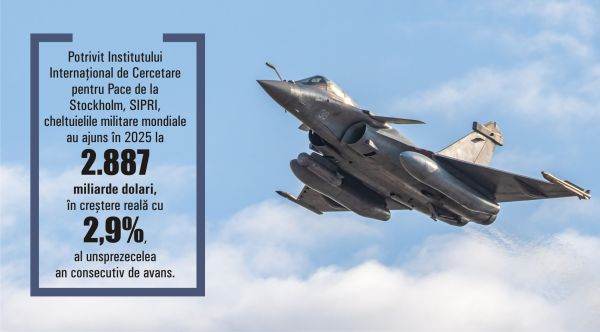
The sheer scale of the market makes these difficulties all the more significant. According to the Stockholm International Peace Research Institute, SIPRI, global military expenditure reached $2.887 trillion in 2025, rising by 2.9% in real terms and marking its eleventh consecutive year of growth. Europe spent $864 billion, up 14% from the previous year. However, these budgets include salaries, operations and other expenditure categories, meaning they do not translate entirely into orders for arms factories.
Manufacturers' revenues nevertheless confirm the expansion. The world's 100 largest arms-producing and military services companies recorded combined sales of $679 billion in 2024, up 5.9% from the previous year, according to SIPRI. The institute also warned of delays, cost overruns and supply difficulties. The defence industry serves a growing market, but it must demonstrate that it can deliver on time, within agreed costs and with sustainable profitability.
In South Korea, the gap between investor enthusiasm and corporate performance has become striking. According to CNBC, citing an analysis published on South Korean website SBS, the combined market capitalisation of Hanwha Aerospace, LIG D&A, Hyundai Rotem and Korea Aerospace Industries had fallen to approximately 62 trillion won ($46.5 billion) by the end of October 2026, compared with a peak of 170 trillion won ($118.49 billion) in October 2025. The difference amounts to 108 trillion won, or approximately 63.5% of that peak. This loss in market value illustrates how sharply investors have revised their expectations.
Financial results explain part of the disappointment. According to CNBC, Hanwha Aerospace's operating profit fell by more than 46% in the third quarter compared with the same period in 2025, with the company citing changes to delivery schedules and exceptional costs. Its shares had lost more than 28% since the beginning of the year. Hyundai Rotem had reported a decline of more than 11.1% in operating profit, while its shares had fallen by almost 60%.
There is also an exception: Korea Aerospace Industries, whose quarterly sales increased by approximately 52% and operating profit by around 32%, limiting its year-to-date share price decline to just over 8%. These differences matter because they contradict the notion of a uniform collapse across South Korea's defence industry. Investors are beginning to distinguish between companies that turn demand into results and those whose commercial promises take longer to materialise.
Speaking to CNBC, KB Securities analyst Peter Kim identified a combination of high stock market valuations, an appreciating won, delayed overseas orders and a shift of capital towards semiconductors. Compounding these factors is the slow pace at which governments turn political defence commitments into approved budgets and contracts. The market had priced in rapid expansion, but public procurement timelines failed to keep pace with expectations.
South Korea's advantage has rested on new tanks, howitzers and missile systems offering competitive prices and delivery times. Recent wars, however, have pushed drones, counter-drone systems and air defence to the forefront of military priorities. For buyers, the relationship between equipment costs, survivability and effectiveness in an environment saturated with sensors and unmanned munitions is becoming critical.
Nevertheless, this does not mean that tanks and artillery have become obsolete. David Roche, a strategist at Quantum Strategy, told CNBC that drones cannot seize and hold territory on their own, and that traditional manufacturers face a challenge of adaptation: conventional platforms must be integrated with reconnaissance, electronic warfare and protection against aerial attacks. All of this requires investment and technological development at a time when shareholders are already demanding profits.
In Germany, Rheinmetall illustrates a different source of disappointment. The company reported sales of approximately euro8.4 billion for the first nine months of 2026, up 38%, and an operating result of euro1.339 billion. Nevertheless, its annual revenue target was lowered to around euro13.2 billion from the previous range of euro13.7-14.2 billion, while its projected operating margin fell from approximately 19% to 18.5%. The group cited delays to Germany's Arminius project and the postponement of acceptance tests for batches of artillery ammunition. Investors' reaction was brutal. According to CNBC, Rheinmetall shares fell by more than 17% in early trading yesterday, bringing their year-to-date decline to approximately 46%. This was the second downgrade to the company's outlook, following the one announced by the German defence giant in August. The August revision followed four years during which Rheinmetall recorded an average annual share price gain of 119%, benefiting from accelerating European defence spending.
The contrast is stark: in the third quarter, Rheinmetall had generated revenue of euro3.15 billion and operating profit of euro553 million, with the latter up 62%. Strong results were overshadowed by the prospect of delayed cash receipts. The Arminius contract for Boxer vehicles was also expected to push anticipated advance payments into 2027, undermining the company's previous cash conversion target. Rheinmetall also flagged delays to expected revenue from new business activities, including its cooperation with Dutch company Destinus.
RBC analysts warned CNBC that these developments could fuel doubts about the prospects for traditional military technology relative to emerging technologies. Yet Rheinmetall's difficulties show that an anticipated order is not a signed contract, and a contract is not the same as cash received.
The pressure on cash flow is already apparent. At the end of the third quarter of 2026, Rheinmetall reported negative operating free cash flow of euro1.698 billion, partly because of inventory accumulation to support growth. Materials, components and production must be financed before all expected deliveries and payments materialise. Expansion can therefore consume cash even as accounting profit rises.
The American examples show that the risks extend beyond delayed orders. According to CNBC, Lockheed Martin reported approximately $1.6 billion in programme-related losses in the second quarter of 2025. Of these, $950 million came from a classified programme within its Aeronautics division, while $570 million stemmed from the Canadian Maritime Helicopter Programme. Quarterly net profit fell to $342 million from approximately $1.6 billion a year earlier, even though sales remained around $18.2 billion. Also in 2025, Northrop Grumman recognised a first-quarter pre-tax loss of $477 million on the initial production phase of the B-21 bomber. The group's net profit immediately fell by 49% to $481 million. At the same time, its order backlog reached $92.8 billion. In effect, the company had substantial business prospects, but a strategic programme was severely undermining its current profitability.
There are, nevertheless, contracts that challenge the idea that the market for conventional weapons is disappearing. In April 2026, Hanwha announced an agreement worth approximately euro546 million with Finland for 112 K9 howitzers and spare parts, with deliveries beginning in 2028. In February, the company had also announced a contract worth around $922 million with Norway for 16 Chunmoo launchers, guided missiles and logistical support. The transformation of warfare is changing the mix of equipment that armed forces require without eliminating the need for artillery and long-range strike capabilities.
Against this backdrop, as Romania pursues a major programme to equip its armed forces, funded primarily through the SAFE mechanism, it remains to be seen how much of its financial commitment to defence will translate into lasting production, modernisation and maintenance capabilities. An army purchases equipment through successive contracts; an industry survives only if there is continuity between those contracts.






















 Euro
 Dolar SUA
 Franc elveţian
 Liră sterlină
 Gram de aur




























Reader's Opinion