 English

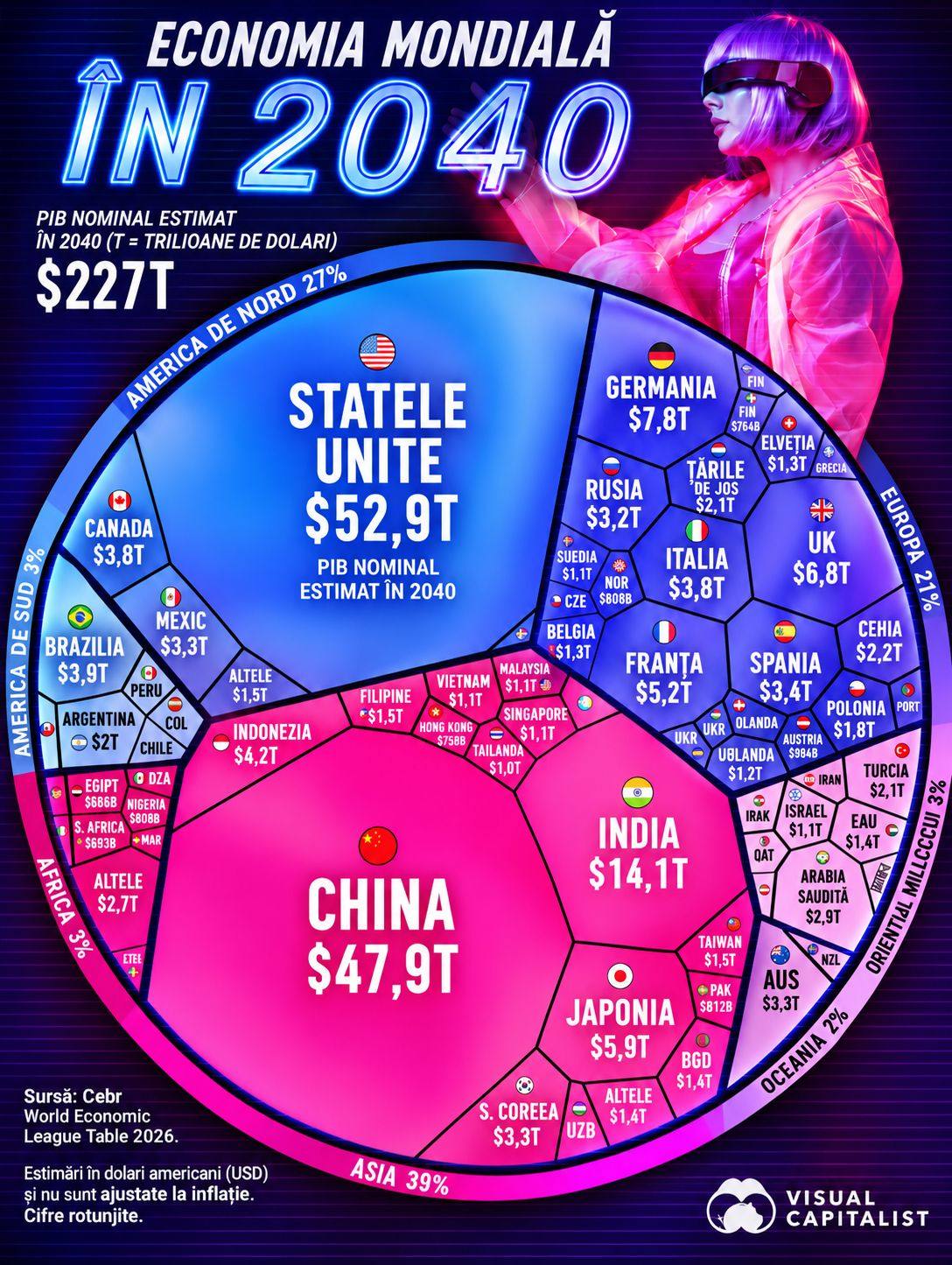
The global economy is set to grow from approximately $124 trillion in 2026 to $227 trillion by 2040-an expansion of 83% in nominal terms. This growth will reshape economic hierarchies: China will narrow the gap with the United States, and Asia will command an increasingly larger share of global output, according to visualcapitalist.com.
The cited source presents an analysis of the projected GDP for 190 economies in 2040, based on the 2026 World Economic League Table developed by the Centre for Economics and Business Research (Cebr). The figures measure annual economic output in US dollars (at nominal value) and are not adjusted for inflation.
• China to approach US GDP levels by 2040
According to Cebr's projections for 2026, the US economy accounts for approximately 26% of global GDP, with a value of $31.6 trillion, while China holds a 17% share, at $20.9 trillion. By 2040, the gap between the world's two largest economies is projected to narrow to approximately $5 trillion, down from $10.7 trillion in 2026. The US is expected to remain in the top spot with $52.9 trillion, followed by China with $47.9 trillion.
China's share of global GDP is expected to rise to 21%, while America's share is projected to fall to 23%. According to IMF data, by 2026, China will already be the world's largest economy in terms of purchasing power parity-a metric that accounts for differences in local price levels.
China's progress is part of a broader economic shift toward Asia, whose share of global GDP is estimated to grow from approximately 32% in 2026 to 39% by 2040, according to the cited source. Europe's share is expected to decline from 26% to 21% over the same period, while North America's share will fall from 30% to 27%.
Although the US is projected to remain the largest single economy, the growth of China, India, and Indonesia will give Asia a more significant role in shaping global demand and investment.
• India and Indonesia climb the rankings
India will move up from fourth place in 2026 to third place by 2040, the source notes. Its economy is projected to more than triple-growing from $4.5 trillion to $14.1 trillion over the specified period-surpassing the combined projected output of Germany ($7.8 trillion) and Japan ($5.9 trillion).
According to Cebr, the diversification of supply chains by manufacturers-achieved by reducing reliance on China-presents an opportunity for India; the expansion of Apple's manufacturing operations in the country serves as a case in point.
Meanwhile, Germany and Japan are losing ground in the rankings: by 2040, Germany is set to fall from third to fourth place, while Japan will drop from fifth to sixth. Although both economies are expected to grow, India will overtake Germany, and the United Kingdom will surpass Japan.
Indonesia is set to make an even more dramatic leap, climbing from 17th to 8th place. By 2040, its economy is expected to reach $4.2 trillion, overtaking Italy ($3.8 trillion). Consequently, Italy will fall out of the top 10.
• China's economy grew by 4.5% in the third quarter
China's economy outperformed expectations in the third quarter of 2026, driven by a strong surge in exports and robust industrial activity. These factors offset weak domestic demand and eased pressure on authorities to implement more aggressive stimulus measures, according to Reuters. According to data published in October by the National Bureau of Statistics in Beijing, China's growth rate of 4.5% exceeded the 4.4% forecast and marked an improvement over the 4.3% recorded during the April-June period-the lowest level in three years.
This performance was driven by an increase in exports, with China's trade surplus growing more than expected in September.
In the first nine months of this year, China's economy grew by 4.6%, a figure in line with the target set by the government.
• Over 3.4% growth for the US economy
The United States economy recorded an annualized growth rate of 3.4% in the third quarter of 2026-surpassing analysts' estimates-according to CNBC.
Data released late last month by the Department of Commerce shows that the growth in US Gross Domestic Product (GDP) exceeded the 3.1% forecast and the 2.2% growth recorded in the previous quarter.
The expansion of the American economy was driven by investments in artificial intelligence infrastructure and by consumer spending; household expenditures rose by 3.8% in the third quarter, while private domestic investment grew by 19.4%-a figure bolstered by a 20.9% increase in equipment investments, CNBC notes.


























 Euro
 Dolar SUA
 Franc elveţian
 Liră sterlină
 Gram de aur





























Reader's Opinion