English


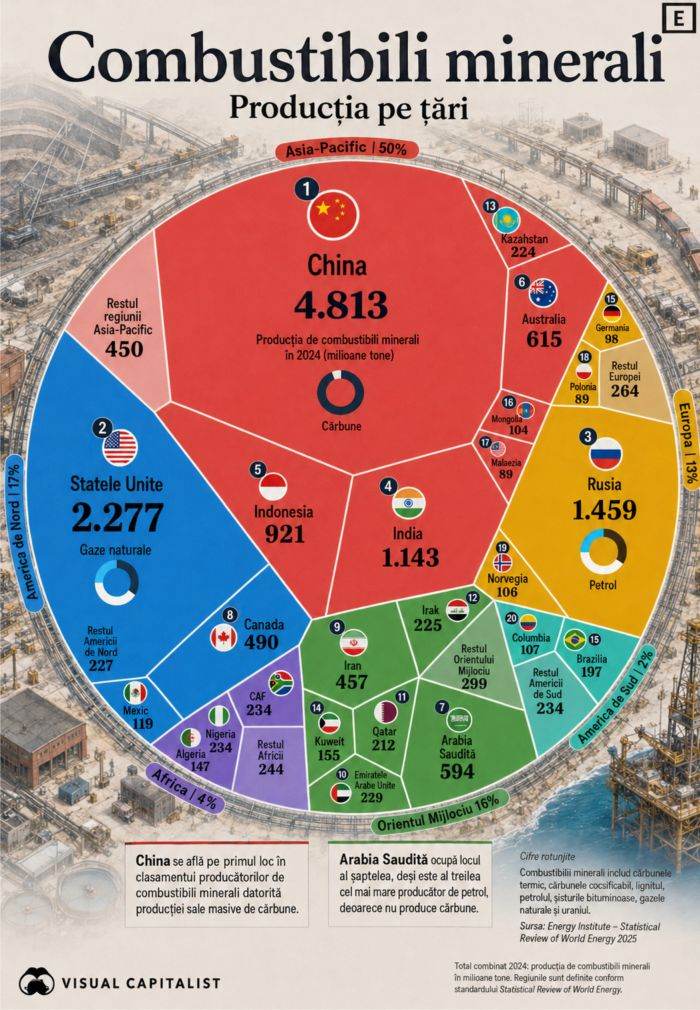
Fossil fuels underpin electricity generation, transportation and industrial activity, but the countries producing the largest amounts vary significantly depending on how production is measured.
Visualcapitalist.com presents a ranking of fossil fuel production by country in 2024 (in tonnes), using data from the Austrian Ministry of Finance, covering thermal coal, coking coal, lignite, oil, oil shale, natural gas and uranium.
Because the ranking measures physical production rather than value or energy content, high-volume commodities such as coal significantly influence the results. This explains why several coal-producing economies rank ahead of some of the world's largest oil and gas producers.
• China leads the way
China ranks first, with a fossil fuel production of 4.8 billion tonnes in 2024, equivalent to 28.6% of global production. The vast majority of China's production comes from thermal coal and coking coal, which also contributes to China's position as the world's leading producer of minerals.
China produces more than twice as much fossil fuel - by weight - as the United States, which ranks second, with 2.28 billion tonnes, or 13.5% of the global total. Their production mixes differ greatly: coal dominates China's production, while oil and natural gas account for the bulk of US production.
• Coal dominates three of the top five producers
After China and the US, Russia ranks third, with 1.46 billion tonnes of fossil fuels, equivalent to 8.7% of the global total. Its production mix resembles that of the US, with oil and natural gas accounting for the largest share.
India ranks fourth, with 1.14 billion tonnes, representing 6.8% of global production, with thermal coal being the largest category of fossil fuels. Indonesia ranks fifth, with 921.4 million tonnes, or 5.5% of global production, with thermal coal also dominating production.
Together, China, the US, Russia, India and Indonesia produced 63.1% of the world's fossil fuels by weight in 2024. China alone extracted almost three out of every 10 tonnes of fuel.
• Asia-Pacific produces half of the world's fossil fuels
Regionally, Asia-Pacific produced 8.36 billion tonnes of fossil fuels in 2024, equivalent to 49.7% of global production by weight.
North America came in second, with 2.91 billion tonnes or 17.3% of the total. The Middle East and Europe followed closely, accounting for 12.9% and 12.5% of the total, respectively.
Saudi Arabia highlights how measuring fossil fuels by weight can change the rankings. Although it ranks third among crude oil producers, it only ranks seventh in this ranking, with 594.2 million tonnes, or 3.5% of global fossil fuel production. Countries with high coal density may rank higher because coal is produced in much larger physical volumes than fuels with higher energy densities.
Beyond the largest producers, the amount extracted is significantly lower. Germany, Poland, and Malaysia each account for less than 1% of global fossil fuel production.
• China and the United States lead total mineral production
China led global mineral production in 2024 by a wide margin, putting 5.3 billion tons on the market, or 26.9% of the global total, according to the cited source. Most of this volume came from coal production (4.8 billion tons).
The United States came in second, with 2.4 billion tons, or 12.1% of the global total, less than half of China's production. The US's top position reflects its substantial production of fossil fuels, particularly crude oil and natural gas, where the United States is the world leader.
Russia (1.56 billion tonnes; 7.9% of the total), India (1.41 billion tonnes; 7.1% of the total) and Australia (1.33 billion tonnes; 6.7% of the total) complete the other places in the Top 5. Russia is a major producer of fossil fuels, gold and base metals, while India is the world's second largest coal producer. Australia is the world's leading producer of bauxite, iron ore and lithium.
Other major energy producers also appear in the Top 10. Saudi Arabia (seventh) produced 620 million tonnes (3.1% of the total), while Iran (ninth) marketed 540.3 million tonnes (2.7% of the total). Indonesia ranked sixth with 941.9 million tonnes (4.7% of the total), and is both a major fossil fuel producer and the world's largest nickel producer.
• Asia-Pacific produces half of the world's minerals
The Asia-Pacific region generated 50.3% of global mineral production in 2024, equivalent to almost 10 billion tonnes. The region's total was driven by China, India, Australia and Indonesia. Even excluding China, Asia-Pacific produced 4.7 billion tonnes of minerals, or 23.4% of the global total, highlighting that the region's advantage extends beyond a single country.
North America ranked second, with 15.9% of global production (about 3.15 billion tonnes), followed by Europe with 12% (2.37 billion tonnes) and the Middle East with 11.6% (2.31 billion tonnes). Africa accounted for 5.5% of total production (1.08 billion tonnes), despite being a major producer of lower-volume commodities such as cobalt and platinum group metals. South America, a leading region for copper and lithium, accounted for 4.7% (934 million tonnes). The cited source adds that the top 25 countries in the ranking accounted for almost 90% of global mineral production in 2024. In terms of volume, the majority of global production therefore comes from a relatively small group of countries. This concentration reflects differences in geology, energy reserves, industrial capacity and the size of domestic demand. It also shows that large producers remain the backbone of global energy supply chains, infrastructure and manufacturing.























 Euro
Euro Dolar SUA
 Franc elveţian
 Liră sterlină
 Gram de aur