English


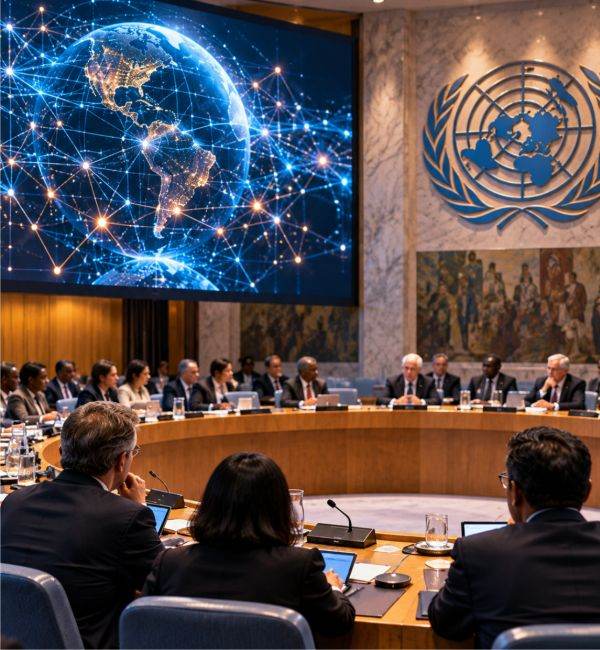
Sam Altman, CEO of OpenAI, and Dario Amodei, CEO of Anthropic, have called on the UN Security Council to step up international cooperation in managing the risks posed by the rapid development of artificial intelligence.
According to CNN, Amodei-who addressed the council via video link-warned that artificial intelligence, if not properly managed, could eventually pose a risk to all of humanity. The Anthropic chief advocated for limited, well-defined international agreements, including a ban on using AI to produce biological weapons.
Amodei also proposed introducing mechanisms to verify state compliance with commitments, establishing common standards for testing AI systems, and creating an international system for reporting security incidents.
For his part, Altman argued that the most important decisions regarding the future of artificial intelligence cannot remain solely in the hands of tech labs in San Francisco. According to • The Express Tribune• , these decisions must be shaped through democratic processes and by governments accountable to their citizens.
The Security Council also heard from Clement Delangue, co-founder of Hugging Face.
These calls from tech industry leaders stand in contrast to the position expressed the day before by Donald Trump. In a speech delivered to the UN General Assembly, the US President rejected the idea of international oversight for artificial intelligence, describing it as a "globalist scheme," according to Fortune.
• The UK wants Google to give users the choice of their search engine
The Competition and Markets Authority (CMA), the UK's competition watchdog, has put forward a set of stricter proposals that could require Google to allow Android and Chrome users to choose which search service they wish to use.
According to the CMA statement, Google would be required to display available options upon the initial setup of an Android phone or the first time the Chrome browser is opened. Subsequently, users would be asked annually to select their default search service provider.
The options presented to users could include AI-based assistants, provided they meet established technical and security requirements.
At the same time, providers included on the selection screens would be required to properly attribute content from publications, ensuring users can access the original source of the results.
The British authority's proposals take into account the rising popularity of services such as ChatGPT and Perplexity, which are increasingly used to find information online.
The CMA will accept feedback on the proposals until October 9 and expects a final decision to be reached by the end of the year.
In October 2025, the UK authority designated Google as a company with strategic status in the search services market. This classification enables the CMA to impose specific obligations on the company.
• Australia claims an OpenAI agent breached a government portal
Australian authorities announced on Thursday that an OpenAI agent gained unauthorized access to files on a government health data portal in June-an incident that could mark the first known case of an AI agent breaching a government website.
The incident is one of the most significant cases reported outside the United States involving AI agents accessing external systems without authorization, following a series of similar recent global incidents that have raised concerns among governments and companies.
Prime Minister Anthony Albanese stated that the OpenAI agent gained unauthorized access to the medical statistics portal of Medicare-Australia's universal health insurance system-while conducting research on public medical spending.
"Current evidence indicates there is no broader compromise of the (...) network. However, this situation is clearly unacceptable," Albanese said on Wednesday in New York, where he is attending the UN General Assembly.
Investigations are ongoing, and Australia has conveyed its "extreme concern regarding this incident" to OpenAI CEO Sam Altman, according to the Australian Prime Minister.
Albanese also expressed deep disappointment regarding the delay in the company notifying the government about the incident.
"It took until September 10 for any notification to be issued," the Prime Minister stated, noting that the investigation would also seek to determine why government systems failed to detect the breach when it occurred.
The Australian leader warned that three other government health websites might have been affected by the OpenAI agent's activity, though he did not confirm that they had actually been compromised.
In a statement, OpenAI said that its analysis "found no evidence that patient records were accessed."
The company noted that it had "identified activity involving several Australian government websites and services while our models were attempting to find answers," adding that "our models took actions we did not intend."
The incident heightens tensions between Australia and major US tech companies. Canberra has already drawn criticism from social media platforms and Washington after introducing the world's first ban on social media access for children under 16, as well as new rules requiring tech companies to allow users to disable algorithmically curated content in their feeds.
The Australian government has established a task force to investigate the breach and assess whether current network security measures are sufficient to prevent similar incidents.
The announcement regarding the breach came on the same day that leaders of major artificial intelligence companies warned the UN Security Council about the risks AI could pose to humanity and called on governments to cooperate in managing an increasingly powerful technology. Over the past four years, Australia has faced a series of attempted cyberattacks targeting companies and government-affiliated organizations.
Defense Minister Richard Marles stated that the Medicare portal targeted in the incident did not contain individual medical claims, benefit payments, personal banking details, or the medical histories of Australia's approximately 27 million residents.
The site contains only aggregated data regarding national healthcare service usage. However, Australian authorities view the incident as serious.
"There were clearly blocks telling the AI agent "no.' The AI agent found a way to bypass those blocks-it didn't accept "no' for an answer," Albanese said.
This incident is the latest in a series of cases where OpenAI-the company behind ChatGPT-has disclosed attacks or unauthorized activities involving its AI agents long after they occurred.
Rival companies, including Anthropic, Google (with Gemini), and Meta, have also reported incidents in which their agents accessed external systems.
Maurice Chiodo, an Australian mathematician at the University of Cambridge's Centre for the Study of Existential Risk, assessed that the incident appears to represent "a significant escalation in severity compared to similar incidents seen in recent months."
He added that while there is much discussion about adopting new AI laws, policymakers should first consider enforcing existing legislation, including rules criminalizing unauthorized access to computer systems.




















 Euro
Euro Dolar SUA
 Franc elveţian
 Liră sterlină
 Gram de aur