English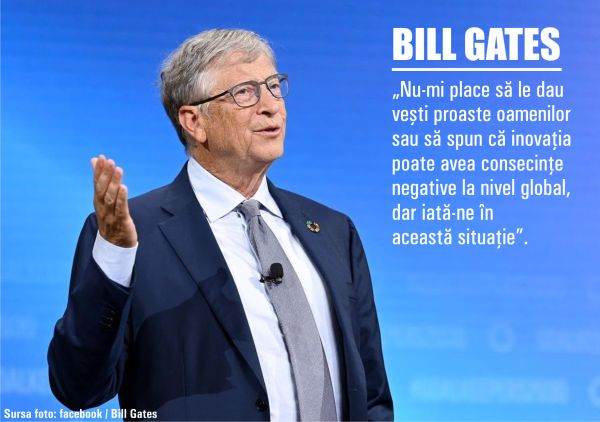
Bill Gates, co-founder and former CEO of Microsoft, is calling for an international approach to the effects of artificial intelligence on the economy and society, proposing the introduction of a tax on AI-generated content and robots, the creation of a global oversight body and the reservation of certain jobs for humans, AFP reports.
"I don't like to give people bad news or say that innovation can have negative consequences globally, but here we are,” Bill Gates told The New York Times. The position represents a change of tone for one of the most famous entrepreneurs in the technology industry. Gates believed last year that artificial intelligence will have a clear positive effect on humanity overall, even if the technology will also generate negative effects. "The world needs a plan to regulate the effects of this technology on our societies,” Gates warned in a wide-ranging message, in a position similar to those recently expressed by several leaders of the AI industry.
• Proposal for an international authority
Gates believes that artificial intelligence developers should not be the ones to determine alone how the technology will be regulated. In this context, he supports the creation of an international AI oversight body, following models such as the International Atomic Energy Agency and the International Civil Aviation Organization. The idea of such a structure has also been supported by other leaders of the technology industry, including Sam Altman, Dario Amodei and Demis Hassabis. They discussed the need for international coordination in the field of artificial intelligence at the G7 summit in Evian, in June.
• Tax on robots and AI-generated content
One of Bill Gates' most controversial proposals concerns taxation. The American billionaire believes that automation could reduce the number of jobs over time and, implicitly, tax revenues from paid work. To compensate for this development, he proposes the introduction of a tax on AI-generated content and robots. According to Gates, such a tax would not only have the role of generating revenue for the budget. It could "slow down the rush towards” work automation a little and would allow raising funds for professional training and strengthening social protection. The proposal comes at a time when the impact of AI on the labor market is becoming one of the main topics of the economic debate. Many representatives of the technology sector argue that artificial intelligence will ultimately generate more jobs than it will eliminate. Gates, however, has a more pessimistic perspective. "Without appropriate measures, there will be (ultimately) many fewer jobs than there are today,” he believes.
• Some jobs could be reserved for humans
Bill Gates also argues that certain jobs should be reserved for humans, in order to limit the effects of automation and preserve the relational component of some professions. The proposal starts from the idea that not all activities should be evaluated exclusively in terms of technological efficiency. In some areas, human interaction is an important component of the service provided. Gates currently devotes most of his work to his foundation, where he serves as chairman, after retiring from the operational management of Microsoft. His warnings are part of a wider debate on how societies and economies should manage a rapidly advancing technology, given that tax rules, the labor market and social protection systems do not always keep pace with the pace of automation.

























 Euro
Euro Dolar SUA
 Franc elveţian
 Liră sterlină
 Gram de aur