English


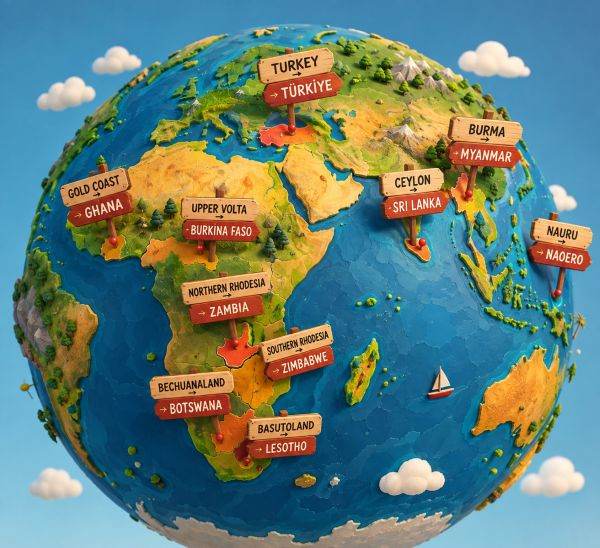
Changing a state's name is not merely a matter of vocabulary, nor is it as rare an occurrence as one might imagine. From decolonization and breaking with the past to redefining national identity, numerous countries have changed the names by which they were known globally since 1945. The most recent case is Nauru, which officially reverted this week to the form "Naoero." Romania has not been immune to such ideas either; in recent years, there have been initiatives to rename the country Dacia or Getia, though these lacked the necessary substance to bring about any actual change.
• Nauru becomes Naoero
The small South Pacific island nation reverted in 2026 to the name "Naoero," which its authorities consider the country's traditional name.
President David Adeang announced the change during his address to the United Nations General Assembly on September 22, 2026, stating that the country was returning to the name and pronunciation used historically by the local population. The Associated Press reports that Adeang described the move as a reaffirmation of national identity. According to a document released by the Nauruan government, the proposal to replace all references to "Nauru" with "Naoero" aims to more faithfully honor the nation's heritage, language, and identity. The document explains that the form "Nauru" became the international standard after the local name, "Naoero," was adapted by foreign speakers. The case is interesting precisely because the difference between the two names is slight. It is not a matter of the emergence of a new state, but rather a return to a form considered by the country's authorities to be closer to its own language and identity.
• Romania has also been drawn to the idea of a name change
Romania has not remained entirely untouched by this desire for change. In 2012-2013, an online petition circulated calling for the country's name to be changed from Romania to Dacia. According to media reports from the time, the petition launched in 2012 had gathered just over 3,000 signatures by May 2013. However, the initiative did not result in a constitutional change to the Romanian state's name. More recently, an initiative emerged to change Romania's name to Getia. In 2023, an online petition called for a referendum on this change. The petition page identifies Daniel Mărgărit as the initiator and notes that while Gheorghe Funar and Diana Iovanovici-Şoşoacă were not the authors, their public statements had inspired the move. Gheorghe Funar publicly advocated for changing Romania's name to Getia. In January 2026, he reiterated the request in a press release, arguing for a return to the name "Getia."
However, the distinction between a public initiative and a legislative one is important. An online petition or a political statement does not alter the state's constitutional name. Article 1 of the Romanian Constitution establishes that "Romania is a sovereign and independent, unitary and indivisible national state." Consequently, changing the state's name would entail amending the Constitution, rather than a mere administrative decision or a shift in diplomatic usage. The procedure for constitutional revision is stipulated in the Constitution, and the Romanian Parliament officially publishes legislative drafts along with their status in the parliamentary process. Regarding initiatives concerning "Dacia" or "Getia," the efforts identified in this research remained at the level of petitions, declarations, and political statements, without leading to an amendment of Article 1 of the Constitution. Interestingly, these initiatives originate from nationalist-sovereignist circles-a political current currently enjoying a surge of popularity in the country.
• From colonies to states with their own names
After 1945, one of the most significant waves of name changes was linked to decolonization. In Africa, the Gold Coast became Ghana in 1957 upon gaining independence. Northern Rhodesia became Zambia and Nyasaland became Malawi, both in 1964. Bechuanaland became Botswana and Basutoland became Lesotho in 1966. In 1980, following the end of colonial rule, Southern Rhodesia became Zimbabwe. In 1981, British Honduras became Belize, and in 1984, Upper Volta became Burkina Faso. The British Government's official chronology of state names, updated in July 2026, records these transformations and distinguishes between a name change, the attainment of independence, and a modification of the state's official designation. In many instances, the name change was linked not only to independence but also to a desire to abandon a name associated with the colonial era.
• Africa: New Names for Old States
Another significant case is that of Dahomey, which changed its name to Benin in 1975. The United Nations includes Benin among its member states, and the UN nomenclature explicitly mentions the old name... Congo-Leopoldville, a state that gained independence in 1960, has gone by several names. In 1971, the name was changed to Zaire, and in 1997, the state reverted to the name Democratic Republic of the Congo. This case is also recorded in the official UN nomenclature. Similarly, the Malagasy Republic reverted to the name Madagascar in 1975.
• Asia: Ceylon - Sri Lanka and Burma - Myanmar
In Asia, one of the best-known cases is Ceylon, which adopted the name Sri Lanka in 1972. Another example is Burma, whose name was changed to Myanmar in 1989. In UN records, Myanmar currently appears under this name, while the old form, Burma, is listed as a former name. Cambodia, too, has gone through several official names over the course of just a few decades: Khmer Republic, Democratic Kampuchea, then Cambodia, and-in its current official form-Kingdom of Cambodia.
In the case of Laos, the official name became the Lao People's Democratic Republic in 1975. These examples demonstrate that a state's name can be altered not only following a break from foreign rule but also as a result of a radical change in political regime. More recently, Swaziland became Eswatini in 2018. The UN records that the name change to "Kingdom of Eswatini"-with the short form "Eswatini"-came into effect on April 19, 2018. In 2019, the Republic of Macedonia became the Republic of North Macedonia following an agreement with Greece and the process that led to the resolution of the name dispute. This change is recorded both by the UN and in the organization's statistical nomenclature. In 2022, Turkey requested that the UN use the form "Turkiye" in international communications. This is a somewhat different case: neither a new state was created nor the country's constitutional identity changed; rather, the international form used in English was altered. The British government includes this modification in its official timeline.
Similarly, "Czechia" was introduced as the short form of the Czech Republic's name, without the official name "Czech Republic" disappearing. The Netherlands is an example of an official change in the name used for international communication. Since 2020, authorities have stopped promoting the name "Holland" and adopted "The Netherlands" as the official name for external communication. "Holland" actually refers to only two of the country's 12 provinces-North Holland and South Holland. The change was part of a strategy to reposition the country's image abroad, and the state's constitutional name did not change.
• Not all changes are changes of state
The list becomes much longer if one includes states that have successively modified their official names without changing their international identity. This is the case, for example, with certain African states that, following independence, transitioned from a monarchy to a republic or adopted other constitutional forms. Tanzania represents a distinct case. Tanganyika gained independence in 1961 and Zanzibar in 1963; the two territories united in 1964. The new state took the name "United Republic of Tanzania." The British timeline of name changes records the union of Tanganyika and Zanzibar and the formation of Tanzania. Therefore, when discussing "countries that have changed their names," a distinction must be made between changing the name of an existing country and the emergence of a new state through independence, unification, or the dissolution of a previous state.
• A special case: Timor-Leste
In 2002, East Timor gained independence under the name Timor-Leste. The UN lists Timor-Leste among states that have undergone a name change, with "East Timor" being the former designation. In this instance, the name change is directly linked to the formation of an independent state, rather than a mere administrative alteration of an existing country's name. Another case that has fueled international discussion in recent years is India. In India, "Bharat" is an official name used in Hindi alongside "India." Speculation arose in 2023 regarding a potential switch from "India" to "Bharat" in international relations, following the use of the title "President of Bharat" on an official invitation. However, India remains listed as "India" in UN records; thus, this case cannot be placed in the same category as Eswatini or North Macedonia.
Ultimately, for a state, a name is more than just the word on the cover of a passport. It is the name under which the state is recognized in treaties, international organizations, and diplomatic relations; above all, it is one of the most visible expressions of how a nation defines its own identity.




















 Euro
Euro Dolar SUA
 Franc elveţian
 Liră sterlină
 Gram de aur