 English


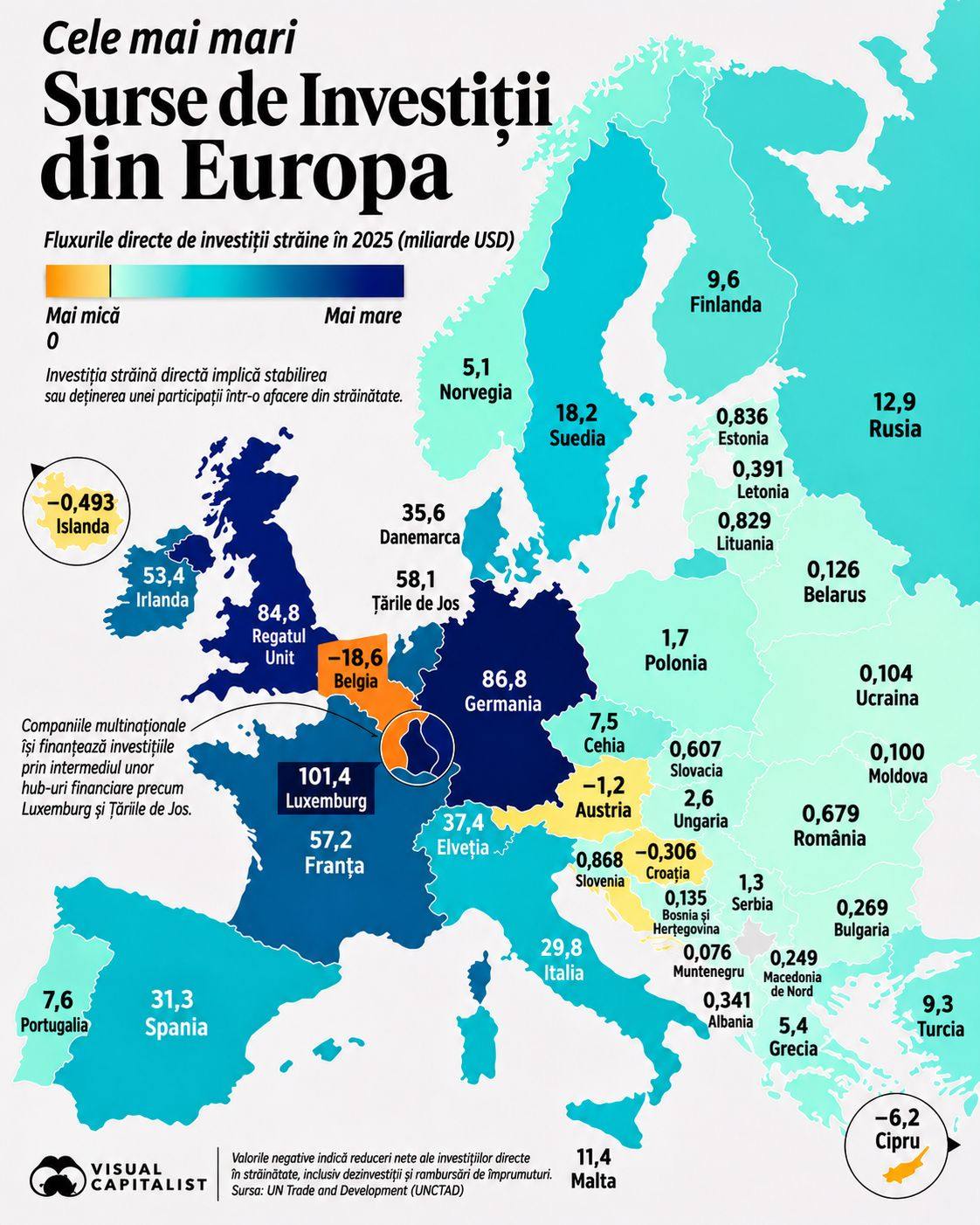
Companies across Europe invested nearly $650 billion abroad in 2025, according to visualcapitalist.com, which notes that the largest source was a country with a population of under one million inhabitants.
Visual Capitalist presents foreign direct investment (FDI) flows from European countries in 2025, based on data from the 2026 edition of the World Investment Report.
Foreign direct investment involves holding a lasting interest in a business abroad, including acquisitions, reinvested earnings, and loans between entities within the same corporate group. These figures encompass investment flows between European countries, not just investments made outside the continent.
• Largest European investors abroad
Luxembourg recorded $101.4 billion in outward investments in 2025, followed by Germany with $86.8 billion and the United Kingdom with $84.8 billion. Together, these three countries accounted for over 40% of the total recorded across Europe. Luxembourg's leading position partly reflects its role as a financial conduit for multinational companies-a role also shared by the Netherlands ($58.1 billion, ranking fourth). Positions 5 through 10 are held by: France ($57.15 billion), Ireland ($53.41 billion), Switzerland ($37.43 billion), Denmark ($35.63 billion), Spain ($31.34 billion), and Italy ($29.79 billion).
Investments channeled through locally registered companies may ultimately originate from owners based in other jurisdictions. The primary sources of foreign direct investment include both major economies and smaller nations that possess extensive international business networks. Denmark, for instance, ranks ahead of much larger economies such as Italy and Spain.
Five countries recorded negative outflows last year, with Belgium reporting the largest net reduction in investments, amounting to $18.6 billion. Negative figures may reflect divestments, a decrease in equity holdings, or the repayment of loans extended to foreign subsidiaries. This does not necessarily mean that firms have ceased investing beyond their national borders.
• German companies expand into major markets
Germany's strong position reflects the global reach of Europe's largest economy, with industrial companies operating well beyond the domestic market. Recent projects illustrate how German firms are expanding, moving closer to customers in the United States and China-two of their largest export markets.
In March 2025, Siemens announced a $285 million investment in electrical equipment production facilities in California and Texas. This expansion has more than doubled the company's U.S. production capacity for infrastructure-related equipment-such as that used in data centers-demonstrating how the technological boom is driving demand for European industrial suppliers.
Meanwhile, in November 2025, BASF began production at its chemical complex in Zhanjiang. This multi-year project, valued at approximately $10 billion, is designed primarily to serve customers in China.
• The pharmaceutical sector and acquisitions shape investment
European drug manufacturers are also expanding their operations in the United States. In 2025, the Anglo-Swedish company AstraZeneca announced plans to invest $50 billion in U.S. production and research facilities by 2030. Similarly, the French group Sanofi has announced its intention to invest at least $20 billion over the same period. The commercial motivation is significant. According to the cited source, AstraZeneca aims for half of its projected $80 billion in revenue for 2030 to be generated in the United States. Expanding production and research facilities strengthens the company's presence in a key market while simultaneously reducing potential exposure to future U.S. tariffs.
Investments are also reshaping European companies. In April 2025, the Danish group DSV completed the acquisition of the German firm Schenker, in a transaction with an enterprise value exceeding $15 billion. This merger brought together nearly 160,000 employees across more than 90 countries, illustrating how a cross-border European acquisition can rapidly expand a company's global footprint.
These corporate examples illustrate the scale of European investments abroad, although the multi-year commitments announced do not necessarily correspond to the foreign direct investment flows recorded in any single year.
























 Euro
 Dolar SUA
 Franc elveţian
 Liră sterlină
 Gram de aur


























Reader's Opinion