 English
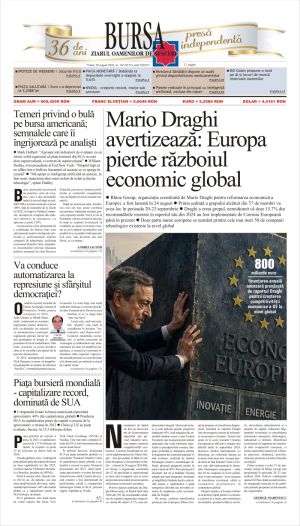
Unhappy that, although two years have passed since the presentation of his report on the measures needed to increase economic competitiveness, the European Commission has not moved to implement them, Mario Draghi - former president of the European Central Bank and former prime minister of Italy - launched on August 24, 2026 Rhine Group, an organization made up of 57 specialists and representatives of large companies that would present several projects for reforming the European economy.
According to data published by the Draghi Observatory, at the end of July 2026, out of 383 recommendations followed by the experts of that organization, only 60, or 15.7%, had been fully implemented. If those partially implemented are also included, the progress exceeds 40%, but the overall picture remains that of a European Union that advances through specific measures, but avoids structural reforms that involve common money, deep integration and the renunciation of fragments of national control by the states. Another assessment, carried out by the Institut Montaigne using a different methodology, places the legal progress around 30%. The percentages can be discussed, but not the trend: Europe more easily adopts programs, declarations and limited simplifications than a true capital union, an efficient energy market or joint investments of the magnitude recommended by Draghi.
Therefore, according to the manifesto posted on its website, the Rhine Group aims to transform the diagnosis formulated in the Draghi report into a concrete program for economic reform of Europe. The quoted text shows that at the moment the European Union is in a more difficult situation than in September 2024, because the international environment has deteriorated and internal reforms have advanced much too slowly. Europe is losing ground to the United States and China, is poorly represented in emerging technological fields - where out of 50 companies worldwide, only 4 are European - and is failing to transform research, ideas and promising companies into global competitors.
The group argues that Europe must act quickly to compete, build and grow by stimulating investment, productivity and innovation, developing infrastructure and capital markets, reducing economic fragmentation and strengthening energy, technological, industrial and military autonomy. The manifesto warns that stagnation threatens not only European companies, but also the very ability of states to finance defense, health, pensions, education, social protection and the ecological transition.
The first session of the 57 specialists gathered in the Rhine Group is scheduled for September 20-23, 2026. According to the Spanish daily El Pais, the organization's first proposals and documents are to be published after this inaugural meeting.
• What the Draghi report predicts
The Draghi report, published in September 2024, starts from a severe observation: the European Union is losing ground to the United States and China because it invests insufficiently, innovates slowly, supports expensive energy, regulates excessively and fragments its resources between 27 national policies. The proposed solution is not to abandon the European social model, but to build a genuine common economic, industrial and financial policy.
The report groups the intervention in three main directions: reducing the innovation gap, transforming decarbonization into an economic advantage and reducing external dependencies. Added to these is the reform of financing and the way in which European institutions operate.
In the field of innovation, Mario Draghi proposes focusing European funds on technologies with major potential - artificial intelligence, semiconductors, advanced computing, biotechnology, quantum technologies and clean energy -, expanding digital infrastructure and creating European funding mechanisms inspired by the American agency ARPA. Universities and high-performing institutes would receive more resources, and research would be better connected to industry. Start-ups should be able to operate under a single European legal status, without opening separate structures in each state. The stakes are justified by the huge gap: European companies invested around 270 billion euros less in research and development than American ones.
In energy and decarbonization, the Draghi report calls for a clearer separation of the price of clean electricity from the volatile price of gas, the use of long-term contracts, massive investments in networks, interconnections, storage and energy production. The green transition must be coordinated with industrial policy, so that climate rules do not lead to the disappearance of European industry and the import of products from countries with lower standards. Mario Draghi does not reject climate objectives, but calls for technological neutrality, support for nuclear energy where countries choose it and the protection of energy-intensive sectors. The central problem is that European energy remains much more expensive than American energy, and this handicap hits chemistry, metallurgy, the automotive industry and the production of clean technologies.
To reduce strategic dependencies, the report recommends securing critical raw materials, diversifying suppliers, building up stocks and making joint purchases. Trade policy should be used more actively against subsidies and unfair practices by competitors, and foreign investment in sensitive areas should be controlled in a unified manner. In defense, Draghi proposes aggregation of demand, joint purchases, standardization of equipment and consolidation of European industry, since fragmentation of national orders prevents large-scale production.
The most ambitious measure in the Draghi report presented in September 2024 is the mobilization by the European Commission of additional investments of approximately 750-800 billion euros annually, equivalent to almost 5% of the European Union's GDP. The financing would come from private capital, national budgets, the European Investment Bank and common European funds.
Mario Draghi also supports the completion of the capital markets union, the orientation of Europeans' savings towards EU companies and the issuance of common debt for European public goods such as energy networks, defense or cutting-edge research. However, he does not propose that the entire amount be covered by public money or common debt.
The report also calls for simplification of legislation, reduction of administrative burdens and application of the subsidiarity principle. At the same time, it proposes stronger economic coordination, faster decisions and wider use of qualified majority voting, so that strategic projects are not permanently blocked by the right of veto.
In essence, the Draghi report calls for a shift from a Union that mainly sets rules to one that invests, produces and defends its economic interests. The diagnosis is convincing, but implementing the measures would require a leap towards fiscal and political integration that European governments have so far avoided. Without this change, the euro800 billion needed annually risks remaining more a measure of the European gap than a budget for a genuine recovery.
• Scenario: What would have happened if the reforms requested by Draghi had been implemented
According to experts from the Rhine Group, if the measures proposed by Mario Draghi had been assumed immediately after the presentation of the report, in September 2024, the European Union would today have a somewhat larger, more dynamic economy and better prepared to compete with the United States and China, without having solved in less than two years the structural problems accumulated over the last decades. This is because the instant mobilization of the 750-800 billion euros annually estimated by Draghi would have been impossible, because energy, digital, industrial and military projects had to be prepared, authorized and executed.
A realistic scenario assumes additional investments of euro250-350 billion in 2025 and reaching an annualized pace of euro450-600 billion in 2026, financed by private capital, national budgets, European funds, European Investment Bank loans and joint bonds. Under these conditions, EU economic growth could have reached around 1.8-2.1% in 2025, compared to around 1.4% in reality, and in 2026 it would probably have been between 1.7% and 2.2%, compared to around 1.1% in the current European Commission forecast. By August 2026, the Union's real GDP would thus have been around 1.2-2.2% higher than it is today, which would have meant, in a central scenario, almost euro300 billion more in the European economy.
The first effects would have been seen in the construction and modernization of energy networks, the production of electrical equipment, defense, semiconductors, data centers, artificial intelligence, the automotive industry and research. Joint orders and predictable European funding would have prompted companies to restart postponed investments, and the single legal status for innovative companies and the reduction of bureaucracy would have encouraged start-ups to develop within the EU, instead of moving their activity and capital to the United States.
According to the experts cited, the economy could have created between one and two million additional jobs, but the shortage of engineers, electricians, computer scientists and skilled workers would have limited the expansion of production and pushed up wages. A significant part of the money spent would have inevitably been transferred to imports, because Europe could not immediately produce all the chips, batteries, raw materials, digital equipment and military components needed. Perhaps 20-35% of the additional demand would have supported the economies of the United States, China and Asia, reducing the effect of investment on European GDP.
In energy, joint gas purchases, long-term contracts, the development of storage capacities and the coordination of reserves would have reduced price volatility and better protected the industry against the energy shock of 2026. However, prices would not have fallen quickly to US levels, as power plants, interconnections and networks take years to build. Up to now, European companies would have mainly benefited from somewhat more stable prices and clearer prospects, while the structural reduction in costs would have occurred after 2027-2028.
The immediate cost of implementing the Draghi report would have been temporarily higher inflation, probably by 0.3-0.6 percentage points in 2025, as massive investment would have increased demand for materials, equipment and labour in a capacity-constrained economy. The ECB would have cut interest rates more cautiously, partially reducing the stimulus. If about a third of the investments had been publicly financed, the aggregate debt of the European states would have increased by about 1.5-3 percentage points of GDP by now. Issuing common bonds would have distributed the burden more evenly, while exclusively national financing would have favored the rich states and deepened the differences between the economies of the Union. Germany, France, Italy, Spain, the Netherlands, Poland and the Nordic countries would have attracted the bulk of the technological and industrial investments, and Romania could have benefited from energy projects, the defense industry, nuclear energy, renewables and component production, provided that it had mature projects and the administrative capacity to execute them.
Productivity would not have increased spectacularly to date, because the results of investments in research, artificial intelligence, semiconductors and education appear after several years. The direct contribution to productivity would probably have been only 0.1-0.3%, but the Union would have entered a much more favorable trajectory for the period 2027-2035. Immediate implementation of the Draghi report would therefore not have produced an economic miracle, nor would it have transformed the EU into an equal technological rival of the United States in just two years. But it would have created an economy up to 2.2% larger than today, stronger investment, around two million additional jobs, and better resilience to energy and geopolitical shocks.
• Adrian Mitroi: "Europe does not understand that only through a low cost of credit can it finance development and risk”
Finance and economics expert Adrian Mitroi, professor of behavioral finance at the Bucharest Academy of Economic Sciences, told the BURSA newspaper that the group launched by Mario Draghi will not be successful until Europe realizes that it needs to reduce the cost of credit to finance the development of companies and increase their competitiveness.
Adrian Mitroi told us: "With a low price of credit and capital, you can finance credit and development. Europe does not understand that, through a low cost of capital - which means a low cost of credit and, implicitly, of equity -, you can finance development and risk. You need a much lower cost of equity and debt.”
He stated that, unfortunately, at the moment the biggest problem for Europe is the USA, which, for the financing and refinancing of the 40 trillion dollar debt, has two points of support: Asia and Europe.
"Therefore, the USA must transfer high interest rates and a strong euro to the European Union, in order to make it difficult for it to finance its very high sovereign needs and the purchase of technology. I do not know if this is necessarily the order, but I know what the first thing that must be financed is: all sovereign credits. This means that the eviction effect appears. It also means high interest rates both in the short term and in the long term, corroborated with a currency that is badly appreciated. The euro is too strong in relation to European productivity and economic efficiency. In this context, capital is expensive: both borrowed and bank capital, and, implicitly, private capital. Therefore, the capital available for financing is both expensive and short-term. The combination of expensive capital and capital available only in the short term is obviously completely unsuitable for financing development and growth. Unfortunately, currently, central banks mainly deal with stability and inflation, not financing”, said Adrian Mitroi.
The finance and economics expert also gave an example of our country's situation:
"Look at Romania, how backward it is in terms of financing after 35 years. As someone who worked, in my early years, in venture capital and private equity, I can tell you that the field has remained at the same level as 35 years ago, just like Romanian politics. Romanian capital does not know how to finance, does not want to, does not get involved in company management and is very shy.
The same patterns are perpetuated in Europe. Europe has no appetite and no capital, and business schools do not really teach anything like that. There are only some annexes regarding private equity and venture capital. Do we know how to evaluate artificial intelligence today? We have no idea”.
Mr. Mitroi also referred to the Draghi report, which he stated had a great weakness, due to the author's membership in the group of central bankers.
"Europe does not have the competitiveness financing structure that he was talking about. It is a deficit in the financing structure, a structure that is not formed by legislation, but by legislative permission. Financing hyperdeficits is currently complicated and very difficult. Central banks, especially the FED, will have a big problem. The crowding-out effect will be very strong, especially in Europe, in terms of trade financing. We know very well that Europe disavows risk financing and finances on the basis of the balance sheet, not the profit and loss account. I have done a lot of research in this area. Europe finances on the basis of the balance sheet, has a fixation on the balance sheet and, therefore, needs this "medieval nonsense” of certain guarantees. It claims that it does not have enough capital and that it must adjust it according to Basel III. In these conditions, without having capital available to finance risk and development, you only have capital for the working capital and for the usual investment projects. So this deficit comes into play collision with the hyper-agglomeration in the area of deficit financing, especially in Europe. The US juggles its own long-term yield curve and the yen, through its big friends, the only ones who remained direct buyers of American debt, especially long-term debt. Europe is facing this crowding-out effect: first, commercial banks enter into competition with investment banking and risk financing; second, commercial banks, which finance themselves with relatively cheap capital, prefer this carry trade that we commonly see in Romania as well. They make a very profitable carry trade by financing deficits”, Adrian Mitroi told us.
Also, the finance and economics expert believes that the European Union does not lack a single capital market, but the financing of economic growth in the most important sectors at the moment.
Adrian Mitroi stated: "Currently, "the name of the game" means two things: defense, namely the "drone economy", which I wrote about five years ago, and the "AI economy". These are two very important areas. Without the capacity to finance research and development in these sectors, you will remain a simple buyer in the value chain. You are not able to finance upstream activities, research and development, so as to build your own "drone economy" here in Europe. The same with AI. Under these conditions, you will have to buy. What Palantir will sell you will be gold for you. You will prefer to buy Palantir products at the exit of the production chain. Europe no longer has the time, patience and capacity to finance upstream activities, neither in the military nor in the artificial intelligence field. It does not have any major AI companies. There is a French LLM, but that is, for now, a childhood of some graduates. In the conditions of Asian hyper-competition and the American technological hyperpower, now extended into space, there are two different but mutually reinforcing business models. Europe is only a buyer and therefore must find solutions for the acquisition of these technologies. It cannot finance them and does not know how to produce them”. He concluded by saying that other fundamental and structural problems of the European Union are the purchasing power of pensions and the financing of deficits, which will lead to a high demand from the states to finance their own budgets, and he showed that, unlike the community bloc, the US has put visionary people in key positions and at the head of the Treasury, who understand the importance of the depreciation of the dollar and price management, not just liquidity.
























 Euro
Euro Dolar SUA
 Franc elveţian
 Liră sterlină
 Gram de aur


























Reader's Opinion