 English
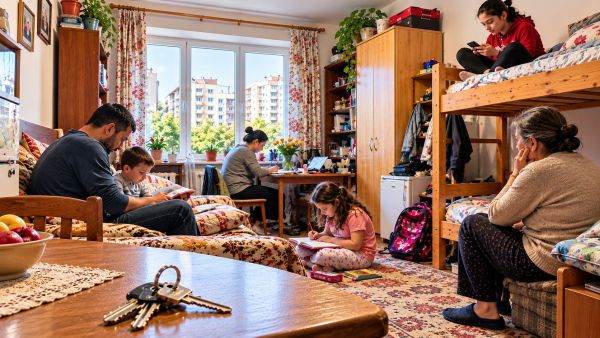
Rising housing prices and rents are putting pressure on the budgets of European households, hindering employee mobility, and deepening social inequalities. For an increasing number of young people and families, securing adequate housing has become a major economic challenge. In Portugal, people have taken to the streets to protest against soaring housing costs. Access to housing has emerged as one of the significant social and economic challenges facing the European Union. While the situation varies from country to country, rising property prices, higher rents, and the costs associated with maintaining a home are straining household incomes - particularly in large cities, where jobs and educational opportunities are concentrated.
According to data from the Council of the European Union, housing prices across the bloc have risen, while household incomes have failed to keep pace. Nearly one-fifth of the average European household's income is allocated to housing, and approximately one in ten people report being unable to pay their rent or mortgage installments on time. The issue, therefore, extends beyond the real estate sector. Housing costs influence decisions regarding starting a family, access to education, and the choice of employment-all of which have implications for economic development and social cohesion.

• Prices are rising faster than purchasing power
Trends in the European real estate market indicate that homeownership is becoming increasingly difficult for individuals who lack substantial savings or financial support from their families. According to the Council of the EU, housing prices in some member states have risen by more than 200% since 2015. While the increase in costs is not uniform, the overall trend is exacerbated by the widening gap between property prices and the population's disposable income. Eurostat data published in 2026 show that, between 2010 and 2025, housing prices in the European Union increased by approximately 61%, while rents rose by 29%. There are significant variations between countries and regions, with the situation influenced by factors such as housing supply, demand in major urban centers, and financing conditions.
For individuals with low incomes, the impact is more severe. According to Eurostat data, in 2024, 31.1% of Europeans living below the poverty line allocated at least 40% of their disposable income toward housing. Among those not at risk of poverty, the proportion was only 3.8%. This disparity demonstrates that the housing issue extends beyond the mere difficulty of purchasing a property. Even for those who rent, high housing costs can limit one's ability to save and reduce the resources available for food, education, healthcare, and other daily needs.
• Young people face high rents and dependence on their families
One consequence of the housing crisis is the delay in young people's ability to build an independent life. According to Eurostat, in 2025, young people in the European Union left their parents' homes at an average age of 26.3. In Croatia, this average reached 31.5 years, while in Greece and Slovakia, it was 30.9 years. At the other end of the spectrum were Finland, at 21.4 years, and Denmark, at 21.8 years.
These differences reflect both cultural and familial characteristics, as well as economic conditions and access to housing. In countries where rents and property prices are high relative to income, moving into a separate home can entail a significant financial burden. For young people early in their careers, housing costs diminish their ability to save for a down payment, invest in education, or accept a job in another city. Furthermore, housing insecurity can delay decisions regarding marriage and having children. The issue also has a broader economic dimension. An unaffordable housing market can hinder the movement of workers toward regions where jobs are available, exacerbating imbalances between the supply of and demand for labor.
• High housing costs affect economic competitiveness
High housing costs can also become a problem for employers, especially in major economic hubs. When staff cannot afford to live near their workplace, recruitment becomes more difficult, and commuting entails additional time and expenses. The Council of the EU highlights that the effects of the housing crisis extend to labour mobility, access to employment and education, and regional disparities. Although housing policy remains primarily the responsibility of Member States, its economic and social consequences justify a European approach. In December 2025, the European Commission presented the European Affordable Housing Plan, designed to support Member States in their efforts to improve access to housing. The initiative aims, among other things, to boost housing supply, mobilise investment, and support groups affected by high costs. However, increasing supply does not depend solely on funding. The availability of land, permitting procedures, transport and utility infrastructure, construction costs, and the capacity of local administrations all influence the pace at which new housing can be developed.
Furthermore, an increase in the number of properties built does not automatically guarantee their affordability. Factors such as location, final price, and the ratio between costs and the incomes of potential buyers or tenants are crucial.
• The lack of adequate housing: a growing social problem
The most serious consequence of the housing crisis is the exclusion of individuals who can no longer afford even a stable housing solution. According to the latest estimate published by FEANTSA, the European organization that monitors homelessness, approximately 1.44 million people in Europe sleep in public spaces, reside in emergency shelters, or use temporary accommodation services. The organization cautions that these figures should be viewed as estimates of the scale of the phenomenon, as definitions and counting methods vary from country to country. The lack of a stable home can be linked to unemployment, poverty, health issues, domestic violence, and discrimination. At the same time, the absence of a fixed address can hinder one's ability to find employment or access medical and social services, making it even harder to escape a state of exclusion. At the European level, this issue has gained greater prominence on the agenda of EU institutions. In October 2026, the Council of the EU adopted a recommendation on combating housing exclusion and homelessness, encouraging member states to strengthen their strategies in this area.
• Between the free market and the need for affordable housing
The housing crisis presents governments with a difficult challenge: how can they encourage investment and the development of the real estate market without making access to housing increasingly restrictive for the general population? Measures discussed at the European level include the development of social and affordable housing, the simplification of administrative procedures, the mobilization of investment, and the improved utilization of the existing housing stock. Their effectiveness will depend on how they are implemented at both the national and local levels, as well as on the authorities' ability to tailor policies to the specific characteristics of each market. For European nations, the challenge goes beyond merely lowering prices; it also involves ensuring an adequate supply of suitable housing, located in areas with access to transport, education, and employment. In a Europe simultaneously grappling with an aging population and labor shortages, the inability to find affordable housing can become an additional barrier to economic development. The continent requires a workforce and greater professional mobility, yet housing costs threaten to prevent people from settling where opportunities exist. The housing crisis, therefore, is not just an issue for the real estate market-it is a matter of competitiveness, social equity, and long-term economic sustainability.

























 Euro
 Dolar SUA
 Franc elveţian
 Liră sterlină
 Gram de aur






























Reader's Opinion