 English


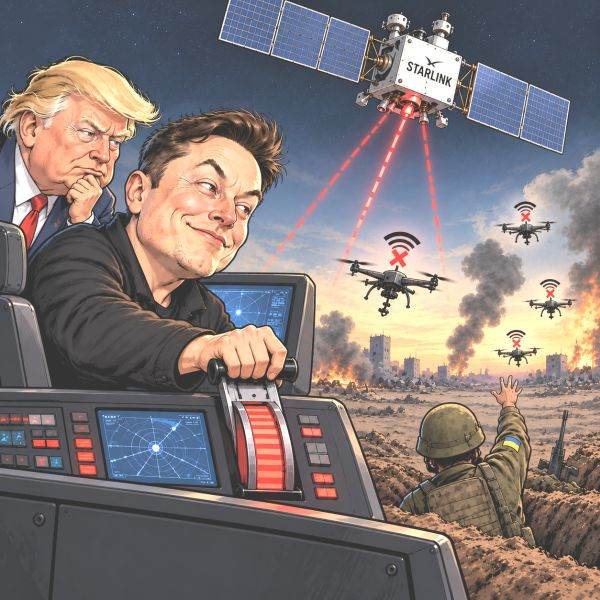
Elon Musk ordered a reduction in the connection speed of a military version of the Starlink satellite communications network used by the Ukrainian armed forces, causing concern in Kyiv and confusion within the administration of US President Donald Trump, according to government sources cited by The Wall Street Journal.
According to the cited source, the measure affected the Ukrainian military's ability to use attack and interceptor drones, at a time when relations between Washington and Kyiv are going through another period of tensions and Trump is putting pressure on Volodymyr Zelensky.
The American billionaire's decision comes amid a complicated diplomatic context, marked by the Trump administration's dissatisfaction with Ukrainian attacks on Russian energy infrastructure and the intensification of negotiations to end the war.
According to information published by The Wall Street Journal, both Elon Musk and Donald Trump have expressed dissatisfaction in recent weeks with Ukraine's attacks on refineries and diesel production facilities in Russia. The US president believes that these operations are contributing to rising international energy prices, at a time when his administration is trying to limit fuel costs ahead of the US congressional elections in November.
The restrictions on the speed at which Ukrainian military equipment can remain connected to the Starlink network have significantly reduced the effectiveness of certain categories of attack and interceptor drones, with some becoming practically unusable under the operational conditions for which they were designed.
According to sources cited by the American publication, Musk and Trump discussed the Starlink situation by telephone shortly after the restrictions became public, while the US president was participating in election-related activities. One source claims that the two had also addressed the issue before the limitations were introduced, raising questions about the level of involvement of the US administration in adopting the measure.
Public reactions from Ukrainian President Volodymyr Zelensky, who warned that maintaining the restrictions could result in loss of life, have amplified uncertainties regarding responsibility for the reduction of Starlink services. The situation even prompted informal inquiries at the White House, in an attempt to establish who authorized the changes and whether they were coordinated with administration representatives.
Meanwhile, SpaceX representatives contacted White House officials to clarify the common position of the company and the Trump administration and to coordinate public communication regarding the decision, according to sources familiar with the discussions.
• Musk and Trump both deny ordering restrictions on Ukraine's use of the Starlink network
A few hours after information about the restrictions emerged, Elon Musk stated on the X platform that any limitations on the speed or use of the network are established by the US military and, ultimately, by the President of the United States. Donald Trump, however, told reporters on Monday that he did not know who was responsible for reducing Starlink's speed, but that he wanted to find out.
Several US officials claim that Musk acted on his own initiative and that President Trump did not explicitly order punitive measures against Ukraine. Another person familiar with the situation, however, says that the billionaire discussed the matter with several senior administration members, including Trump, before the restrictions were introduced. Ukrainian officials warned that the limitations may have allowed some Russian missiles to evade the country's defense systems.
US Secretary of State Marco Rubio stated yesterday, during a visit to India, that the Washington administration had not requested a reduction in Starlink's speed and had no prior knowledge of the decision.
The restrictions, introduced starting October 14, followed a series of statements and measures by the Trump administration perceived by Ukrainian authorities as hostile. Repeated criticism of Zelensky by the US president and Elon Musk fueled Kyiv's suspicions that the limitation of access to Starlink had been decided either by the White House leader or by the owner of SpaceX.
The incident contributed to the deterioration of relations between the United States and Ukraine, with tensions reaching one of their highest levels since the verbal confrontation between Trump and Zelensky that took place last year in the Oval Office.
At the same time, the situation highlighted the considerable influence Elon Musk exerts over the course of the conflict, given that Starlink represents an essential communications infrastructure for Ukrainian units on the front line. The network is used both to coordinate operations against Russian forces and to operate certain defensive systems, while changes to connection parameters can have direct consequences for Kyiv's military capabilities.
Michael Kofman, a specialist in the conflict in Ukraine at the Carnegie Endowment for International Peace in Washington, explained that Ukrainian forces continue to face difficulties in using attack and interceptor drones. According to him, the equipment requires functional connections at speeds of up to 160 kilometers per hour, but the current limits are below 130 kilometers per hour, affecting both offensive operations and air defense.
Ukrainian diplomat Denys Sienik stated on Tuesday that authorities in Kyiv are still awaiting an official response following contacts with the Pentagon and SpaceX, including at the leadership level, to understand the circumstances of the incident and determine whether connectivity services have been or will be fully restored, according to The Wall Street Journal.
The dispute over Starlink overlaps with accusations made by Zelensky regarding an alleged temporary interruption of US military intelligence support. The Ukrainian president claimed that the measure had affected his military's ability to monitor Russian missile launches and carry out strikes against targets deep inside enemy territory.
The US administration, however, rejected these accusations. Marco Rubio stated on Tuesday that reports regarding the deliberate suspension of support were false, although he acknowledged that relations between Washington and Kyiv are marked by increasingly pronounced tensions.
For his part, US Secretary of Defense Pete Hegseth stated that the Pentagon had not withdrawn its support for Ukraine and had not issued instructions to restrict Starlink services. The official emphasized, however, that the network operator has the ability to make its own decisions regarding the conditions of use of its services.
Trump and Musk's dissatisfaction with the Ukrainian leadership has intensified in recent weeks, amid concerns within the US administration about the evolution of diesel prices. The US president attributes part of the price increases to Ukrainian attacks on Russian energy facilities, although most analysts believe that the war in Iran has had a greater impact on energy markets.
On October 10, just a few days before the Starlink restrictions were introduced, Trump stated that he had told Zelensky to avoid attacks on Russian refineries, arguing that these have consequences for the global fuel market. The American leader publicly expressed his dissatisfaction with the continuation of Ukrainian operations against diesel production infrastructure.
Elon Musk reacted to a video published by the White House containing the president's statements, saying on X that Zelensky had gone too far. Four days later, Ukrainian drone operators began reporting the loss of unrestricted access to Starlink, without explanations regarding the causes of the technical problems, prompting Kyiv to urgently request clarification.
What is certain is that, throughout this period, Russia's attacks on Ukraine could no longer be intercepted as before with the help of Starlink equipment, resulting in multiple casualties, including the killing of women and children in civilian areas.
Regarding military assistance, the Trump administration has considerably reduced direct deliveries of American weapons to Ukraine, while maintaining the possibility for European countries to purchase US-made military equipment for transfer to Kyiv. This mechanism operates through the Prioritised Ukraine Requirements List (PURL) program, designed to meet Ukraine's priority military needs.
The United States also continues to provide military intelligence and technologies for which European allies do not have equivalent capabilities, maintaining Kyiv's dependence on American support in areas essential to the conduct of the war.
Diplomatic and military developments thus highlight the contradictions characterizing the current relationship between Washington and Kyiv. Disputes over access to military technology, intelligence sharing and the continuity of weapons deliveries are amplifying uncertainties regarding American support for Ukraine and its ability to sustain its defensive operations.
























 Euro
 Dolar SUA
 Franc elveţian
 Liră sterlină
 Gram de aur

































Reader's Opinion