 English

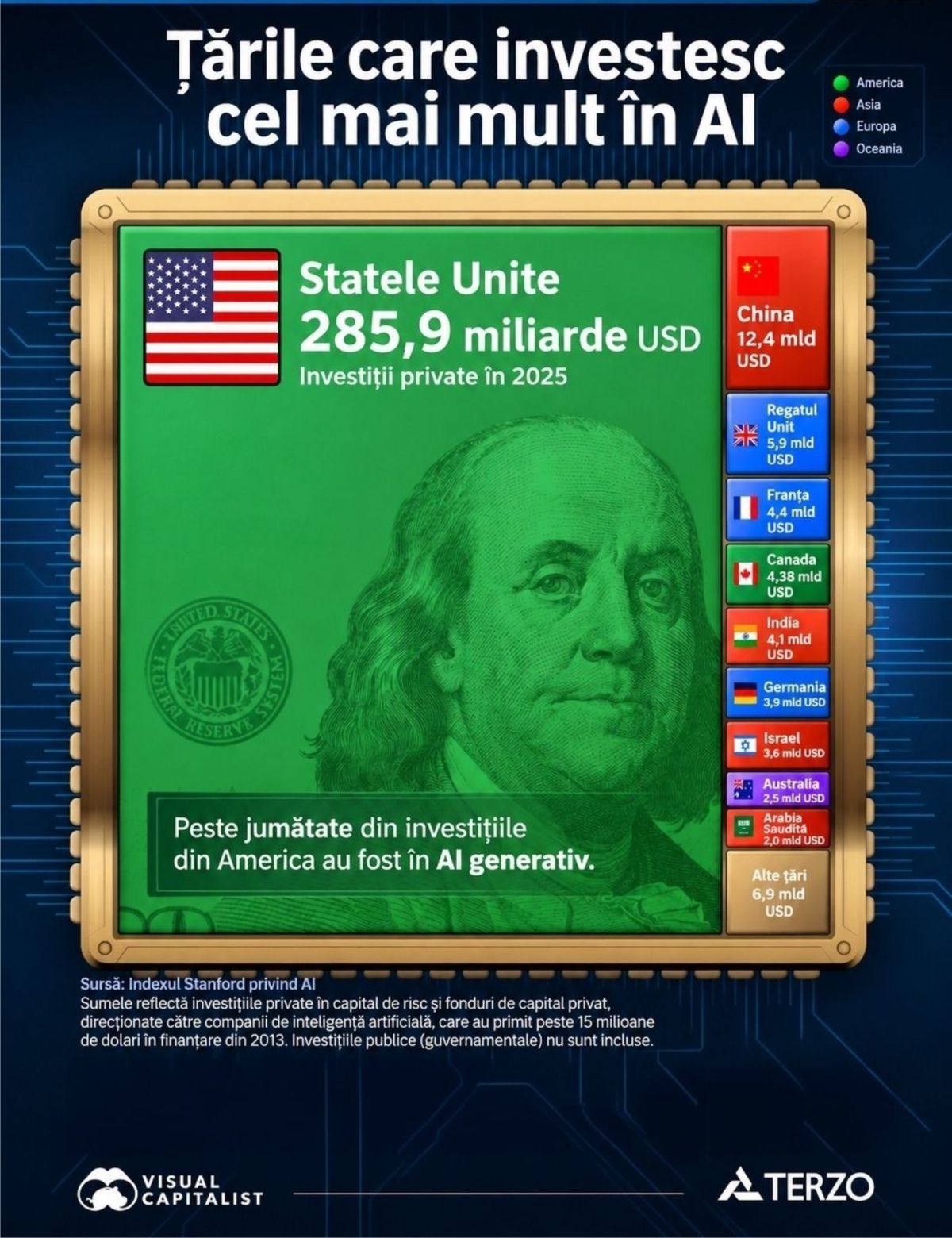
As artificial intelligence (AI) capabilities advance and the competition between the US and China intensifies, billions of dollars are being funneled into AI-related companies globally. Yet, the investment race is far from over. In 2025, the US attracted $285.9 billion in private AI investment-a sum more than 23 times greater than the total recorded by China, according to visualcapitalist.com.
The source presents a ranking of countries attracting the most funding-amid the accelerating global expansion of artificial intelligence-based on the Stanford AI Index. The figures represent private investments-such as venture capital or private equity-directed toward AI companies that have received funding exceeding $1.5 million since 2013.
• The US accounts for 85% of all private funds allocated to AI.
The US leads the ranking, capturing an impressive 85% share of the $336 billion invested in AI globally in 2025. More than half of private investments in the US have been directed toward the generative AI (GenAI) sector. According to Microsoft, this is a branch of artificial intelligence capable of creating new, original content-such as text, images, music, video, programming code, and audio-by learning patterns and relationships from vast amounts of existing data.
The US's significant lead is also reflected in entrepreneurial activity. For instance, in 2025, 1,953 AI-related companies in the US secured funding, compared to 172 in the United Kingdom and 161 in China.
US investments were 23 times higher than those of China-which ranked second-amounting to $12.4 billion. It is important to note that these figures for private investment do not include government-backed funding.
According to Stanford, China invested approximately $184 billion in artificial intelligence companies between 2000 and 2023 through so-called "Government Guidance Funds." These are public-private investment vehicles-established primarily by central, provincial, and local Chinese government agencies-used to channel state capital and mobilize private investment toward strategic and emerging industries.
In this context, data based solely on private investment likely underestimates the total amount that China is investing in AI. The United Kingdom ranks third globally, with $5.9 billion in AI investments in 2025. This position is supported by a solid research foundation, a growing pool of talent in the field, and a thriving startup ecosystem. The rankings for positions 4 through 10 are as follows: France ($4.4 billion), Canada ($4.3 billion), India ($4.1 billion), Germany ($3.9 billion), Israel ($3.6 billion), Australia ($2.5 billion), and Saudi Arabia ($2 billion).
As artificial intelligence becomes increasingly critical to economic competitiveness, the countries that attract the most investment may be the best positioned to shape the next generation of technology.
• BofA: Data center spending to reach $2.1 trillion by 2028
Global spending on data centers is projected to reach $1 trillion by 2026 and double to $2.1 trillion by 2028, driven by the growing demand for artificial intelligence services, according to analysts at BofA Global Research in a report published last month, as cited by Reuters.
Investments in data centers have become a rapidly growing revenue stream for industrial companies that manufacture generators, construction equipment, electrical switches, and cooling systems.
The data center market, valued at $275 billion in 2022, could reach $2.93 trillion by 2030, according to BofA analysts, as reported by Agerpres. Artificial intelligence is considered the primary driver behind this expansion; the brokerage firm estimates that this trend will generate a compound annual growth rate (CAGR) of 37% for the overall market between 2025 and 2030.
Chip manufacturers and server developers are among the main beneficiaries of the AI-driven expansion of data centers, particularly in the United States. Analysts at BofA estimate the construction costs for data centers at $49 million per megawatt, with IT-related expenditures accounting for 78% of total investment. For AI-focused data centers-so-called "Neoclouds"-construction costs rise to approximately $57 million per megawatt; however, these facilities benefit from requiring less physical space compared to traditional data centers.
According to the brokerage firm's estimates, servers represent the most expensive component of a data center, at $31.4 million per megawatt, followed by network infrastructure, which costs $4.8 million per megawatt. The remaining components-such as switches, power distribution equipment, generators, backup power systems, and cooling solutions-range in cost from $100,000 to $1.1 million per megawatt.
• IMF and OECD warn that AI could widen the gap between rich and poor nations
Artificial intelligence could boost global economic growth; however, poor countries, smaller companies, and young workers risk being left behind unless there are improvements in access to energy, digital infrastructure, and skills, according to officials from the International Monetary Fund (IMF) and the Organisation for Economic Co-operation and Development (OECD), as reported by Reuters via Agerpres. This warning, issued in October, comes against a backdrop where massive investments in chips and infrastructure for artificial intelligence (AI) have bolstered global growth and propelled stock markets to all-time highs-while simultaneously raising questions about whether companies can generate sufficient returns to justify their enormous expenditures, especially at a time when borrowing costs are on the rise.
"For many developing economies, the key question is whether they can adopt and disseminate artificial intelligence," stated Era Dabla-Norris, Deputy Director of the IMF's Fiscal Affairs Department, speaking at the Reuters Global Markets Forum.
The IMF estimates that the effective adoption of artificial intelligence could add up to 0.5% to annual global economic growth over the medium term. "However, to date, the evidence regarding productivity at an aggregate level has been much more modest," Dabla-Norris noted.
Meanwhile, the OECD estimates that artificial intelligence could contribute between 0.4% and 1.2% to annual productivity growth across its member countries. Nevertheless, OECD Chief Economist Stefano Scarpetta pointed out that the use of AI in the workplace lags behind its adoption by consumers, with only limited integration into core business functions. "There is a significant gap between exposure to this technology and its actual use," Scarpetta said. The IMF estimates that approximately 40% of jobs worldwide could be exposed to the impact of artificial intelligence.
























 Euro
 Dolar SUA
 Franc elveţian
 Liră sterlină
 Gram de aur





























Reader's Opinion