 English
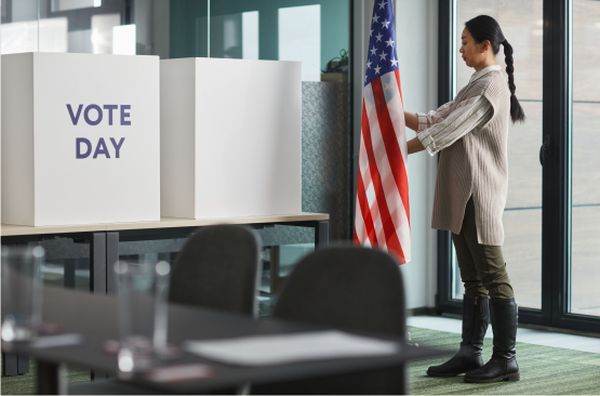
U.S. President Donald Trump is not on the ballot in today's and tonight's elections. Yet, his name looms large over these midterm elections. After nearly two years in office, a period marked by political, financial, and economic controversies centered on him, Americans are now deciding whether to grant his party continued control of Congress, or to empower an opposition ready to block his agenda and scrutinize his administration.
At stake are all 435 voting seats in the House of Representatives and 35 seats in the Senate, including two special elections. On the same day, voters will elect governors in 36 states and three territories, while contests for state legislatures and various referendums provide further impetus for voter turnout. For the individual voter, all of this boils down to very concrete questions: what is the cost of living, how much security does the government provide, and how much trust remains in those in power?
In a parliamentary system, losing a majority can mean losing the government itself. In the United States, however, Trump remains in the White House even if Republicans lose both chambers of Congress. What changes are the individuals with whom he must negotiate and those who can demand accountability. A Democratic victory would place opponents in charge of congressional committees, where they could investigate the administration's contracts, the business dealings of the presidential family, public spending, and military decisions.
The House of Representatives has the authority to demand documents, convene hearings, and subpoena witnesses. The executive branch can challenge these requests, meaning a shift in the majority could also trigger a long series of legal battles. The Senate possesses another lever: it confirms judges and numerous high-ranking officials nominated by the President. If he loses control of it, Trump will have less freedom to select the individuals through whom he exercises his power.
According to information published on the Congress website, for a bill to be enacted, both chambers must approve the exact same text. Losing control of even one chamber would force the Republicans to reach an agreement with the Democrats. However, even if the opposition were to win both chambers, it would not be able to impose any measure it chooses. The President retains the power of veto, and overriding it requires a two-thirds majority in each chamber. In the Senate, ending debate on many legislative proposals typically requires 60 votes, even though a smaller majority can control the institution.
For the same reason, the prospect of a new impeachment proceeding (the process of bringing charges against the U.S. President) should be viewed with a degree of caution. The House of Representatives can vote to impeach with a simple majority, but removing the President from office requires a two-thirds vote of the senators present. There is, therefore, a significant political gap between the opposition's desire to sanction the President and the actual possibility of removing him from office.
If the Republicans hold a majority in both the House of Representatives and the Senate, Donald Trump will continue to seek support primarily from within his own party. If the Democrats win only the House, they will be able to intensify investigations and negotiate legislation, while the Republican-controlled Senate will be able to continue the confirmation process. If the opposition secures the Senate, presidential appointments will become a contentious issue. And if they take both chambers, their oversight of the administration will expand though the President's constitutional powers will remain intact.
Fortunately for the Trump administration, the new members of Congress will not begin their terms until January 3, 2027. Until then, the current lawmakers remain in office, including those who were defeated, and the period between the election and the seating of the new Congress could prove significant for next year's budget and the appointment of high-ranking officials.
For now, the two chambers present different electoral outlooks. Republicans hold 53 Senate seats, Democrats hold 45, and two independents align with the Democratic caucus. The opposition needs a net gain of four seats to secure a majority of their own. In a 50-50 split, Vice President JD Vance can cast the tie-breaking vote in favor of the Republicans. In the House, with all seats filled, the threshold for a majority is 218 seats.
• What the polls say
The final assessment from Fox News points to a Democratic advantage in the House and a toss-up in the Senate. This is a notable signal, precisely because it comes from a media outlet closely aligned with a conservative audience. However, a national advantage must be translated into local victories; votes won in a "safe" district cannot compensate for a narrow defeat in another.
Polls from The New York Times/Siena Research Institute, published on November 1, highlight several challenging races for the Republicans. In Alaska, Mary Peltola is at 48% compared to 46% for Dan Sullivan, while in Iowa, Josh Turek is at 48% and Ashley Hinson is at 47%. In Kansas, Adam Hamilton is polling at 49%, while Roger Marshall is at 44%. In Maine, Troy Jackson stands at 51%, compared to 45% for Susan Collins. Polls indicate 53% for Abdul El-Sayed and 42% for Mike Rogers in Michigan; 49% for Sherrod Brown and 44% for Jon Husted in Ohio; and 50% for James Talarico and 43% for Ken Paxton in Texas.
These figures come from the same series of polls, each with its own distinct sample and margin of error. Especially where the gap is only one or two points, voter turnout could shift the standings. Even a string of leads for the Democrats can be misleading if the polls share the same estimation error. For Republicans, the mere fact that they must defend seats once considered safe consumes time and resources that could have otherwise been used to challenge the opposition.
Democrats, for their part, head into Election Day with visible rifts. According to Reuters, in Michigan, Haley Stevens, who was defeated by Abdul El-Sayed in the primary, has endorsed the Republican candidate, Mike Rogers. The dispute touches on issues including Israel and campaign messaging. Stevens stated that she was no longer welcome in her former opponent's campaign, while the party leadership reaffirmed its support for El-Sayed. Her endorsement does not automatically shift votes to Rogers, but it illustrates the extent of internal conflict within a party that is, ostensibly, united by its opposition to Trump, the source notes.
High early voter turnout adds further tension to the final stretch of the campaign. The Guardian reports record-breaking figures for the midterm elections in North Carolina, Texas, South Carolina, and Georgia; however, high voter turnout does not necessarily reveal how people are voting. Declared party affiliation does not compel a voter to support their own party's candidate, and preferences regarding early voting vary between the two sides.
• What the midterm elections mean for ordinary American citizens
Beyond electoral strategies, the Trump Administration is being put to the test by citizens in areas where politicians might least expect it: while shopping, paying rent, or renewing health insurance. Data from the Bureau of Labor Statistics (BLS) shows an annual inflation rate of 3.7% in the U.S. for September, up from 3.4% in August, with a monthly price increase of 0.6%. Gasoline prices rose by 9.1% in a single month, accounting for more than half of the overall monthly increase in the index. If food and energy price hikes are excluded from the inflation calculation, the annual inflation rate stands at 2.6%.
For a family, a slowdown in inflation does not mean a return to the prices of the past. What matters is what remains to be spent after bills are paid, especially since, as The Guardian notes, some voters are forced to choose between medical treatment and food. While such personal experiences cannot replace statistics, they explain why optimistic assessments from Washington may carry little weight within an individual household.
Costs and prices play a significant role in this discontent. These are paid at customs by importers, and the cost can be shared among firms, suppliers, and consumers. The cost is not always passed on entirely to the buyer, nor is it automatically borne by the exporting country. For companies, another issue arises: how can they make investment plans if they do not know how long the tariffs will remain in place or which products might be targeted next?
On February 20, 2026, the Supreme Court rejected the use of the International Emergency Economic Powers Act (IEEPA) as the legal basis for the widely contested tariffs. Reuters reported that, by the end of July, approximately $100 billion in refunds, including interests, had been processed. The administration subsequently turned to other legal grounds. The ruling limited one of the president's tools, though it did not eliminate all U.S. customs duties.
Healthcare also links daily life to major budgetary decisions. The tax and spending legislation enacted on July 4, 2025, combines tax adjustments, changes to social programs, and additional expenditures for other priorities. The Congressional Budget Office (CBO) estimates an impact of approximately $4.2 trillion on deficits over the 2025-2034 period, accounting for interest and macroeconomic effects.
Proponents of the legislation point to the investments and economic activity spurred by the tax cuts. Opponents criticize how the benefits are distributed and the scaling back of social programs. For the average voter, the dispute becomes personal when it affects their health insurance; for the investor, it becomes significant when it alters the government's borrowing requirements and the outlook for interest rates. Donald Trump does not set every price, but he bears political responsibility for the measures adopted and the promises made. In an analysis by the Associated Press ahead of today's vote, tariffs and the conflict involving Iran complicate the Republicans' efforts to distance themselves from economic discontent.
• The battle for votes has also played out in the courts
The outcome also depends on the rules by which votes are translated into seats. The drawing of electoral district boundaries can concentrate a party's voters concentrated in a few districts or dispersed, such that groups with similar national-level support end up with different levels of representation. According to Reuters, an April ruling by the Supreme Court regarding Louisiana's electoral map narrowed the scope for challenging districts on the grounds of racial discrimination. The immediate effect favored the Republicans; beyond this specific election, the dispute concerns the protection of minority representation.
In Alaska, a legal battle arose even before the votes were counted. According to Reuters, the Trump administration sought to block the certification of a potential defeat for Senator Dan Sullivan, citing issues related to votes cast for a candidate with a similar name. On November 1, Judge Sharon Gleason dismissed the case, noting, among other reasons, that the federal government lacked the legal standing to sue. The Department of Justice has announced its intention to appeal. The ruling addresses the issue of federal intervention; it does not, in itself, resolve all allegations concerning the candidate with the similar name.
Mail-in voting and citizenship verification have emerged as further points of contention. Verification processes are intended to prevent legal violations, yet they must not hinder eligible voters from casting their ballots due to flawed voter rolls or disproportionate measures. The Chinese news agency Xinhua framed the disputes in California and Alaska as evidence of the partisan use of the judicial system.
The campaign is also unfolding in an environment where the creation of a compelling image has become inexpensive. Yesterday, Xinhua published an analysis on the use of artificial intelligence-generated content in American political advertising. According to the cited source, forgeries can deceive voters, but they can also provide an alibi for those caught in an authentic recording: any inconvenient image can be dismissed as artificial, making the source and context crucial.
Ultimately, voters may choose to penalize the Trump Administration for issues such as prices, specific policies, conflicts of interest, or general conduct. Should the Democrats win, they will need to translate their pledges to conduct investigations into precise inquiries, backed by documentation and substantiated conclusions. If the Republicans retain their majority, they face the same obligation regarding their own party's administration. Parliamentary oversight loses its purpose if it is exercised solely against political opponents.
Today and tonight, Americans will decide who leads congressional committees, who sets the agenda for hearings, and who has the power to compel the Trump Administration to provide public accountability. Donald Trump remains president. What may change is the degree of difficulty he faces in governing without having to provide explanations.
























 Euro
 Dolar SUA
 Franc elveţian
 Liră sterlină
 Gram de aur





























Reader's Opinion