English


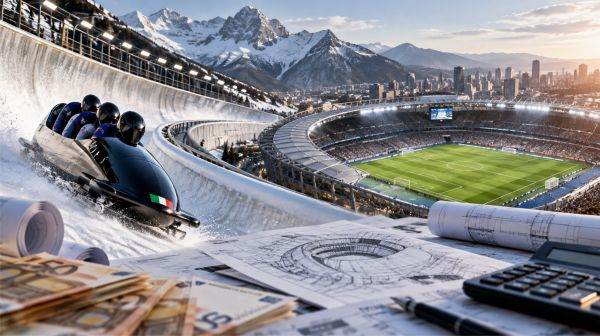
Elite sports have never lacked funding. However, in 2026, several projects and competitions reignited an uncomfortable question: who actually pays, and who benefits from these investments? From Olympic infrastructure in Italy and publicly funded stadiums in Romania to the hosting of the football World Cup in North America, high costs and unequal revenue distribution have fueled the debate regarding the economic efficiency of major sporting events.
• The Cortina Olympic track: nearly three times the initial cost estimate
At the Milan-Cortina 2026 Winter Olympics, the bobsleigh, skeleton, and luge events took place on a rebuilt track in Cortina d'Ampezzo. The project cost reached approximately euro118 million, compared to the initial estimate of euro41.7 million.
The International Olympic Committee (IOC) had suggested using existing tracks in Austria or Switzerland, but Italian authorities opted to rebuild the infrastructure in Cortina. The project faced criticism due to its high costs and uncertainties regarding its long-term use. Sliding-sport tracks require specialized maintenance, and keeping them operational after the competitions end can entail significant public expenditure. Among the arguments supporting the investment, organizers cited the track's potential use during the 2028 Winter Youth Olympic Games. However, it remains to be seen to what extent the infrastructure can be utilized afterward to justify construction and maintenance costs. The experience of past Olympic Games suggests a need for caution. The bobsleigh track built for the 2006 Turin Olympics was subsequently abandoned, serving as an example of the challenges associated with specialized sports infrastructure, where post-competition usage can be limited.
• Stadiums in Romania: Investments Lacking Financial Viability
Romania has its own list of sports investments that raise questions regarding financial performance. According to a study conducted by USR MP Brian Cristian, the stadiums analyzed are operating at a loss, with the gap between revenue and expenses approaching 50 million lei annually. The study was based on data requested from the institutions that manage these sports arenas. The findings highlight issues concerning operating costs and the ability of administrators to generate sufficient revenue to cover expenses. Despite these challenges, projects to build new arenas are moving forward. The estimated cost for the Dinamo Stadium is approximately 170 million euros, while the planned arena in Timişoara is projected to cost around 165 million euros. Such investments may be justified by factors beyond commercial profitability, such as sports infrastructure development, public access to competitions, or urban regeneration. However, for projects funded by public money, annual operating costs and future revenue sources should be analyzed alongside the initial investment. The issue is not merely the cost of building a stadium, but also the amount authorities must pay to keep it running after its inauguration.
• The 2026 World Cup: global revenues, local expenses
The football World Cup hosted by the United States, Canada, and Mexico was billed as a record-breaking revenue event. FIFA announced earnings of approximately $11 billion, while local authorities had to fund a significant portion of the preparations and services required to stage the tournament. An analysis published by ProPublica, in collaboration with the "Houston Chronicle"and "The Texas Tribune", reveals that agreements with several host cities shifted significant responsibilities onto them regarding security, stadium upgrades, and the organization of fan zones. In contrast, the cities had limited access to some of the revenues generated directly by the matches, including those from tickets, concessions, merchandise, and parking. This situation raises questions about the distribution of economic benefits: FIFA reaps global revenues, while local authorities must cover expenses that are not always offset by direct income. Proponents of hosting such events, however, point to the positive impact on tourism, services, and international visibility.
In Kansas City, state and local public funds contributed to financing the preparations. At the level of host cities, however, assessing profitability remains difficult, partly because contracts are not always fully public.
In Canada, costs have risen significantly compared to initial estimates. On For Vancouver, estimates published in 2024 indicated gross expenditures of CAD 483-581 million, covering city and provincial costs as well as stadium upgrades. These figures were nearly double the initial projections. Authorities later clarified that revenues and government contributions would reduce the net cost borne by the province.
The World Cup case illustrates the challenge of balancing the global organizer's commercial revenues against the public costs incurred by host cities. Even when a competition generates economic activity, it does not automatically mean that authorities fully recoup their expenditures.
• The bill beyond the spectacle
Major sporting events can bring tourism benefits, infrastructure investment, and international visibility. However, these advantages do not eliminate the need to assess total costs, maintenance expenses, and revenue-sharing arrangements. For authorities and organizers, the real test begins after the competition ends-when infrastructure requires maintenance, expenses must be covered, and promised benefits must be weighed against actual outcomes.






















 Euro
Euro Dolar SUA
 Franc elveţian
 Liră sterlină
 Gram de aur