 English


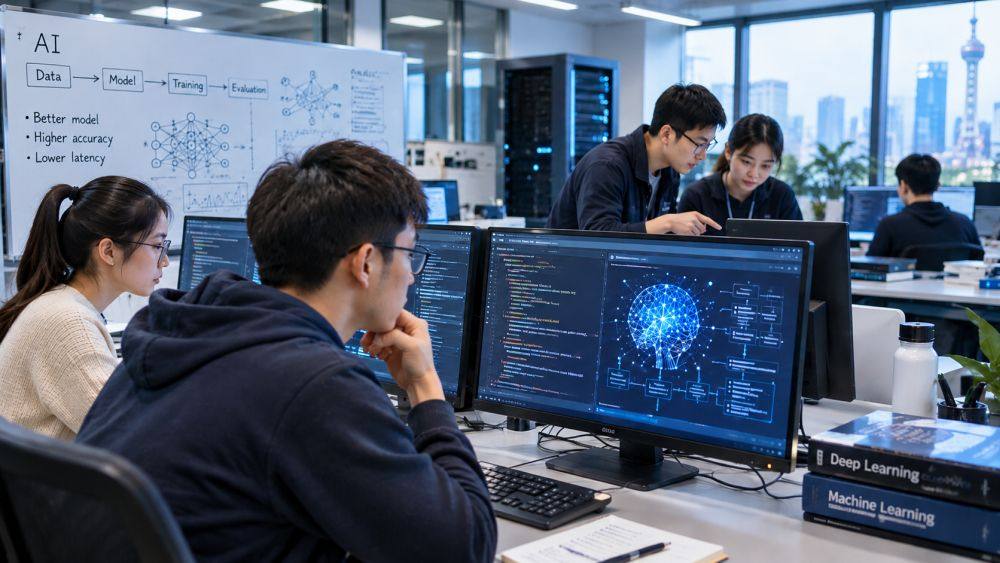
Chinese entities are resorting to increasingly sophisticated methods to use the outputs generated by the most advanced American artificial intelligence models to train their own systems. This strategy is part of Beijing's efforts to strengthen its AI capabilities and limit the effects of restrictions imposed by the United States on China's access to advanced chips, Reuters reports.
According to the cited source, an analysis covering more than 300 academic papers, patents, corporate documents, recruitment advertisements and Chinese government materials shows that the technique known as "distillation" has moved beyond university experiments and become a widely used practice in industry.
The documents indicate that Chinese researchers use American models to obtain answers to complex questions, generate computer code and identify solutions to difficult problems. Chinese companies subsequently develop programs that automate these operations, while specialized personnel prepare the information obtained to train smaller domestic models.
At the same time, authorities in Beijing are encouraging the use of distillation to reduce the costs of artificial intelligence and facilitate its implementation in China's manufacturing sector.
Distillation is not an illegal practice and is also used in other regions of the world. Although the method does not allow the full replication of an advanced model's capabilities or eliminate the need for high-performance computing infrastructure, it facilitates the transfer of certain capabilities to smaller systems with lower operating costs.
The expansion of this practice in China could reduce the effectiveness of American restrictions on exports of advanced semiconductors, as Chinese developers can acquire new AI capabilities by leveraging the performance of models created by American competitors. Washington announced new measures on Monday to limit China's access to chips produced by companies such as Nvidia.
• Distillation becomes a new source of dispute between Washington and Beijing
The use of this technology has become a sensitive issue in relations between the world's two largest economies ahead of the Asia-Pacific Economic Cooperation (APEC) summit, scheduled for November 18-19 in Shenzhen. US President Donald Trump and his Chinese counterpart Xi Jinping are expected to attend the meeting.
In September, American authorities publicly accused Chinese companies of conducting aggressive and highly targeted distillation operations on an industrial scale, using artificial intelligence models developed in the United States.
The issue had also been addressed during discussions held in July in Chengdu between representatives of the US Department of Commerce and Chinese regulators. According to three people familiar with the meetings, American officials expressed concern about the systematic collection of outputs generated by American models, warning that certain activities could constitute intellectual property violations.
Chinese representatives argued that distillation is a common method of artificial intelligence development and expressed willingness to intervene in cases where intellectual property violations are identified. However, they made no concrete commitments, according to a US official familiar with the details of the previously unreported discussions.
The US Department of Commerce and the Cyberspace Administration of China did not respond to Reuters' requests for comment.
• How the outputs of American models are transformed into tools for Chinese developers
The distillation process involves using a high-performance model, known as a "teacher", which generates answers or demonstrates ways of completing tasks. The resulting information is then used to train a smaller system, known as a "student" model.
For Chinese developers, who face computing capacity limitations, the main advantage lies in the possibility of repeatedly leveraging the result of a single costly query, a former Alibaba Group engineer explained on condition of anonymity.
Thus, an American model can provide the solution to a complex problem once, and the Chinese team can retain the relevant examples and subsequently use them to train its own system, without constantly relying on the original provider.
A study published in November 2024 by researchers at Shanghai Jiao Tong University describes the selection of approximately 5,000 responses generated by OpenAI's o1 model. These were translated using GPT-4o mini and transformed into a set of 10,750 bilingual examples, used for additional training of the Qwen2.5-72B model developed by Alibaba.
The authors of the research warned, however, that excessive dependence on distillation could limit original innovation, as developers risk becoming dependent on advances made by companies producing the most advanced models.
The project demonstrates how outputs provided by American systems can be transformed into reusable data, helping improve Chinese models without the need for repeated queries.
A more systematic approach was presented by Alibaba researchers in an April 2025 study. They used GPT-4 and GPT-4o, developed by OpenAI, to generate training materials in languages other than Chinese, after which they refined and evaluated the responses before using them to train smaller versions of the Qwen models.
In February 2026, researchers from Shanghai Jiao Tong University and Chinese food delivery company Meituan presented another application of the method. They used GPT-4o to develop plans for coordinating AI agents involved in solving programming problems, thereby contributing to the training of a smaller model capable of organizing such activities.
• The United States cites intellectual property risks, while China promotes the industrial use of AI
Distillation practices also raise questions regarding compliance with the commercial terms imposed by American artificial intelligence developers.
OpenAI restricts, through its terms of use, the use of outputs generated by its own models to develop competing systems, with certain exceptions. Anthropic likewise imposes restrictions on training rival models without authorization.
A US official familiar with the Chengdu discussions stated that Washington considers industrial-scale distillation the main reason why Chinese artificial intelligence models have narrowed the performance gap with American models.
This interpretation is disputed by two people familiar with the work of Chinese developers. According to them, distillation represents only one of the factors that have contributed to the progress of China's AI industry, alongside improvements in engineering, algorithms, data quality and model architecture.
Chinese government documents do not contain explicit instructions encouraging companies to distill American models. However, authorities promote this technique as part of the national strategy to expand the use of artificial intelligence in the economy.
A national policy package entitled "AI+Manufacturing", published in January by eight Chinese government institutions, includes recommendations on training, fine-tuning and distilling models intended for industrial applications.
Authorities in Shanghai and Shenzhen have also encouraged the adoption of technologies that reduce computing power requirements.
These initiatives reflect Beijing's objective of introducing smaller and more affordable AI systems into a wide range of economic activities, particularly in industry.
Against the backdrop of growing geopolitical sensitivities associated with distillation, Chinese artificial intelligence developers have sought clarification from the national industry regulator in recent months.
Companies are trying to establish the boundaries between the ordinary use of foreign models and the organized collection of their outputs for the purpose of training competing systems, the cited source reports.
The administration of US President Donald Trump announced new restrictions on Monday aimed at limiting China's access to advanced artificial intelligence chips produced by companies such as Nvidia. The measures were presented in the context of the White House leader's trip to China, where he is scheduled to hold talks with President Xi Jinping, according to Reuters.
The new initiative by the US Department of Commerce seeks to intensify oversight of overseas data centers and combat the smuggling of high-performance semiconductors. The decision comes amid growing criticism regarding the effectiveness of measures adopted so far by American authorities to prevent the transfer of sensitive technologies to China.
The new regulations restrict shipments of advanced chips to Southeast Asian countries such as Malaysia, Singapore and Thailand, where Chinese companies have used computing infrastructure to obtain the computing power needed to train artificial intelligence models.
At the same time, American authorities are introducing additional requirements for data centers outside the United States that provide significant amounts of computing power to companies headquartered in China.
The publication of the new rules comes just days after the resignation of Nvidia CEO Jensen Huang, following reports of an extramarital relationship with a woman suspected of having ties to Chinese intelligence services. She worked for Megaspeed, a Singapore-based cloud services company and Nvidia partner that rents out computing capacity through its own data centers.
Megaspeed came under the scrutiny of American authorities amid suspicions regarding the possible illegal diversion to China of advanced chips intended for artificial intelligence applications.
John Moolenaar, the Republican chairman of the House Select Committee on China, stated that the new regulations send a clear signal regarding Washington's intention to eliminate vulnerabilities in the export control system, which he claims have been exploited by Beijing for several years.
Under the new provisions, Singapore, Thailand, Malaysia, Indonesia and Brazil are considered countries where there is a high risk that advanced semiconductors could be diverted to China.
Consequently, exports of chips covered by the regulations to these five countries will require a license from American authorities.
However, the new obligations do not apply to American companies operating data centers in the five countries, as they are exempt from the additional authorization requirements.
















 Euro
 Dolar SUA
 Franc elveţian
 Liră sterlină
 Gram de aur























Reader's Opinion