 English
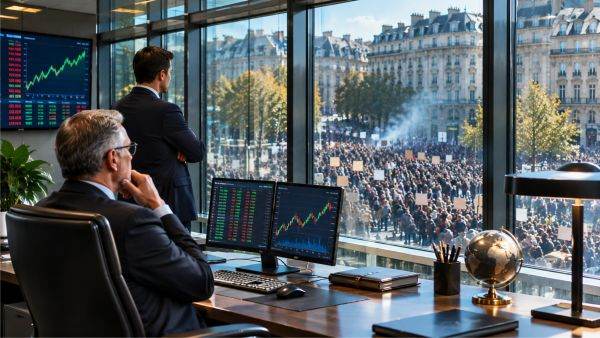
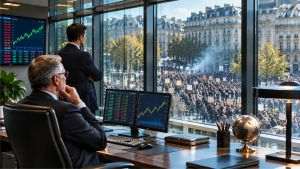
European markets fluctuated yesterday, following Friday's collapse in technology stocks. Investors shifted their attention toward Apple's financial results, dynamics in the oil market, and developments concerning the war in Iran. Consequently, the violent protests occurring across the region do not appear to be impacting European stock exchanges at this time.
The CAC 40 index-representing the French stock market, where some of the most intense protests have been taking place for several weeks-rose by 0.3% as of 14:52 local time, while Germany's DAX index, also affected by demonstrations, climbed 0.2%.
Italy's FTSE MIB index gained 0.5% by 15:11, and Spain's Ibex 35 rose by 0.8%. Conversely, Poland's WIG30 index fell by 1.3% at 14:58, as the country grapples with a political crisis.
Eurozone government bonds saw a slight decline following last week's gains, with investor sentiment remaining fragile amid concerns regarding France's fiscal outlook.
• New Student Protests in France
Yesterday, French students blocked the entrances to dozens of high schools across the country, resuming protests-albeit on a smaller scale-following the two-week school break, according to The Independent. By 08:30 GMT, 41 educational institutions had been blocked, including in Paris, Marseille, and Rennes. However, the disruptions were less extensive than those seen during the autumn break, when hundreds of schools were blocked.
In Lille, near the Belgian border, individuals were seen throwing trash cans into a fire lit in front of the Montebello International High School, all while police officers equipped with protective shields looked on.
In the southern port city of Marseille, students blocked the entrance to a school using trash containers, after talks held last week between student representatives and the government failed to resolve their differences.
"We've resumed the movement because, theoretically, we did receive some responses, but... it's clear that it's not enough," a 16-year-old student told the AFP news agency. Last week, Minister of Education Edouard Geffray proposed capping class sizes at a maximum of 28 students, allocating 4 billion euros for school renovations, and creating 15,000 new higher education places-along with a new admissions system-by 2028.
However, student representatives-who have been protesting since September 17th against conditions in their classrooms-stated that these proposals are insufficient and that they will continue their protests.
On Saturday evening, at the end of the third weekend of nationwide demonstrations, incidents occurred in Paris and several other French cities. Law enforcement intervened to disperse small groups of violent protesters following the march in Paris, while tear gas was used in Lyon and Toulouse, in the southwest of the country.
It is worth noting that a wave of protests by so-called "Generation Z" has swept across several European countries this autumn-including Germany, Italy, Belgium, and Albania-fueled by grievances regarding issues such as the cost of living, the poor state of schools, the deterioration of public services, and corruption.
• Threats of severe sanctions in Germany
German ministers have threatened severe sanctions against those who looted and caused damage to shops over the weekend, following protests in which tens of thousands of people took to the streets across dozens of cities to demand a better education system and a lower cost of living, according to the cited source. In Frankfurt, the country's financial hub, individuals with their faces covered caused damage to 17 shops-five of which were looted-Roman Poseck, the Interior Minister of the state of Hesse, stated during a press conference on Sunday. More than 100 police officers were injured during the clashes, and 54 people were arrested.
Yesterday, German Chancellor Friedrich Merz called for a firm response against those responsible for the violence during the weekend's unrest. According to DPA, the Chancellor stated: "Violence has no place on our streets, and my government will show zero tolerance in this regard. Anyone who attacks police officers and emergency service personnel, or loots shops, is attacking our freedom and mocking both society and the legitimate interests of young people. Those who break the law will face its full force."
• Wage Dispute in Germany
Employees in the German engineering and metalworking industry launched warning strikes on Sunday as part of a wage dispute involving approximately 3.7 million workers. The trade union IG Metall is demanding a 5% pay increase, while companies face mounting economic difficulties-particularly in the automotive sector-reports Reuters, via news.ro.
The initial protests began at midnight, when about 300 employees from the Rasselstein division of the industrial group Thyssenkrupp, joined by workers from nearby companies, temporarily halted operations, according to IG Metall. The actions were initiated after the union rejected an offer from employers presented during the second round of wage negotiations. The employers had proposed a one-off payment equivalent to 1% of annual gross salary, to be paid in the summer of 2027, followed by a 1.3% wage increase starting in July 2028.
IG Metall deems the proposal unacceptable, arguing that it would amount to a pay cut in real terms once inflation is taken into account. The union is seeking a 5% increase in remuneration over a 12-month period, according to union representative Marc Winter, who also chairs the works council at Thyssenkrupp Rasselstein. Jorg Kohlinger, head of the central district for the IG Metall union, warned that the protest at Thyssenkrupp is merely the beginning of a broad wave of warning strikes, intended to increase pressure on employers to improve their wage offers.
The union has announced that further temporary work stoppages will take place in the coming days across the states of Hesse, Rhineland-Palatinate, Saarland, and Thuringia. Negotiations are unfolding against a challenging backdrop for German industry, which is currently grappling with a crisis in the automotive sector and mounting pressure on production costs.
• Political crisis in Poland
Poland is facing a political crisis. According to international media, conservative President Karol Nawrocki and pro-European Prime Minister Donald Tusk are accusing one another of violating the Constitution. The opposition, which supports President Nawrocki, accuses the ruling coalition of attempting a coup d'etat and seeking to remove Nawrocki from office.
Meanwhile, a dispute over judicial independence, the appointment of judges, and control of the Constitutional Tribunal has sparked massive protests, necessitating police intervention and prompting international calls for calm. The European Commission-which supports the Tusk government-has also intervened.
Against this backdrop, hundreds of Poles spent the night of October 31 to November 1 outside the Constitutional Tribunal in Warsaw, though no major confrontations occurred. Police maintained a security presence following earlier incidents that resulted in the detention of three individuals.













 Euro
 Dolar SUA
 Franc elveţian
 Liră sterlină
 Gram de aur





























Reader's Opinion