 English


September found Romania in the same state of limbo that marked the end of summer: a dismissed government forced to handle issues beyond the scope of an interim cabinet, political parties unable to form a majority, and an economy where every political delay risked translating into additional costs. The nomination of Siegfried Mureşan offered a prospect for ending the deadlock, but the vote on September 30 ended the month with a new failure. The proposed cabinet secured only 182 votes-51 short of the number required for investiture. By month's end, 148 days had passed since the dismissal of the Bolojan government. Compounding this crisis was a scandal sparked by international media reports concerning the US Ambassador to Greece, Kimberly Guilfoyle, and the promotion of American liquefied natural gas in the region. Statements attributed to the diplomat regarding the potential ousting of governments, her meetings with Romanian politicians, and disputes over the advisability of gas purchases shifted the debate from the commercial realm to issues of sovereignty and political accountability. However, journalistic confirmation of certain statements did not amount to proof of American intervention in the dismissal of the Bucharest government. On the streets, the sheep farmers' protest demonstrated how quickly economic grievances can merge with political radicalization. Within state institutions, the reform of state-owned companies brought to light a portfolio of nearly 1,900 enterprises, over a thousand of which met the criteria for restructuring analysis. Meanwhile, at the Ministry of Finance, efforts to correct the deficit continued alongside pressures stemming from interest payments, subsidies, and outstanding obligations to energy suppliers.
The budgetary picture remained the authorities' primary selling point: the eight-month deficit dropped to 2.89% of GDP, and investment spending rose. However, the state had already paid 42.05 billion lei in interest, the National Bank of Romania's foreign exchange reserves had shrunk by 4.805 billion euros in a single month, and the impending deadline for the National Recovery and Resilience Plan (PNRR) forced institutions to work under the pressure of the final payment request. Romania ended September with a visible fiscal adjustment but an unresolved political issue.
• Siegfried Mureşan: Prime Minister-designate without a secure majority
Following the withdrawal of Eugen Tomac and the rejection of the Adrian Veştea Cabinet, President Nicuşor Dan turned to Siegfried Mureşan to form a new government. The candidate's European experience and negotiating skills were the key arguments for his nomination; however, consultations at Cotroceni Palace had failed to yield an agreement among the parties. The PSD claimed the premiership, the PNL and USR supported Mureşan, while AUR made its support conditional on its own participation in the government. The UDMR warned that the prime minister's profile could not substitute for a parliamentary majority. Options involving a technocratic prime minister or successive minority governments were also discussed, yet none of these variants resulted in an agreement.
The nomination thus shifted the political test to Parliament. Nicuşor Dan criticized the parties' electoral preoccupations and emphasized the need for a government capable of passing the budget revision. Siegfried Mureşan agreed to attempt forming the Cabinet but faced the same obstacle that had blocked previous attempts: the support pledged by certain parties was insufficient for investiture.
Hearings held on September 28 and 29 revealed the limited willingness to compromise. On September 30, the Mureşan Cabinet was rejected by the plenary session of Parliament. The 182 votes in favor confirmed that negotiations had failed to overcome opposition from the PSD and AUR. Romania remained dependent on an executive with limited powers precisely during the period when the budget for the following year was being prepared. The debate pitted two interpretations of economic adjustment against each other. Supporters of the Cabinet presented the reduction of waste and state reform as prerequisites for recovery, whereas the PSD characterized the continuation of Bolojan's policies as a perpetuation of austerity, and AUR called for early elections. Kelemen Hunor, the UDMR leader, warned that society was losing both patience and confidence. The failure to confirm the government did not suspend the state's economic obligations. Payments, projects, and the preparation of budgetary decisions had to continue, while any measure exceeding the interim administration's mandate depended on fresh parliamentary negotiations.
• The Guilfoyle Scandal: US gas at the heart of the political crisis
On September 26, the Wall Street Journal published an article about a discussion held in Athens in March between Kimberly Guilfoyle and the Greek Minister of Energy. According to the report, the ambassador allegedly referred to the imminent fall of the Romanian government and the US's capacity to bring about such changes in other countries. The diplomat's lawyer disputed the description of the conversation. The "Financial Times" later independently confirmed the statement attributed to the ambassador and placed the conversation at a dinner on March 18. However, the publication noted that it was unclear whether Guilfoyle had advised the Social Democrats to leave the government. This distinction remains crucial: reporting a claim about political influence and demonstrating the actual exercise of that influence are two different things. Images from the March 31 meeting at the Isoletta restaurant-attended by Sorin Grindeanu, Bogdan Ivan, presidential advisor Florin Vlădică, and Guilfoyle-fueled the controversy. Grindeanu maintained that the discussions focused on the Vertical Corridor and rejected the allegations, while George Simion denied the existence of any such agreements.
The government stated that no discussions had taken place between the Prime Minister's Chancellery and the ambassador, and that no document committing Romania to liquefied natural gas (LNG) purchases had been approved. The executive distinguished between the development of transit infrastructure and the actual purchase of gas.
Beyond the diplomatic statements, the controversy highlighted the economic terms of a potential purchase. According to documents presented by the domestic media, Romgaz had rejected a proposal to purchase American LNG in December 2025, estimating that the terms could have resulted in annual losses of euro50-300 million. Media reports indicate that Energy Minister Bogdan Ivan attempted to persuade the company again in February-albeit unsuccessfully-and that the Ministry of Energy's Control Body initiated an inspection at Romgaz that same month. The company confirmed the start of the inspection on February 16, noting that its objective was to review the investment at Iernut. In a statement issued on September 28, Romgaz explicitly denied that any Romanian official had exerted pressure to conclude a gas purchase or sale contract. The company cited corporate governance rules and the practice of basing decisions on economic, commercial, and strategic criteria.
• Deficit drops by nearly RON 27 billion; interest payments reach RON 42 billion
The eight-month budget execution report, presented by the Ministry of Finance on September 26, confirmed the ongoing fiscal adjustment. The consolidated general government deficit stood at RON 59.42 billion, down from RON 86.36 billion during the same period in 2025. This represented a nominal reduction of RON 26.94 billion (approximately 31%), with the deficit-to-GDP ratio falling from 4.51% to 2.89%. Total revenues rose by 11.4% to 468.10 billion lei, while expenditures increased by 4.2% to 527.53 billion lei. VAT receipts reached 103.35 billion lei, 25.2% above the level recorded in the first eight months of 2025. Tax revenues totaled 242.69 billion lei, and funds received from the European Union and other donors rose by 37.7% to 43.38 billion lei.
Personnel expenses decreased by 4.26 billion lei, falling to 109.04 billion lei. Investments climbed from 71.95 billion lei to 97.05 billion lei, an increase of 25.1 billion lei. European funding and the NRRP (National Recovery and Resilience Plan) supported this trend, offsetting the reduction in investments from national sources.
However, debt pressure continued to rise. Interest payments totaled 42.05 billion lei-an increase of 8.86 billion lei, or 26.7%, over the 2025 level. This amount was nearly equal to the total revenue from wage and income taxes, which stood at 42.86 billion lei. While deficit correction improved the current situation, an increasingly large share of state resources remained consumed by debt servicing.
• NRRP: Awaiting the final payment request
The report presented to the Government on September 3 outlined the status of the NRRP following the deadline for completing investments and reforms. The first four payment requests had been submitted and assessed; however, regarding the third request, euro869.81 million remained suspended due to six milestones not having been satisfactorily met.
The fifth request, submitted on August 14, covered 75 targets and milestones and had a net value of euro2.085 billion. For the final request, authorities indicated a deadline of September 30 and a net value of euro4.348 billion, comprising euro2.582 billion in grants and euro1.765 billion in loans.
Together, the two requests amounted to approximately euro6.43 billion. Their value did not equate to funds already received, and the announced timeline for the final request did not, in itself, confirm its submission or approval. Payment was contingent upon the European Commission's assessment and the fulfillment of the agreed-upon conditions.
Against this backdrop, the extension of the interim mandate maintained the separation between project administration and executive authority to adopt the necessary legislative reforms. The state had to close a key investment program at a time when it remained impossible to build a political majority to steer it.
On September 30, the Government officially submitted the final payment request under the NRRP to the European Commission, amounting to euro6.04 billion before the deduction of pre-financing. According to the Ministry of Investments and European Projects, the net amount requested by the country is euro4,347,770,169: euro2,582,415,100 in non-repayable European funds and euro1,765,355,069 in the form of a loan.
• Foreign exchange reserves drop by euro4.8 billion in one month
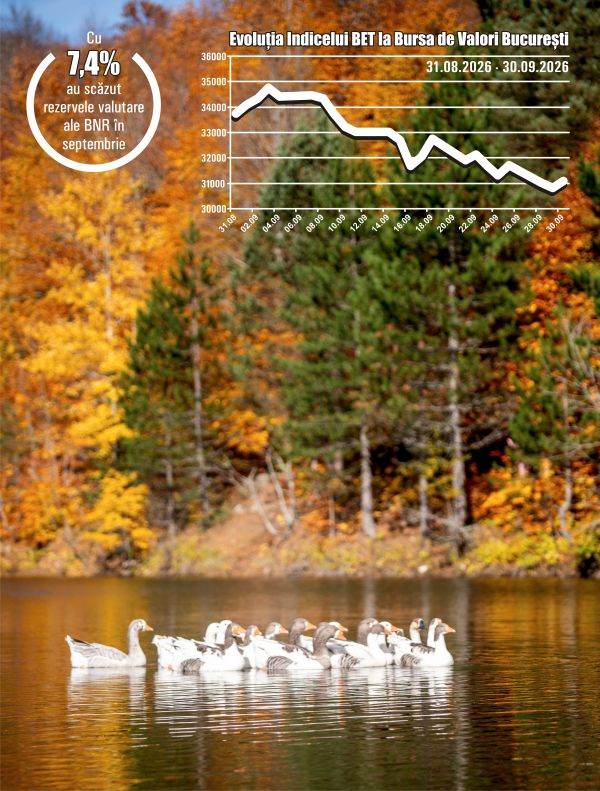
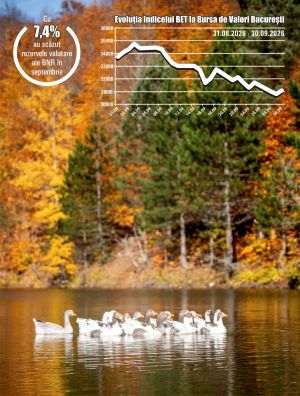
As of September 30, the National Bank of Romania's (BNR) foreign exchange reserves stood at euro60.06 billion, down from euro64.865 billion at the end of August. The reduction amounted to euro4.805 billion, or approximately 7.4%, in a single month.
The BNR reported inflows of euro3.302 billion and outflows of euro8.107 billion. These operations included changes in banks' minimum foreign currency reserves, movements in the Ministry of Finance's accounts, and payments from the European Commission's account. Principal and interest payments on foreign-currency public debt accounted for approximately euro2.684 billion of the outflows. Data published by the NBR does not allow the entire decline to be attributed to a single cause.
Gold reserves remained at 103.6 tonnes, valued at euro12.280 billion. Total international reserves-comprising foreign currency and gold-fell from euro77.627 billion to euro72.340 billion. For October, foreign-currency public debt payments due were estimated at approximately euro350 million.
Also in September, the NBR published its annual survey on foreign direct investment for 2025, showing a net inflow of euro7.907 billion and a stock of euro134.823 billion at the end of that year. Earnings realized by non-resident investors amounted to euro11.493 billion. These figures describe the previous year and the economy's investment base, without indicating a rebound in flows in September 2026.
• Over one thousand state-owned companies subject to restructuring analysis
On September 18, the Government received the preliminary results of an inventory of public enterprises. Out of a total of 1,868 companies, 1,098 met the technical criteria for an analysis regarding restructuring and portfolio reduction. A total of 533 enterprises-representing 28.5% of the total-had failed to submit their financial statements for the previous year on time.
Meeting these criteria did not imply the automatic closure of the companies. The supervising authorities were required to provide a rationale for either maintaining or restructuring each company, accompanied by specific measures and an implementation timeline. The statutory deadline for mandating portfolio reduction measures was June 30, 2027, with the results of the requested analyses due within 20 working days and subject to monthly monitoring.
The launch of the "guvernanta.gov.ro" platform introduced a transparency component, providing information on 121 active central government-owned companies and over 1,350 documents regarding their management teams. Aggregated data revealed more than 100 individuals holding at least two simultaneous positions, 115 individuals with monthly incomes between 25,000 and 50,000 lei, 36 earning between 50,000 and 100,000 lei, and one individual earning over 100,000 lei.
Publishing details on mandates and remuneration made the cost of management teams more visible. However, the true test of the reform remained the state's ability to link these costs to performance outcomes and to justify the retention of each equity stake.
• Sheep farmers protest; interim government limits authorities' response
The protest on September 15 brought sheep farmers' grievances regarding exports, sanitary measures, compensation, and feed costs to Victory Square. The demonstration escalated into violence, and gendarmes removed 30 individuals for identification and questioning. The media documented the presence of participants known for supporting Călin Georgescu and for their involvement in other demonstrations. The government maintained that six meetings with sector representatives had taken place since July and that the ANSVSA had submitted a plan to the European Commission to unblock exports. A draft law existed to compensate for additional feed costs, but its adoption fell to Parliament, given the absence of a fully empowered executive. The following day, the farmers' delegation left the Cotroceni Palace dissatisfied after talks with a presidential advisor. Representatives of the protesters even raised the possibility of traveling to Brussels. The promise to resume dialogue once a new government was installed highlighted the core issue: farmers needed immediate solutions, whereas institutions made part of the response contingent on resolving the political crisis.
Regarding support for farmers, on September 18, the executive approved 155.36 million lei for growers of corn and sunflower crops affected by the 2025 drought, with funding split equally between European funds and the national budget. The maximum support was 333 lei per hectare for fully affected areas, with reductions applied based on the extent of the damage. Separately, the agricultural diesel scheme received an additional 149.37 million lei. These measures provided resources to the agricultural sector, though they did not address all the demands of the sheep farming industry.
• State releases energy payments; diesel prices remain under pressure
In September, the Ministry of Finance increased the Ministry of Labour's spending limit by 1.058 billion lei. Approximately 1.03 billion lei was earmarked for reimbursements to cover electricity and natural gas consumption costs. Minister Alexandru Nazare acknowledged that payment delays were affecting suppliers' liquidity as well as their capacity for financing and investment. The additional funding aimed to accelerate reimbursements, in the context of raising the upfront payment percentage-issued upon submission of claims-from 40% to 60%, and settling the outstanding balances for claims that had previously been only partially reimbursed.
In the fuel market, the temporary 25% reduction in diesel excise duty was maintained for the period of September 16-30. The effective excise duty rate stood at 2,103.22 lei per 1,000 liters. The ministry's assessment indicated a 51.19% variation in Platts quotations and a 27.47% change in the average pump price, based on the indicators of the legal mechanism.
For transport operators, the partial excise duty refund was linked to the general reduction: at the 25% tier, the subsidy amounted to 43 bani per liter. The state sought to curb the pass-through of price hikes into transport costs and consumer goods prices, yet these interventions continued to strain a budget undergoing adjustment.
• Managers anticipate stability but also further price increases
The National Institute of Statistics (INS) business tendency survey for September-November indicated relative activity stability, alongside expectations of price increases. In the industrial sector, the balance of opinion regarding production stood at -1%, while the balance for the number of employees was -6%. Regarding industrial prices, the balance was +21%. In construction, price expectations showed a balance of +33%, and in retail, +32%. These figures represent the difference between the shares of positive and negative responses, not the percentage by which prices were expected to rise.
At the "Economic@BNR" debate on September 29, the discussion on sustainability linked the issues of deficits, the quality of public spending, energy, and investment predictability. Alexandru Nazare pointed to the prospect of exiting the excessive deficit procedure by 2030, while business representatives called for priorities that would remain consistent despite changes in government. By the end of the month, the need for such an agreement was evident, yet the political majority required to implement it remained lacking.
• Metrorex: insufficient subsidy, losses of nearly 300 million lei
The Metrorex budget approved on September 11 projected revenues of approximately 1.797 billion lei and expenses of 2.093 billion lei. The estimated loss was 295.5 million lei, a 5.31% decrease compared to the previous year. The subsidy of 761.49 million lei covered only 59.65% of the compensation requirement justified by the company-1.276 billion lei. Passenger numbers were projected to rise from 153.27 million to approximately 165.5 million, while personnel costs exceeded one billion lei.
The Government subsequently discussed a roadmap for restoring contractual and financial balance, rebuilding net assets, and evaluating the management team. The company's issues were thus linked to both management performance and the funding of the public service mandated by the state.
• CFR Călători receives budget; Braşov-Sighişoara secures EIB funding
On September 18, the Government approved a budget for CFR Călători featuring revenues of 4.138 billion lei, expenses of 4.113 billion lei, and a projected gross profit of 25 million lei-following a loss of 27.3 million lei in 2025. Subsidies were set at 1.674 billion lei, 17.62% less than the previous year. Planned investments totaled 1.132 billion lei. Separately, the Ministry of Finance secured a euro630 million loan from the EIB to co-finance the modernization of the Braşov-Sighişoara railway line. The project covers 113 kilometers of double-track electrified railway, with an estimated completion date in 2029. The funding paves the way for the continuation of works; the outcome will be measured by the infrastructure actually put into service.
• Braşov-Făgăraş highway: 9.3 billion lei for nearly 50 kilometers
On September 24, the Government approved the technical and economic indicators for the Braşov-Făgăraş motorway: an investment of 9.3 billion lei, a length of 49.75 kilometers, and an estimated construction period of 36 months. The funding was set to come from the Transport Program and the state budget.
At the same meeting, the control phase of the electronic road tolling system was approved, involving a value of over 132 million lei and 250 fixed devices. The new system is designed to enable distance-based tolling for freight transport vehicles exceeding 3.5 tonnes. These approvals advanced investment preparations during a month when political gridlock continued to weigh on implementation capacity.
• Energy companies gain staff; transmission network awaits expropriations
In September, the Government approved filling 270 vacancies at Romgaz and increasing the workforce by another 860 employees to support operational expansion, including the Neptun Deep and Iernut projects and the integration of Azomureş. The estimated financial impact for 2026 was 61.2 million lei, to be covered by the company's own revenues.
Nuclearelectrica Serv received approval to fill 53 vacancies, while Hidroserv was authorized to fill 102 vacancies and add 92 additional positions. These staffing needs were driven by operation, maintenance, and refurbishment contracts.
Earlier in the month, the Executive had also allocated 8 million lei for compensation related to the Gădălin-Suceava 400 kV power line, which spans approximately 260 kilometers. Securing funds for expropriations was a prerequisite for authorizing construction. The development of energy infrastructure remained contingent on the same sequence of concrete decisions: staffing, funding, land acquisition, and project completion.



















 Euro
Euro Dolar SUA
 Franc elveţian
 Liră sterlină
 Gram de aur































Reader's Opinion