 English


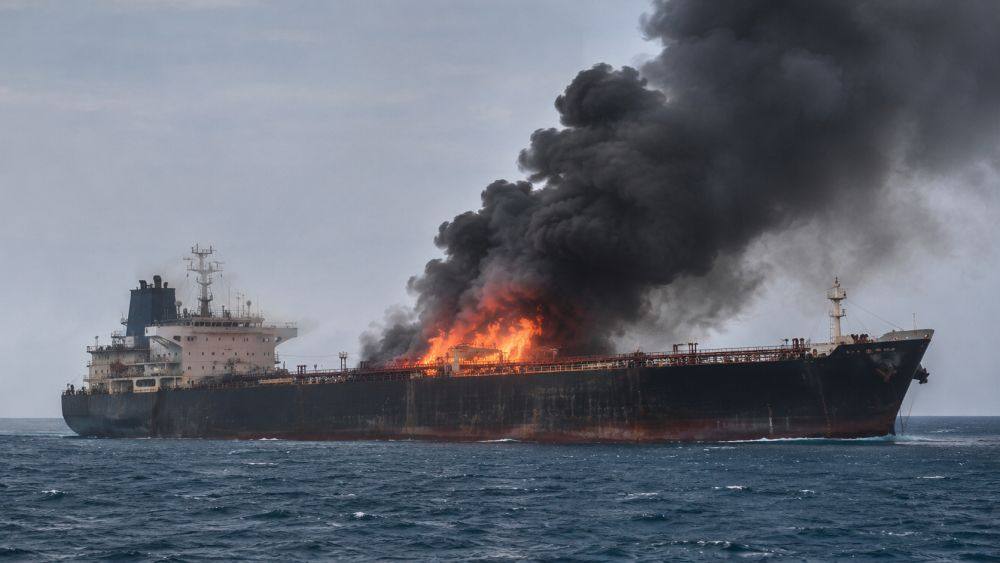
The wave of drone attacks this autumn has brought the Russo-Ukrainian War to within a few nautical miles of the Romanian and Bulgarian coastlines. Commercial vessels flying the flags of nations with no direct connection to the conflict have been struck, set ablaze, or sunk; their crews have become casualties of a confrontation in which the transport of grain, oil, and other commodities has itself become a target. The Sulina Channel and the Danube ports are increasingly exposed, forcing shipowners and insurers to reassess the risks of navigating in the region.
Yesterday in Brussels, Minister of Defense Radu Oprea discussed the security situation in the Black Sea with his European counterparts, in light of repeated attacks on commercial shipping in the region-attacks attributed to Russia. The Romanian official advocated for guaranteeing freedom of navigation and for the swiftest possible operationalization of the maritime security center. Furthermore, he called for the expedited delivery of radars manufactured by Thales.
When asked whether Romania is considering escorting commercial vessels or establishing protected maritime corridors, the Minister stated that such measures are being discussed with regional partners and cannot be adopted unilaterally. "We are in a dialogue with our partners-both Turkish and Bulgarian-so these decisions do not rest solely with Romania; they are decisions made collectively. (...) It is a growing threat in our region. It is not just about security; it is also about the economy-about how we manage to conduct trade in our region. Romania, Bulgaria, and Turkey are under threat, as is Ukraine," declared Radu Oprea. Currently, Romanian authorities are issuing warnings to mariners, recommending that they proactively avoid areas where risks are high. Maritime traffic is not prohibited, but ship captains are urged to exercise heightened caution. The Minister of Defence stated that Romanian Naval Forces vessels continue to conduct patrols in the region, and that authorities are working to improve surveillance capabilities in order to identify potential threats more quickly.
The Black Sea is currently enduring one of the most perilous periods for commercial shipping since the onset of the Russian invasion of Ukraine. While the primary threats to navigation during the early years of the war were concentrated near Ukrainian ports and Russian-controlled areas, by the autumn of 2026, the conflict had expanded westward, reaching the vicinity of Romanian and Bulgarian territorial waters. Since September, aerial and maritime drone attacks have targeted tugboats, cargo ships, and vessels transporting petroleum and chemical products. Some were struck while heading toward Ukrainian ports or the Sulina Channel, while others were in transit through exclusive economic zones or near the coasts of NATO member states. The toll is severe: sailors killed, dozens of individuals reported missing, crews injured, vessels lost, and cargoes that never reached their destinations. Furthermore, these incidents have brought about a significant shift in the perception of maritime security. Previously, proximity to the territorial waters of Romania and Bulgaria was considered to offer an additional layer of protection for commercial vessels. The attacks that took place this autumn have demonstrated that distance from the front line no longer serves as a sufficient guarantee of safety.
• First casualties among civilian seafarers
The escalation seen this autumn became apparent as early as September, when the tugboat TEDY-sailing under a Somali flag and owned by the Turkish company Mert Marine Corporation-was attacked near the Ukrainian port of Odesa. According to Euronews, the vessel was first struck near the port and subsequently attacked twice more while en route to Constanţa. Two Azerbaijani sailors, Aslan Aliyev and Asim Gasimov, lost their lives as a result of the attacks. Two other crew members, Imran Novruzov and Rauf Aliyev, were hospitalized with burns, while six others received medical attention on-site. The tugboat had a ten-person crew on board, comprising nationals from Azerbaijan, Turkey, Germany, and Ukraine. The Azerbaijani Ministry of Foreign Affairs confirmed the deaths, though it did not officially assign responsibility for the attack. Ukrainian authorities, by contrast, accused Russia of waging a campaign against civilian vessels and port infrastructure.
The TEDY incident served as a warning regarding the vulnerability of maritime shipping in the region. It was no longer just a matter of vessels transporting grain or fuel; the threat extended to logistical support craft-vessels essential to the functioning of ports and commercial operations.
• A Series of Attacks Near Romania and Bulgaria
The month of October saw an unprecedented intensification of attacks on commercial vessels in the western Black Sea. Within just a few weeks, several ships were struck in areas located tens of nautical miles off the Romanian and Bulgarian coasts. A document submitted on November 2 by Ukraine's Permanent Representative to the United Nations-addressed to the UN Secretary-General and the Security Council-outlines a chronology of the October attacks and their impact on the crews. The document reflects the official position of the Ukrainian government, though the authors note that operational details regarding the specific circumstances and casualties remain subject to verification. The first major incidents occurred on October 5 and 6. On October 5, the cargo ship Royad Mammadov, sailing under the flag of Saint Kitts and Nevis, was struck approximately 30 nautical miles south of Sfântu Gheorghe. According to the document submitted to the UN, two crew members died, 11 were rescued, and three were hospitalized.
The following day, the cargo ship Alfa Watan, flying the Togolese flag, was struck by a drone within Bulgaria's exclusive economic zone, approximately 70 nautical miles off the town of Byala. The vessel sank, and its crew members were reported missing. Accounts vary regarding the number of missing individuals: the Ukrainian document submitted to the UN mentions ten sailors, while a subsequently published Reuters timeline indicates 12. Also on October 6, another commercial vessel, the Able-sailing under the flag of Palau-was struck in the same area. Two sailors were injured and hospitalized, while the other crew members-18 in total-were rescued. Reports A report by The Guardian indicates that the crew of the Bulgarian ferry Dioscuria, having arrived near the site of the attack on the vessel Alfa Watan, discovered an overturned lifeboat and life jackets floating in the water, though no survivors were found at that time. The sequence of incidents demonstrates that such attacks are no longer confined to Ukrainian port infrastructure. Commercial vessels heading toward Danube ports or traversing the western Black Sea have become vulnerable, even at considerable distances from the conflict zone.
• Two vessels struck on the same night, near the Bulgarian coast
On October 13, two other vessels were attacked off the coast of Bulgaria. The "Chelsea 3"-a Maltese-flagged cargo ship owned by Ukrainian interests and used, among other things, for grain transport-was struck by three drones approximately 18 nautical miles from the Bulgarian coastline. The vessel sustained damage, but all 15 crew members were rescued; five of them required medical attention. On the same day, the cargo ship HS Dignity, sailing under the flag of Guinea-Bissau, was attacked and subsequently sank near the locality of Krapets, close to the border between Bulgaria and Romania. Five sailors were rescued, while 11 others were reported missing. These two incidents prompted the Bulgarian authorities to launch search-and-rescue operations and request international assistance. According to Reuters, Bulgarian Prime Minister Rumen Radev condemned the attacks and demanded explanations from the Russian ambassador, though Sofia did not, at that time, issue a definitive official attribution of responsibility. In this context, NATO announced that it would adjust its military presence on the eastern flank, depending on how the threats evolve. Secretary General Mark Rutte stated that the Alliance would examine the measures necessary to safeguard regional security.
• The Sulina Channel at the center of a new high-risk zone
On October 14, the attacks drew even closer to the Romanian coast. The oil tanker Yara J, sailing under the flag of the Comoros, was struck by a drone approximately 8-10 nautical miles southeast of Sulina, within Romania's territorial waters. The vessel sustained damage, but the crew was rescued. The following day, October 15, the oil tanker Wine Trader, flying the flag of San Marino, was attacked approximately 13 nautical miles southeast of the Sulina Channel-outside, yet in the immediate vicinity of, Romanian territorial waters. The ship caught fire, and seven crew members were reported missing. Five sailors were rescued, two of whom sustained injuries. These attacks have sparked concern in Bucharest, particularly because the vessels were located near one of the most critical transit corridors for Ukrainian exports. The Sulina Channel connects the Danube to the Black Sea and serves as a vital route for commercial shipping departing from Ukrainian ports on the Danube, most notably Izmail and Reni. Furthermore, the proximity of the attacks to Romanian territorial waters raises issues that extend beyond the strictly commercial dimension. Romania is not a party to the war; however, its port infrastructure, navigation on the Danube, and the security of its coastline are directly affected by the expansion of the conflict. According to Reuters reports from October 15, a NATO military source stated that the drones that caused the fires on the two oil tankers were of Russian origin. President Nicuşor Dan confirmed the attacks but did not, at that time, explicitly attribute responsibility to any specific party.
• Khoryv: Another vessel sunk near Constanţa
On October 23, another attack took place near the Romanian coast. The cargo ship Khoryv, sailing under the flag of the Comoros, was struck by a drone approximately 13 nautical miles off Constanţa-outside territorial waters, but within Romania's exclusive economic zone. The vessel, which was carrying a cargo of ore and petroleum products, caught fire, capsized, and sank. There were 13 Ukrainian and Azerbaijani sailors on board. Nine individuals were rescued, the body of one sailor was recovered, and three others were reported missing. President Nicuşor Dan condemned the attack, framing it as part of the escalation of Russian aggression against Ukraine. Romanian authorities conducted search and rescue operations under difficult conditions, hampered by strong winds and poor visibility. The incident was particularly significant due to its proximity to Constanţa, Romania's main seaport. It served as yet another signal that commercial traffic near the Romanian coast cannot be considered free from military risks. In an analysis published on October 23, the maritime security firm Ambrey assessed that it was highly likely that Russian forces were responsible for the attack on the vessel Khoryv. The company noted that the ship had made several calls at Ukrainian ports in the Danube Delta region during 2026. However, this is a security assessment, not an official conclusion. part of an international investigation.
On October 28, another commercial vessel was lost in the western Black Sea. The container ship Contship Jet, sailing under the Liberian flag, was struck by three maritime drones within Bulgaria's exclusive economic zone, near Cape Kaliakra. The vessel was en route from the port of Haifa, Israel, to Constanţa. Following the attack, the ship sank, but all 18 crew members were rescued-among them, four Ukrainian citizens. The attack highlighted a significant shift in the nature of the threat: it was no longer just vessels carrying grain or petroleum products being targeted, but also container ships engaged in general cargo transport. The use of maritime drones against such a vessel demonstrates that the risk to commercial shipping now extends to an increasingly diverse range of ship types. In a timeline published by Reuters on November 15, the Contship Jet is listed among the vessels sunk during the series of attacks near Romania and Bulgaria.
• November: Attacks reach Romanian territorial waters
Following the series of incidents in October, the beginning of November brought no reduction in risk. On November 13, the cargo ship Larissa 1, flying the flag of Palau, was struck while heading toward the Sulina Channel. According to information released by the Ministry of National Defence and the specialized publication Seatrade Maritime, one of the ship's cargo cranes was damaged. No casualties were reported. On the evening of November 14, three commercial vessels were struck near the mouths of the Danube. The vessels involved are the Greek-flagged chemical tanker Evia Petrol , the bulk carrier Marsol, and the product tanker Ali Najafov-the latter two sailing under the flag of Saint Kitts and Nevis. Two of the ships were struck within Romanian territorial waters, approximately four to five nautical miles southeast of the Sulina channel. Fires broke out on board the Evia Petrol V and the Marsol, but the crews managed to extinguish them. Damage was reported to the main deck, a crane, and a cargo hold. In the case of the Ali Najafov, the attack also triggered a fire, which was put out by the crew. No casualties were reported among the sailors. Prime Minister Luca Niculescu stated that Romanian fighter jets were scrambled on two occasions following the detection of aerial targets in the area. The official described the incidents as unacceptable, noting that they reflect a deterioration in the security situation caused by Russia's war against Ukraine. At the time, Romania did not officially attribute the origin of the drones, but it did call for closer cooperation with allies to strengthen maritime surveillance and air defense capabilities. According to Seatrade Maritime, France has temporarily deployed a maritime patrol aircraft to Romania, while Romanian authorities have requested additional support from allies in the form of surveillance assets and anti-drone equipment.
• Betul8: 3,000 tons of wheat lost
In Bulgaria's exclusive economic zone, the cargo ship Betul8, sailing under the Somali flag, sank after being struck by a maritime drone, according to naval security sources cited by Reuters. The vessel was carrying 3,000 tons of wheat and was en route from Romania to Egypt. There were 12 Turkish sailors on board; all were rescued by military vessels in the area and transported to shore with the assistance of a Bulgarian helicopter. Authorities stated that the crew members were in good condition and that no casualties or pollution had been reported. Beyond the fact that there was no loss of life, the incident resulted in further material damage to commercial shipping: the loss of a vessel and its cargo of 3,000 tons of wheat. According to the maritime security firm Diaplous-as cited by Reuters-the Betul8 is the 17th vessel to be attacked off the coasts of Romania and Bulgaria since mid-July. This figure indicates that such incidents can no longer be viewed as isolated events, but rather as part of a persistent deterioration in navigation conditions in the western Black Sea.
The human toll: sailors killed, missing, and injured
The figures available for this autumn are incomplete, and some accounts differ regarding the number of missing persons. Nevertheless, information published by Reuters and Euronews, along with a Ukrainian document submitted to the UN, point to a concerning toll. In the documented incidents of this autumn alone, the confirmed toll includes at least seven dead sailors and over 30 missing persons-a figure that does not account for potential casualties from other attacks for which information remains insufficiently clear. While missing individuals cannot be automatically presumed dead, the nature of the search operations and the circumstances surrounding certain sinkings make the prospect of recovering everyone uncertain. Across the conflict as a whole, the specialized registry recorded 52 deaths, 35 missing persons, and 125 injuries among seafarers in the Black Sea, across 159 incidents involving 171 vessels. This register covers the entire period following February 24, 2022-not just the attacks that occurred this autumn. According to the same data, 11 vessels have been sunk.
These figures indicate that merchant seafarers have become a professional group directly exposed to the consequences of the war, despite having no involvement in military operations.
• What shipowners and traders stand to lose: vessels, cargo, time, and money
The damage caused by these attacks extends beyond the loss of vessels. Each incident entails additional costs, including salvage operations, repairs, wreck recovery, compensation for crews, the disruption of transport contracts, and the potential loss of cargo. Regarding the vessels sunk in October, publicly available information does not provide a comprehensive assessment of the commercial value of the ships and the cargo lost. At present, there is no consolidated financial tally that would allow for the quantification of the total damage caused by all the attacks that took place this autumn. One of the most significant economic consequences of this naval conflict is the disruption of Ukrainian and Russian agricultural exports.
Ukraine is a major supplier of grain and vegetable oils to international markets. Attacks on ports, storage facilities, and merchant vessels have forced a shift in transport routes, leading to an increased reliance on Danube ports and Romanian infrastructure. The Sulina Canal plays an essential role in this equation. Through it, vessels can reach Ukrainian ports on the Danube-most notably Izmail and Reni. From there, goods are transported to markets in the Middle East, North Africa, and other regions. According to a Reuters analysis published on September 23, dozens of ships were then waiting for more than two weeks to enter the Sulina Canal. Adjusting access procedures became necessary to reduce congestion and increase transit capacity. The same analysis indicates that the time required to transport grain from Ukraine to Egypt had reached over a month-up from approximately 12 days previously-while shipping rates had climbed to around $100 per ton, compared to $30 in July. In September, exports through Ukrainian Danube ports were estimated at approximately 930,000 tons of grain, down from 1.78 million tons in the same month the previous year. The data show that security concerns are compounding existing logistical difficulties. Attacks on vessels may lead shipowners to avoid certain routes, demand higher risk premiums, or accept only contracts that cover these additional costs. The Black Sea remains a primary commercial link between Europe, Asia, and the Middle East. Yet, by the autumn of 2026, traversing it had become an operation for many crews involving risks that can no longer be assessed solely in terms of distance, time, and transport costs.

























 Euro
 Dolar SUA
 Franc elveţian
 Liră sterlină
 Gram de aur


























Reader's Opinion