English


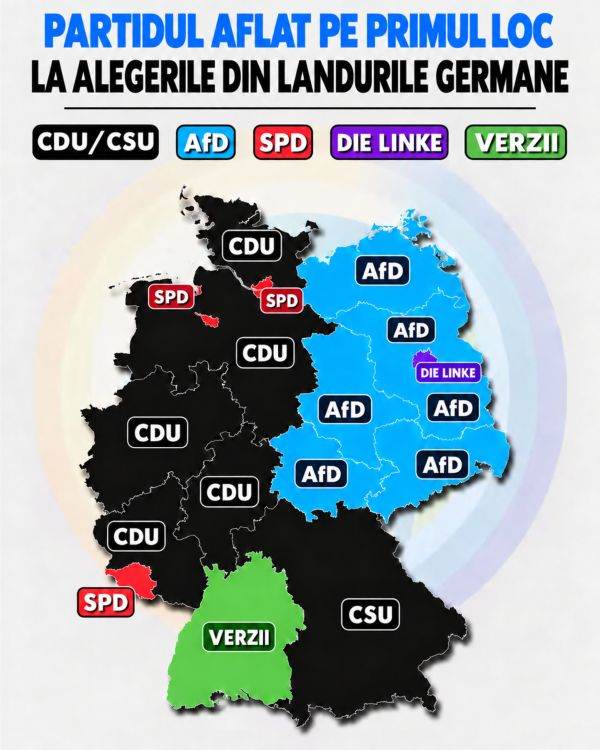
Following the elections in Germany's federal states, the former border between the DDR and the FRG appears to be reappearing on the country's electoral map. Nearly 37 years after the fall of the Berlin Wall, the AfD has achieved some of its strongest results in the states of the former DDR. The sole exception is Berlin, where nostalgia for the communist era led to a victory for the German Left. The lasting impression from these elections is that, although the Berlin Wall fell in November 1989 and the Iron Curtain vanished institutionally-especially following the reunification of the FRG and DDR on October 3, 1990-the two regions remain divided by how millions of people view the state, political parties, and the future of the German nation. To understand why a nationalist party can attract votes in a region ruled for decades by a communist regime, one must first clarify an apparent paradox. Doctrinally, Marxist communism champions the international solidarity of the working class, whereas nationalism places the nation at the center of political loyalty. The two do not represent the same ideology. Yet, in their authoritarian forms, they can employ similar political mechanisms: they portray the collective as a threatened body, divide society into those who truly belong and those accused of betraying it, demand unity against an adversary, and claim to be the sole voice of the "people's" will. In one instance, the threat might be termed "capitalist exploitation" or "imperialism"; ...in the other, "globalist elites," immigration, or the loss of sovereignty. The resemblance lies in the way political conflict is structured, not in the notion that their economic and social agendas are identical.
The DDR illustrates just how complex the boundary between proclaimed internationalism and state patriotism was in practice. The communist leadership declared itself anti-fascist yet also claimed the right to represent the legitimate Germany, in opposition to the West. In the regime's early years, propaganda attempted to blend "socialist internationalism" with patriotism; later, the state spoke of a distinct socialist identity. One cannot claim that the DDR simply taught nationalism, but it would be equally incorrect to suggest that the nation, the external adversary, and the claim to moral superiority were absent from its discourse.
This is where an explanation for a certain continuity might begin, though it is not an automatic "transfer" of the communist vote to the AfD. A vote for the communists in the DDR cannot even be directly compared to a vote in a democratic contest: the regime offered no free alternation of power. Nor are today's voters the same. Some were born after 1989; others lived through the fall of the communist regime but subsequently voted for vastly different parties within the democracy. What gets passed down across generations is, rather, an experience recounted within the family-a distrust of authority or the conviction that crucial decisions are made elsewhere. The AfD can tap into such perceptions, even if they do not all stem from communist doctrine.
Especially since a massive rupture occurred between the era of communism and the rise of the AfD: reunification and economic transformation. According to the Federal Foundation for the Study of the SED Dictatorship, two-thirds of East German industrial workers lost their jobs during the early years of the transition; of the more than four million positions originally under the purview of the Treuhand agency, only about 1.5 million remained by the end of 1994. Behind these figures lie transformed industrial towns, interrupted careers, and families for whom the promise of reunification came hand-in-hand with the loss of security. While this alone does not explain a vote cast in 2026, it helps shed light on the political memory inherited even by those who never experienced the DDR.
The shift was also demographic. Official data show that the population of the eastern states-excluding East Berlin-declined by 16% between 1990 and 2024, whereas the population of the West grew. Roughly half of the net migration to the West occurred in the first decade following reunification. For communities that lost young people, businesses, and services, the narrative of being "left behind" can prove more compelling than national economic growth indicators. DIW research into the 2024 vote identifies links between the AfD's success and the economic, structural, and demographic characteristics of these regions, without reducing the vote to a single cause.
The emergence of new generations of voters does not invalidate this explanation; rather, it makes it more pressing. Young people may not vote out of personal nostalgia for life in the DDR, but they may grow up in towns blighted by decline or in families that frame the transition as a loss of status. At the same time, they have their own reasons for voting, their own sources of information, and their own grievances. In the 2024 regional elections in Thuringia, 38% of voters aged 18-24 votes AfD. At the federal level, support for the party within this same age group rose from 7% in 2021 to 21% in 2025. A phenomenon that mobilizes voters born after reunification in this way cannot be explained solely by the persistence of reflexes from the communist era.
The results reveal both the strength of the AfD and the limitations of a map divided into two colors. In the 2025 federal elections, the party secured 37.1% of the list vote in Saxony-Anhalt, 38.6% in Thuringia, 37.3% in Saxony, and 35% in Mecklenburg-Western Pomerania. These results demand serious explanation. Yet, Berlin placed Die Linke first in the September 2026 regional election, and Brandenburg chose the SPD in the 2024 regional vote.
Some voters view the AfD as a defender of the nation. This perception warrants explanation rather than mere acceptance as a verdict. The party weaves together-into a single narrative-fears regarding identity, migration, and the economy, alongside the sentiment that established parties are ignoring the will of the people. For those who feel they have lost control over their own lives or the country's direction, the promise of a party declaring "we represent you" can hold particular appeal.
Nevertheless, nearly 37 years after November 9, 1989, Germany is not once again split by an Iron Curtain. It has free elections, competing parties, and citizens capable of changing the political course. Yet, the results demonstrate that the reunification of a state does not, in itself, erase the distinct experiences of its various regions. If the old border is still visible in voting patterns, the explanation lies in a history where the authoritarianism of the DDR, the shock of the transition, migration, regional inequalities, and present-day conflicts converge. The AfD has learned to speak to this reality. The question for the other parties is whether they can understand and represent this electorate without reducing Eastern voters to their past.
• Can the AfD experiment be replicated in Romania? AUR, the party voted for out of defiance
Following events in the former DDR, it remains to be seen whether this phenomenon will extend to Eastern European countries that-like East Germany-were once part of the socialist bloc. For the moment, the AfD has succeeded in turning the sense of an unresolved rift between East and West Germany into an electoral force. In Romania, AUR is attempting to capitalize on a different kind of rift: the conviction that while the country has joined the West, too many Romanians have been left out of the promised prosperity. This is where the fundamental similarity between the two parties lies. Both argue that the nation must be "reclaimed" from elites who no longer represent it. In the states of the former DDR, voters did not simply swap one extreme for another; rather, the losses and disappointments of the transition paved the way for a new party promising to restore control to the people. The AfD gave this promise clear adversaries: the established parties, immigration, and Brussels. In Romania, AUR employs the same political framework, yet the collective memory it invokes is different. Romania experienced communism, but it was never partitioned and subsequently reunified. The rift invoked here is the one between the country that has profited from European integration and the people who say they were left to bear the costs of the transition, emigration, and a weak state.
The AfD emerged in 2013 out of opposition to the euro and Eurozone financial bailout policies, before immigration became its defining issue. Romania does not use the euro. For AUR, attacking a currency the country has not yet adopted cannot carry the same electoral weight. The AfD can portray Germany as the state footing the bill for others; AUR must make its case in a country that benefits from the single market and European funding. The AfD's platform calls for Germany to leave the euro system. AUR's platform explicitly states that Romania belongs in the EU and Schengen, though it calls for reforming the Union into a "Europe of nations."
In terms of political rhetoric, the two parties share a strong affinity. Terms such as "sovereignty," "nation," "elites," "bureaucracy," "family," and "cheap energy" all point-individually or collectively-to a real problem and a political culprit. The AfD and AUR do not need to convince every voter of every point in their platforms; it suffices for them to unite diverse groups through the conviction that decision-making power has been hijacked. An employee worried about energy costs, a small business owner unhappy with taxes, a conservative parent, and a voter angry at the established parties might all cast the same vote for entirely different reasons. This is the aspect of the AfD model most easily transferable to our country: a coalition of grievances held together by the promise of reclaiming national power.
• Similarities and differences between the political platforms of AfD and AUR
However, immigration highlights the limits of the comparison. For the AfD, border control, asylum, and "remigration" are central themes of the platform. In Romania, the debate exists, but the country also faces a labor shortage, which employers are attempting to address-including by recruiting foreign workers. There is another contradiction inherent in a Romanian nationalism built around the diaspora: millions of Romanians have benefited from the right to live and work in other European states. AUR can call for migration controls and oppose mandatory relocation schemes without adopting the AfD's entire agenda. Adopting that agenda wholesale would place the party in the position of defending Romanians' freedom of movement while simultaneously denouncing it as a problem for others.
Russia and Ukraine draw an even clearer line between the two projects. The AfD platform calls for lifting economic sanctions against Russia and repairing the Nord Stream pipelines, envisioning a future for Ukraine outside of NATO and the EU. AUR officially anchors its security policy in NATO and the strategic partnership with the United States, and includes reunification with the Republic of Moldova among its objectives. At the same time, it questions the support provided to Ukraine and demands that Romania prioritize its own resources. These positions do not make AUR a carbon copy of the AfD, but they do raise a strategic question for the Romanian party: how can the Republic of Moldova be protected if Ukraine's resistance to Russia weakens? This represents a tension between two political goals, not proof that AUR and AfD share the same relationship with Moscow.
Regarding the economy, both the AfD and AUR promise lower taxes and challenge the costs associated with climate policies. Beyond that, the emphasis shifts. The AfD retains a strong element of fiscal liberalism. AUR places greater weight on strategic resources, Romanian capital, industry, agriculture, and state investment. This combination could gain traction in Romania, where the demand for a state capable of building and protecting coexists with a revolt against taxes. However, it faces a test that rhetoric alone cannot bypass: funding. According to the European Commission, Romania's public deficit stood at 9.3% of GDP in 2024 and 7.9% in 2025. A party promising simultaneous tax cuts, massive investment, and social spending must demonstrate where it will make savings, how it will replace lost revenue, and in what order it intends to implement its measures.
AUR holds another advantage: a distinct national project-reunification with the Republic of Moldova. The party's four stated pillars-faith, nation, family, and freedom-also lend it a much more explicit religious character. While both AfD and AUR champion the traditional family and oppose certain gender identity policies, AUR frames these issues within the language of Christian morality and Romanian national continuity. This approach may help link the conservative vote to the cause of unification; at the same time, it could limit the party's ability to represent citizens who do not share the same definition of family or the same relationship with religion.
There is also a difference between the leaders. Alice Weidel, with her background in economics and finance, can speak for the protest against the German state despite her own privileged professional background. George Simion built his image through unionist activism, protest, and direct confrontation. For him, the challenge lies not in a biography that saw a specialist transform into a populist firebrand, but in the transition from firebrand to institutional figure. When leading a major parliamentary party, one can no longer attribute every failure to a "system" of which one has become a part. The "Simion Plan" demonstrated both the strength and the vulnerability of this style. AUR promoted voter sign-ups through contracts for homes starting at euro35,000-a concrete promise regarding costs, land, infrastructure, financing, and actual housing delivery that could easily be verified. Subsequently, the pledge morphed into mere political marketing, devoid of any basis in reality.
Can AUR, then, replicate the AfD's political success in Romania? It can adopt the electoral mechanism, but it cannot replicate the German context.
The AfD's rise was fueled by an East-West divide that persists decades after reunification. AUR has no Romanian equivalent to the former GDR. It does, however, face rifts between developed and lagging regions, between those who emigrated and those who stayed, and between the beneficiaries of European integration and those who see primarily its costs. If it succeeds in framing these disparate experiences as parts of a single narrative about a country being "taken back," it could attract votes beyond its conservative core.
The real test for AUR is not whether it can sound like the AfD, but whether it can reconcile the conflicting things it asks voters to believe simultaneously: lower taxes alongside higher investment; firm alignment with the West alongside reduced support for Ukraine; freedom for Romanians working abroad alongside restrictions on those coming here to work. Electoral success can encompass these contradictions; governing would require resolving them.

















 Euro
Euro Dolar SUA
 Franc elveţian
 Liră sterlină
 Gram de aur