 English



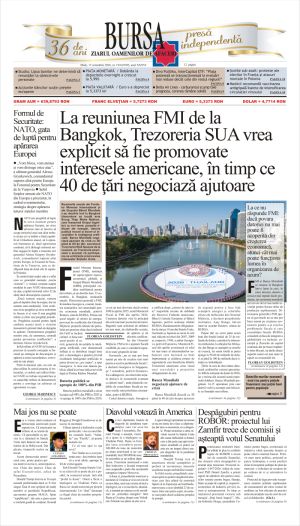
The International Monetary Fund (IMF), the global macroeconomic surveillance institution, and the World Bank Group (WBG), the main multilateral development lender, opened their annual meetings in Bangkok on Monday, October 12. Before the meetings, IMF Managing Director Kristalina Georgieva identified three threats to the global economy, according to Reuters, cited by BURSA. The first is a negative energy supply shock caused by conflicts in the Middle East: high oil prices may persist even if the Gulf war ends soon. The second is a positive demand shock generated by investment in artificial intelligence, which fuels inflation and is distributed unevenly across countries; a market disappointment over the results of artificial intelligence could become a "major shock”, Georgieva said. The third is public debt, which is at its highest level since World War II.
• Public debt is approaching 100% of GDP
Global public debt rose to just under 94% of GDP in 2025 and will reach 100% of GDP in 2029, one year earlier than the IMF estimated in April 2025, according to the IMF's April 2026 Fiscal Monitor. The increase in debt is mainly driven by the world's largest economies. Budgets are under pressure from increasingly high interest payments, social spending, defence spending and the effects of the conflict in the Middle East. The IMF is calling for credible fiscal adjustment, which it considers urgent across all groups of countries.
Governments "can no longer rely only on higher growth rates to solve fiscal problems”, Georgieva said in Singapore on October 7, according to Euronews. She added that "we are not seeing decisive action in highly indebted advanced economies”, where credible medium-term fiscal consolidation plans are the priority at the moment, according to BURSA.
The cost of debt is rising. Georgieva described the recent interest rate increases by the US Federal Reserve, the European Central Bank and the Bank of Japan as "extremely appropriate”, according to the same BURSA report. Yields on 10-year government bonds in the United States, Germany and Japan have risen to their highest levels since 2007, 2009 and 1996, respectively, Georgieva noted, according to Euronews. The April Fiscal Monitor warns that the growing role of non-bank intermediaries operating with borrowed money and the decline in the safety premium enjoyed by US Treasury securities increase the risk of a repricing of government bonds.
• The World Bank is negotiating crisis assistance
The World Bank is in talks with 30 to 40 countries about emergency assistance to cope with rising energy prices and the other effects of the war in the Middle East, the institution's president, Ajay Banga, said in an interview with Reuters, as reported by BURSA. Few countries have so far requested funds from the initial $25 billion fund established when the war broke out at the end of February, but Banga expects requests to increase, and the total amount could reach $50-60 billion, or as much as $100 billion if the situation deteriorates. Developing countries owe external creditors approximately $400 billion in 2026, one-third of which represents interest payments. The World Bank is preparing 14-15 operations through which old, expensive debt will be replaced with cheaper financing.
In many low-income countries, interest payments consume approximately 15% of budget revenues, according to the IMF. Of the 119 low- and middle-income countries with credit ratings, 75 were experiencing debt distress or faced a significant risk of it in March 2026, according to the Center for Economic and Policy Research (CEPR).
• The US Treasury Secretary is absent from Bangkok
US Treasury Secretary Scott Bessent is not attending the meetings in Bangkok because of domestic commitments, while the Treasury delegation is being led by Deputy Secretary Francis Brooke and Under Secretary for International Affairs Erin Browne, according to Reuters, cited by BURSA. Federal Reserve Chair Kevin Warsh is attending the meetings and is scheduled to take part in a public event with Georgieva on October 16, according to Al Jazeera.
The United States holds the G20 presidency this year, and officials from other countries generally use these meetings for bilateral discussions with the US Treasury Secretary. The Treasury has announced five objectives for Bangkok, according to Reuters: "greater transparency and more effective approaches to sovereign debt”; "clear and consistent” standards for creditors and debtors; support to help countries facing debt problems regain stability and return to growth; and a focus by the IMF and the World Bank on their core missions and efficient operations. The fifth objective guides the entire US participation: ensuring that international financial institutions and the international economic system as a whole promote the economic and national security interests of the United States.
• Meeting schedule
On Tuesday, October 13, at 9:00 a.m. Bangkok time (5:00 a.m. Romanian time), the IMF will present its new World Economic Outlook, followed on the same day by the Global Financial Stability Report, according to the meeting schedule. Georgieva has announced that the largest downward revisions to growth forecasts will concern countries affected by the war. The plenary session of the annual meetings will take place on Friday, October 16, while the International Monetary and Financial Committee will present its conclusions on Saturday, October 17.
• Implications for Romania
Romania's public debt rose from 54.8% of GDP in 2024 to 59.3% in 2025, is estimated at 61.6% in 2026 and 63.4% in 2027, and is projected to reach approximately 90% of GDP in 2036, according to the European Commission's 2026 Convergence Report, as reported by BURSA. The report attributes the increase to the high primary deficit and higher interest payments, and assesses medium-term debt sustainability risks as high.
The Romanian state must refinance approximately euro83.9 billion in maturing public debt principal over 2027-2030, excluding future deficits, interest payments and new borrowing, according to an analysis by the National Pact for Agriculture and Sustainable Development, as reported by BURSA. The amount represents an average of more than euro20 billion per year. It is not new debt, but existing debt that must be replaced with new borrowing.
Each new loan carries the interest rate prevailing when it is contracted. Refinancing may increase the cost of debt, especially where maturing loans were contracted at lower interest rates than those prevailing today. Romania borrows on foreign markets in euros and dollars, and the global rise in interest rates adds to the country's own risk premium. In some emerging markets, the global rise in interest rates "more than fully offsets” the hard-won reduction in risk premiums, Georgieva said on September 2, at the G20 finance ministers' meeting in Asheville, according to Ahram Online.
The circumstances surrounding the Bangkok meeting and what it can achieve are analysed in the accompanying article, "What the IMF Does Not Answer: If the Debt Burden Can No Longer Be Covered by Economic Growth, How Much Longer Can the World Continue to Function Under Its Current Organisation?”





















 Euro
Euro Dolar SUA
 Franc elveţian
 Liră sterlină
 Gram de aur































Reader's Opinion