 English


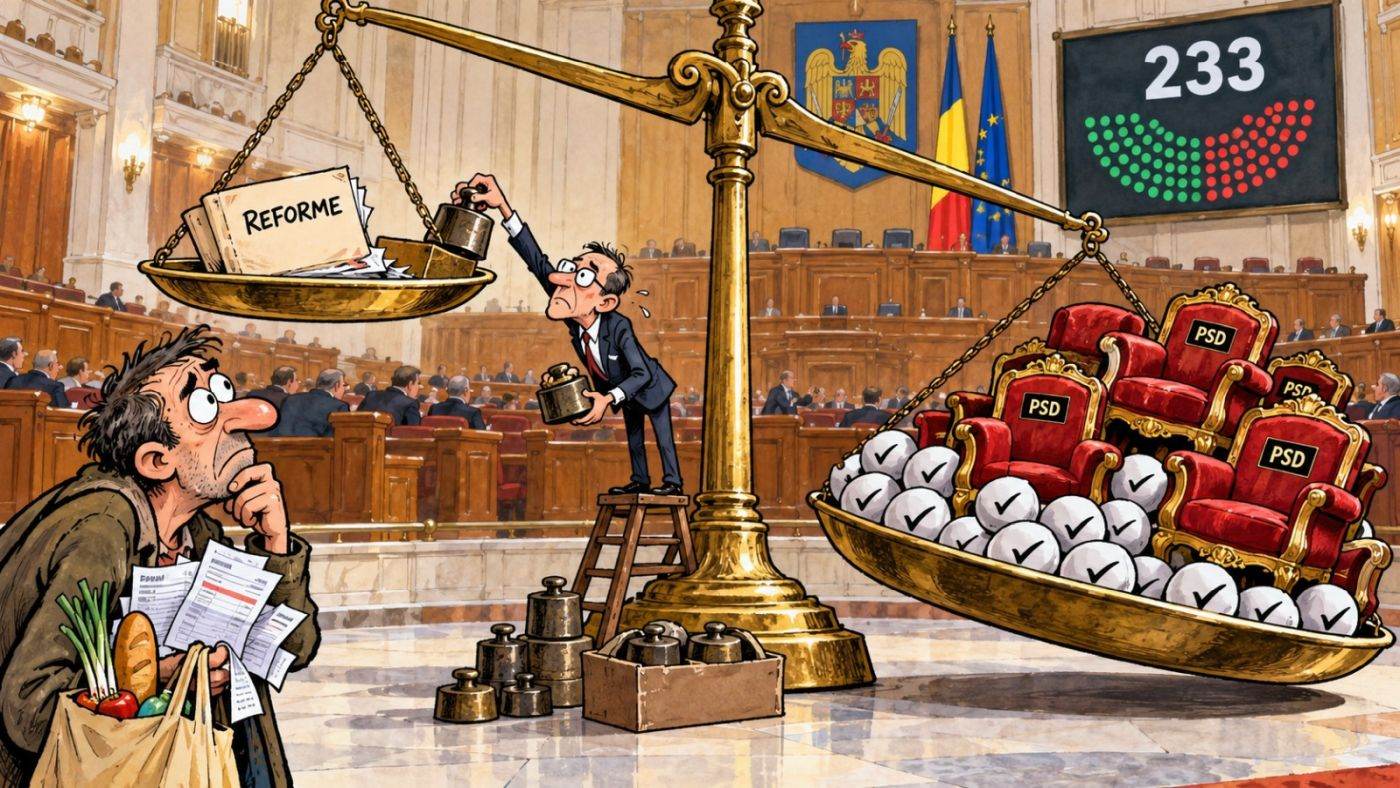
The parliamentary majority required to install a new government comes at a price, reflected in the terms that the Prime Minister-designate agrees to include in the government program at the behest of political party leaders. A simple comparison between the government programs proposed by Siegfried Mureşan in September and by Luca Niculescu now reveals the price paid by the latter to secure the investiture vote for his Cabinet at Palatul Victoria: reforms abandoned, commitments watered down, and social promises amplified, all alongside a substantial contingent of Social Democratic ministers.
While Siegfried Mureşan failed to garner the necessary 233 votes, the new Prime Minister-designate, Luca Niculescu, is attempting to secure them through a formula that maintains budgetary discipline while reducing institutional friction and granting the Social Democrats a direct role in implementing the program. The question remains: how much reform can actually be delivered through the compromise that makes this investiture possible?
In September, Siegfried Mureşan presented a program to Parliament that promised to reshape rules, institutions, and power dynamics. He left without receiving the vote of investiture. Luca Niculescu now brings forward a document that retains a significant portion of that same economic policy, yet abandons several of the most contentious reforms and places social protection at the forefront. The distinction between these two governing approaches is evident in the specific measures proposed. However, the explanation for their parliamentary prospects also lies in the question each party asks itself before the vote: what do they gain, what do they lose, and how much control do they retain over decision-making?
On September 30, the Mureşan cabinet secured 182 votes in favor - 51 short of the 233 required. The government proposed by Luca Niculescu faces the vote with a radically altered composition: the PSD is joining the executive branch, and parliamentary support may also come from political groups that are not contributing ministers to the cabinet. Consequently, the political conditions for the investiture vote - scheduled for tomorrow in the plenary session of Parliament - are significantly more favorable.
Taken together, the two programs demonstrate how the general direction of governance can be maintained while simultaneously adjusting the content enough to make a majority possible.
• The same budgetary constraint, two different political proposals
Neither of the two governing programs sidesteps Romania's core challenge: the state must reduce the budget deficit, fund investments, and prevent the degradation of public services, all during a period of economic and social pressure.
Both Mureşan and Niculescu have cited the goal of bringing the deficit below 3% of GDP by 2030. Both documents support the flat tax, the elimination of the minimum turnover-based tax effective January 1, 2027, the reform of the National Agency for Fiscal Administration (ANAF), the fight against tax evasion, and the prioritization of European funds. Both governing programs emphasize investments in energy, storage, infrastructure, and digitalization. Likewise, the external orientation remains unchanged: the European Union, NATO, and the Strategic Partnership with the United States continue to be the fundamental pillars.
Therefore, presenting the two programs as opposing economic projects would be misleading. Luca Niculescu does not propose abandoning fiscal consolidation, just as Siegfried Mureşan did not propose eliminating social protection. The difference lies in how each document distributes the burden of adjustment and how it envisions the use of future resources. The Mureşan program linked state reform to a reduction in labor taxation and introduced a "reform dividend" mechanism. The Niculescu program places greater emphasis on protecting low incomes, indexing pensions, and supporting vulnerable households.
This shift is politically significant. Reducing labor taxation offers the prospect of future gains, contingent upon savings and tax collection. Indexing pensions and providing support for utility bills address immediate pressures. In the context of parliamentary negotiations, these two types of promises appeal to different interests and voter groups.
However, there is a common constraint: money. Many of the measures in Luca Niculescu's proposed program are explicitly conditional upon fiscal space, available funding sources, and offsetting savings. A stronger social focus does not mean that budgetary obligations have vanished.
• Reforms that have lagged behind
The most significant differences between the programs lie in the institutions that the administration intends to reform. Siegfried Mureşan proposed reducing the number of parliamentarians by 13%, limiting the number of state secretaries per ministry to a maximum of three, and implementing a "one hire for every two departures" rule within the central administration and decentralized public services. Luca Niculescu advocates for conducting a functional audit before any measures are taken, with the sizing of staff to be determined subsequently based on the actual volume of work and proceed with reorganizations. In practical terms, administrative reform continues, but with more room for negotiation regarding each specific intervention.
Regarding state-owned enterprises, the difference lies in the level of firmness and the role assigned to public ownership. Mureşan described an explicit process involving classification, listing, privatization, concession, or closure. Niculescu retains the concepts of company rating, restructuring, and the possibility of insolvency, but places greater emphasis on the mission of public interest and the state's strategic control.
TAROM best illustrates this paradigm shift. The program presented by Siegfried Mureşan last month called for the competitive privatization of the state-owned air carrier or, failing that, an orderly closure should no investor emerge. In contrast, Luca Niculescu proposes attracting a strategic investor, whether for a minority or majority stake, and supporting a viability plan in discussions with the European Commission. This approach offers a broader range of options and a less definitive conclusion.
In the justice sector, the divergence becomes even more pronounced. Mureşan proposed specific changes concerning the election of the Superior Council of Magistracy, the promotion of magistrates, the Judicial Inspection, the practice of temporary assignments, and interventions by hierarchical superiors within the prosecution service. Niculescu focuses on digitalization, infrastructure, staffing, strategic planning, and institutional cooperation, without reiterating those same explicit structural commitments.
Furthermore, the distinct section dedicated to the reform and democratic oversight of intelligence services has no equivalent in the program proposed by Luca Niculescu. Consequently, explicit commitments such as prohibiting undercover operations within the media, politics, and religious denominations, limiting the tenure of leadership, and imposing restrictions on military reservists are absent. Similarly, the Niculescu program does not adopt the explicit reform proposed by Mureşan, which sought to recalculate pensions in the defense, public order, and national security sectors based on individual contributions and length of service.
These differences indicate that the program proposed last month by Siegfried Mureşan simultaneously opened up several fronts of conflict regarding roles, benefits, and mechanisms of influence, whereas the Niculescu program reduces the number of such points of contention.
• The PSD changes the equation for investiture
Regardless of how significant the differences in the proposed programs may be, the direct cause of Mureşan's failure remains a lack of votes. The PSD decided unanimously not to support the cabinet, and its parliamentarians - though present in the chamber - did not participate in the vote. For the investiture to succeed, what mattered was the number of votes in favor, not the fact that there were few votes against. Siegfried Mureşan attempted to argue that the program incorporated proposals from the PSD as well, but this proved insufficient. The negotiations were marked by disputes concerning a meeting with Sorin Grindeanu and the submission of the governing program. The compatibility of certain policy measures did not lead to an agreement on the formation of the government.
In contrast, Luca Niculescu presented a different offer, which includes accepting an increase in the number of PSD ministers in his cabinet, ministers who would head portfolios with significant economic, social, and administrative weight.
This is a distinction that a simple comparison of promises cannot fully capture. A party may refuse to vote for measures it deems partially acceptable if it does not approve of the prime minister-designate, the proposed team, or the underlying political architecture. A party might support a given policy document when it participates in the decision-making process and can take ownership of the outcomes.
At the same time, Niculescu could secure votes from parties that remain outside the Executive branch. The Prime Minister-designate has announced support from the PNL, the UDMR, the national minorities, and other individual parliamentarians, each under their own specific conditions. Ilie Bolojan has proposed an agreement whereby the PNL would vote for the government's investiture and refrain from supporting any motions of no confidence for six months, contingent upon the fulfillment of agreed-upon commitments.
This formula allows the PSD to join the government, while enabling the Liberals to help break the deadlock without having to serve in a cabinet alongside the Social Democrats. A Prime Minister with no political affiliation provides a common ground for positions that might otherwise be difficult to reconcile within a traditional coalition.
• The votes may be there, but will the reforms hold?
Luca Niculescu's governing program is easier to support in Parliament precisely because it offers various actors acceptable guarantees. Proponents of fiscal discipline are presented with deficit targets and budgetary conditions. The PSD gains a role in government and a stronger focus on social issues. Meanwhile, the public administration and the professional sectors targeted by the reforms are offered - in several areas - more gradual implementation processes and greater scope for negotiation.
Time, too, favors compromise. The need for a budget revision, the preparation of the 2027 budget, and the funding of public services make the continued deadlock increasingly costly. Any further refusal would be difficult to justify at a time when economic and administrative challenges demand decisive action.
Yet, the very advantage that facilitates the investiture could become a source of difficulty thereafter. A program flexible enough to bring together diverse forms of support risks generating disputes when must be determined who will make savings, who will receive funds, and which reform should be implemented first. Making social measures contingent upon available fiscal space is a prudent approach; politically, it shifts the focus of the confrontation toward the drafting of the budget.
Mureşan failed in Parliament because he could not translate his governing proposal into a parliamentary majority. Niculescu stands a better chance, as he offers both a revised program and a distribution of governmental responsibilities that is acceptable to several parties. The investiture vote may confirm whether this compromise can secure the necessary support. Only the budget and the initial policy decisions will reveal how much of the program can actually be implemented, and to what extent state reforms have been deferred to make the formation of the government possible.



















 Euro
Euro Dolar SUA
 Franc elveţian
 Liră sterlină
 Gram de aur






























Reader's Opinion