 English
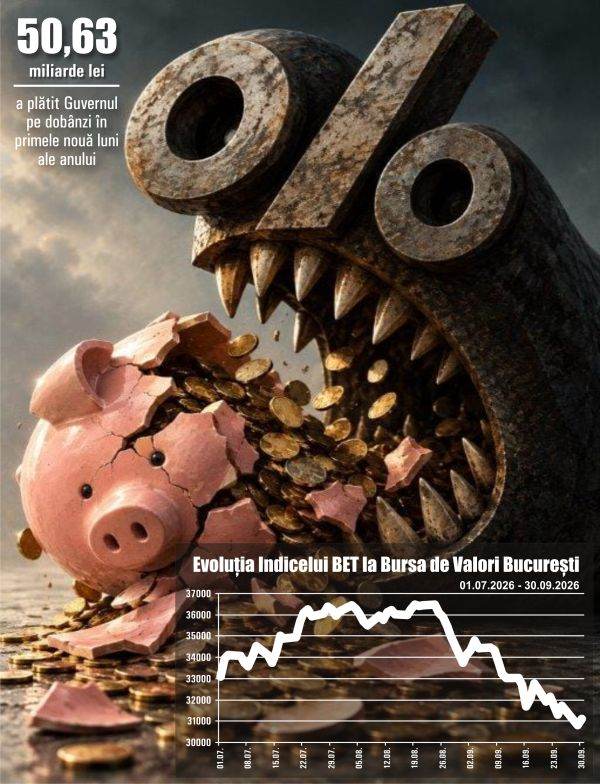
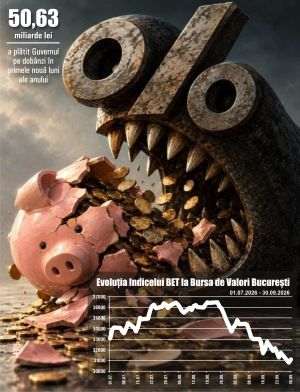
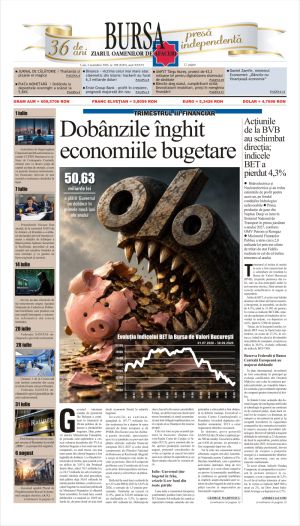
In the third quarter, the interim government led by Prime Minister Ilie Bolojan continued its policy of cutting budgetary expenditures. Although data from the Ministry of Finance show an increase in VAT receipts from July to September and a significantly smaller budget deficit compared to the previous year, the bulk of the fiscal effort was consumed by interest payments. By the end of the third quarter, the country's deficit stood at 3.81% of Gross Domestic Product (GDP) amounting to 78.3 billion lei, which is 24.17 billion lei less than in the same period the previous year. However, 50.63 billion lei had already been paid out in interest alone, according to the nine-month budget execution report published by the Ministry of Finance at the end of October. Over these nine months, interest costs rose by 10.69 billion lei, more than double the savings achieved on public-sector wages.
Investments continued, reaching 107.77 billion lei, though their funding relied heavily on European funds and the National Recovery and Resilience Plan (NRRP). For every ten lei spent on investments, approximately 6.50 lei came from payments linked to the 2021-2027 European financial framework and the two components of the National Recovery and Resilience Plan. The budget managed to fund various works and projects, yet it remains burdened by a persistent, recurring issue: the gap between state revenue and state expenditure.
The nine-month deficit fell from 5.31% of GDP in 2025 to 3.81% in 2026, a correction of 1.5 percentage points. Revenues grew by 11.9% to 522.69 billion lei, while expenditures rose by 5.5% to approximately 601 billion lei. This divergence in growth rates favored fiscal consolidation. However, a smaller deficit compared to last year merely indicates that the state is accumulating additional liabilities at a slower pace; it does not mean the state has reached a point where it can fund itself entirely through its own resources.
This adjustment was put to the test over the course of three months: the dispute between the Government and the High Court of Cassation and Justice (ÎCCJ), the healthcare sector strike in July, the suspension of nuclear power production in August, protests by sheep and goat farmers, and the failure to install a new cabinet in September, all took their toll on the national treasury.
• July: The Government keeps the budget in check, while crises demand funds from every direction
July marked the beginning of a legal confrontation between the Government and the High Court of Cassation and Justice (ÎCCJ) regarding 4.8 billion lei, a sum representing outstanding salary payments for magistrates, which they had secured through various court rulings. The Executive referred the matter to the Constitutional Court of Romania, arguing that the courts had overstepped their authority. The High Court of Cassation and Justice (ÎCCJ) called for compliance with enforceable court rulings.
In the healthcare sector, the general strike organized by the SANITAS union on July 28 involved over 500 facilities. The Government authorized the filling of 6,850 vacant positions, and the strike was suspended after three days.
Also in July, a cyberattack targeted the website of the National Agency for Cadastre and Land Registration. This paralyzed the institution's operations for three weeks, negatively impacting real estate transactions, mortgage-backed lending, and consequently state budget revenues derived from taxes and fees on these transactions.
Furthermore, in July, Pfizer notified Eurocontrol regarding the seizure of funds that the latter was scheduled to pay monthly to ROMATSA, Romania's air traffic control operator, for services rendered. This seizure by Pfizer follows a ruling earlier this spring by the Brussels Court of First Instance concerning vaccines ordered by the Romanian state during the COVID-19 pandemic, which remained unpaid. The amount in question, a liability the Romanian state is now obligated to pay, totals 3.5 billion lei. In response to Pfizer's action, ROMATSA challenged the seizure, while the Government allocated funds from the state budget to ensure the company could continue its operations.
On July 8, the National Bank of Romania (BNR) maintained its key interest rate at 6.50%, against the backdrop of an annual inflation rate of 10.85% recorded in May. The economy had stagnated on a quarterly basis and declined by 1.2% year-on-year in the first quarter, a trend also reflected in a study by the National Institute of Statistics, which indicated relatively stable activity, albeit one impacted by rising prices.
The Bolojan government faced a new sovereign rating assessment. The agency Fitch maintained a BBB- rating with a negative outlook, while highlighting the need for continued fiscal consolidation and the resolution of the political crisis, a crisis triggered on May 5th when the Bolojan government was dismissed following the adoption of a motion of no confidence.
The end of July also brought an unprecedented situation, driven by severe drought across Europe and within the country. At the end of the month, the Danube's flow rate dropped to approximately 1,650 cubic meters per second, a threshold that necessitated the shutdown of Unit 1 at the Cernavodă Nuclear Power Plant, the declaration of a state of alert for the national energy system, and the implementation of hydro-technical interventions costing 7 million lei.
• August: Securing necessary energy - the interim Government's priority
At the beginning of August, Romania faced an energy crisis that emergency measures could contain, though not resolve: the Danube's water level continued to fall, Unit 1 at Cernavodă was already offline, and the operation of the second unit depended on the availability of cooling water. Under normal conditions, these two reactors provide nearly one-fifth of the nation's total electricity output. Consequently, the potential loss of the entire nuclear capacity had become a tangible threat. In the first few days of August, the immediate challenge was meeting electricity demand during the evening. While photovoltaic energy supported the grid during the day, this contribution vanished precisely when other sources, along with imports, needed to take over the load. Authorities mobilized all available capacity, including a reserve unit at the Rovinari power plant, requested increased hydroelectric generation, and turned to imports.
Following a call for energy conservation, consumption on August 4th reached 7,200-7,250 MW between 8:00 PM and 10:00 PM, lower than the projected 7,500 MW. This 250-300 MW difference helped alleviate pressure on the system.
On August 6th, the government approved the Risk Preparedness Plan for the electricity sector. The document outlined a series of successive interventions, including requesting emergency energy from neighboring states and, as a last resort, limiting consumption by large industrial users, while ensuring the protection of the general population and essential services. Concurrently, an additional 5.1 million lei was allocated for dredging operations at Cochirleni and Caragheorghe-Turcescu. Machinery was in constant operation to maintain water access to the power plant. While these temporary solutions bought some time, the worsening drought eventually led to the shutdown of Unit 2 on August 13. Consequently, Romania was temporarily left without any nuclear power generation.
On August 10, the National Bank of Romania (BNR) maintained its interest rate at 6.50%. Annual inflation had fallen to 10.42% in June. During the first half of the year, the current account deficit reached 14.202 billion euros, while direct investments dropped to 669 million euros, down from 3.719 billion euros.
Following negotiations with the European Commission, the amount allocated to Romania under the National Recovery and Resilience Plan was reduced to 20.106 billion euros. The projects are to be completed by August 31, 2026, with the final payment scheduled for December 31, 2026.
Also in August, the European Commission approved a 2.5 billion euro advance for Romania, serving as pre-financing for projects supported by the SAFE mechanism. The necessity for these SAFE-funded projects became clear on August 11, when the threat posed by drones reached the vicinity of the Neptun Deep project. Two "Gerbera" type devices were discovered drifting within Romania's exclusive economic zone, after being spotted by a civilian vessel operating within an offshore investment perimeter. Military divers destroyed them via controlled detonation to safeguard navigation and energy infrastructure. Ukrainian authorities stated that the devices did not belong to them. The incident has drawn attention to the security of the project upon which Romania pins its prospects of becoming the European Union's largest natural gas producer by 2027.
Also in August, with the approval of the 2026-2030 Railway Infrastructure Development Strategy, the interim government led by Ilie Bolojan highlighted the cost of the chronic underfunding that has plagued this sector over the last 36 years. Between 2021 and 2025, only 45.76% of the required funding was met, while the shortfall for maintenance and routine repairs exceeded 12 billion lei. The proportion of railway lines that had surpassed their renewal deadline rose from 10.10% in 1990 to 72.56% in 2025, equivalent to 9,753 kilometers. Passenger transport declined by over 2%, and freight transport by nearly 23%, despite the previous strategy's goal of increasing the latter. The new document proposes addressing the backlog and halting the decline; however, achieving these objectives depends entirely on securing the necessary funding.
• September: Parliament rejects the Mureşan Cabinet
The main event of September was the attempt to resolve the political crisis, a resolution requested by rating agencies Fitch, Standard & Poor's, and Moody's. The nomination of Siegfried Mureşan offered a prospect for ending the interim period, but negotiations throughout September failed to secure the necessary majority. The support of the PNL, USR, and UDMR proved insufficient: the PSD laid claim to the office of Prime Minister, while AUR made its support conditional upon its participation in the government. The dispute also pitted two different interpretations of economic policy against each other. Mureşan's supporters presented the reduction of waste and the reform of the state as prerequisites for recovery. The PSD opposed the continuation of the austerity measures associated with the Bolojan government, while AUR called for early elections. The UDMR warned that the profile of a candidate cannot serve as a substitute for a parliamentary agreement. The hearings held on September 28 and 29 did not alter the balance of power. On September 30, the Mureşan Cabinet received only 182 votes in favor, 51 short of the threshold required for investiture. Romania ended the month facing the same problem: an ousted Executive with limited powers, tasked with managing budgetary pressures and preparing for the coming year. The designation of a new prime minister failed to break the deadlock between the parties, and the political crisis remained a constant throughout the third quarter of the year.
Compounding this was an international controversy sparked by a statement from Kimberly Guilfoyle, the U.S. Ambassador in Athens, regarding the potential dismissal of the Bolojan government, which had opposed a deal to purchase American liquefied natural gas over the next ten years via the Alexandroupoli terminal.
Also in September, the Government faced protests from sheep and goat farmers. Demonstrators gathered in Victory Square (Piaţa Victoriei) to voice grievances concerning blocked exports, sanitary regulations, compensation issues, and the rising costs of animal feed. The protest escalated into violence, leading the gendarmerie to detain 30 individuals for identification and questioning.
The Government maintained that it had held six meetings with sector representatives since July and that the National Sanitary Veterinary and Food Safety Authority (ANSVSA) had submitted a plan to the European Commission aimed at unblocking exports. A draft law exists to compensate for feed costs, but its adoption depended on Parliament, a complicated matter given the interim status of the government.
Discussions held at Cotroceni the following day failed to resolve the conflict; the farmers' delegation left dissatisfied, and representatives of the protesters even suggested taking the matter to Brussels. The promise to resume dialogue once a new government is installed did not address the urgent economic situation faced by livestock farmers. For them, expenses continue to mount, regardless of the political negotiation timeline.
In September, the reform of state-owned enterprises entered a phase involving the inventory of a portfolio whose true scale and reporting issues have become increasingly apparent. Preliminary results presented by the government on September 18 indicated that, out of 1,868 companies, 1,098 met the technical criteria for an analysis regarding restructuring and the reduction of the public portfolio. Another 533, representing 28.5% of the total, had failed to submit their financial statements for the previous year on time.
Concurrently, the platform guvernanta.gov.ro released information on 121 active central-level state companies, along with over 1,350 documents concerning their management teams. The data revealed that more than one hundred individuals held at least two concurrent positions; 115 individuals earned monthly incomes between 25,000 and 50,000 lei, 36 earned between 50,000 and 100,000 lei, and one earned over 100,000 lei. This transparency regarding remuneration has sparked a broader discussion about the costs associated with these management teams. However, the reform was to be judged by its results: the justification for state holdings, management performance, and the implementation of restructuring measures.
• Budget execution - the only piece of good news at the end of the third quarter
The political crisis was also reflected in data from the National Bank of Romania, which recorded a decrease in foreign exchange reserves by 4.805 billion euros, bringing the total to 60.06 billion euros. Outflows included 2.684 billion euros for the repayment of principal and interest on foreign-currency public debt.
The nine-month balance sheet weighed these obligations against the state's actual capacity to finance them. While revenues grew faster than expenditures, a gap of 78.3 billion lei remained. The state spent approximately 1.15 lei for every leu collected.
According to the budget execution data, VAT was one of the primary drivers of revenue growth. Net receipts reached 118.27 billion lei, an increase of 24.8% compared to the same period in 2025. Gross receipts rose by 21.4%, while VAT refunds increased by 8.2%, reaching 26.71 billion lei. The outcome was influenced by changes to VAT rates under Law no. 141/2025. Consequently, higher VAT collections do not automatically imply that the population purchased a proportionally larger volume of goods and services.
Taxes on wages and income generated 47.27 billion lei, an increase of 7.8%. Within this category, receipts from dividends rose by 15.7%, while those related to the "Single Declaration" (tax return) increased by 18.5%. Wage-related taxes grew by 5.6%, outpacing the 3.2% expansion of the total wage bill in the economy.
Social security contributions totaled 165.40 billion lei, an increase of 6.8%, supported in part by an expansion of the tax base. Corporate income tax reached 30.13 billion lei, up 8.7%. Excise duties showed a slower growth rate of only 2.4%, reaching 36.55 billion lei, whereas non-tax revenues fell by 6.8% to 38.32 billion lei.
These variations are significant for the coming months. An increase in revenue achieved through a change in a tax rate has a different profile than one supported by the expansion of economic activity. The former can boost receipts immediately; however, to maintain this momentum once the base-effect comparison wears off, the budget also requires a broader economic base, improved tax compliance, and better collection.
On the expenditure side, public sector wages totaled 122.25 billion lei, 4.43 billion lei less than in 2025. While the reduction of certain bonuses and caps on wages generated savings, spending on goods and services rose by 9.4% to 77.70 billion lei, driven primarily by payments in the healthcare sector. Social assistance spending remained near the previous year's level, at 187.93 billion lei.
The most striking comparison concerns interest payments. At 50.63 billion lei, these exceeded the total revenue collected from taxes on wages and income by 3.36 billion lei. Nearly one out of every ten lei collected by the budget went toward interest payments. The year-on-year increase in these costs, approximately 26.8%, outpaced the growth rates of both total revenues and total expenditures.
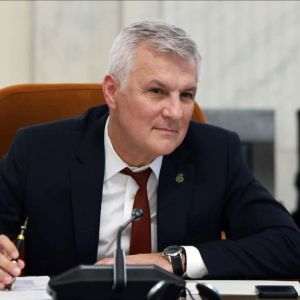
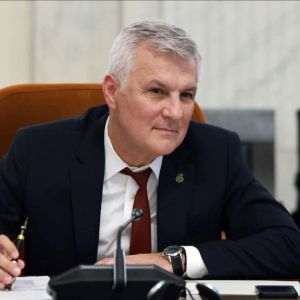
Investments remained the primary counterbalance. At 107.77 billion lei, they were approximately 30.5% higher than in the first nine months of 2025. Payments for projects linked to the 2021-2027 European framework and the National Recovery and Resilience Plan (NRRP) increased by 23.75 billion lei, or 48.8%. EU reimbursements and grants totaled 48.95 billion lei, an increase of 39.8%. Minister of Finance Alexandru Nazare presented the budget execution as confirmation of fiscal consolidation, while warning that the final quarter of the year would exert pressure on the budget. This warning is grounded in reality: the 24.17 billion lei saving, relative to the 2025 deficit target, is significant, yet it coincides with a rising interest burden and investments that rely on the continued flow of European funding. As the year draws to a close, the key question is how much of this achieved correction can be sustained without the state once again deferring expenditures that could help shield it from the next crisis.
















 Euro
 Dolar SUA
 Franc elveţian
 Liră sterlină
 Gram de aur
























Reader's Opinion