English

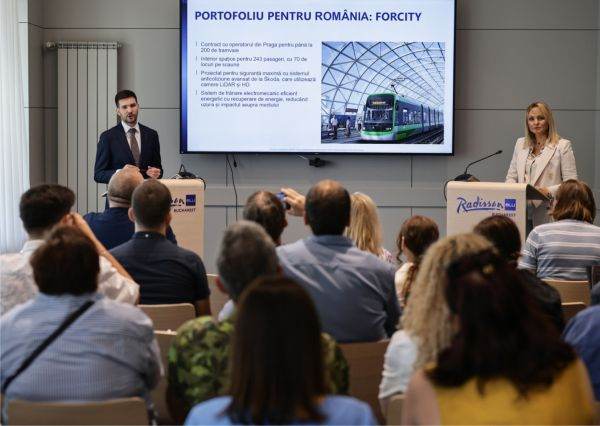
Skoda Group has launched a broad offensive on the Romanian rail transport and urban public transport market, and the offer on the table includes classic electric multiple units and battery trains for non-electrified lines, trams adapted to the infrastructure of each city, collision avoidance technologies, predictive maintenance, automated depots, 15-30-year service contracts and even a local center where advanced maintenance can be combined with the final assembly of rolling stock.
The message sent by the representatives of the Czech company is that Skoda does not want to enter Romania for a tender and leave after the delivery of the vehicles, but to build a permanent industrial presence here.
"We want to develop our presence in Romania," said Olesea Lachi, vice president for Southern and Eastern Europe, of Skoda Transportation, part of Skoda Group, during a press conference. explaining that the decision is a strategic one at the group level. Skoda's arguments are the size of the market, the huge need to modernize rolling stock and infrastructure and Romania's position on the European corridors that connect the Black Sea to the rest of the continent.
"The Romanian market is a large one that requires significant investments, not only in rolling stock, but also in the railway sector. There are major investments that Romania is going to receive in the form of financing from the European Union and in the form of modern technological solutions from us and, probably, from our competitors. Romania is important not only in terms of its size and the need for modernization, but also from a strategic point of view, because the two European corridors that cross it place Romania in a central position of connection between the Black Sea and the rest of Europe", said Olesea Lachi.
The ambition is also confirmed by Vlad Măcelaru, Business Development Manager at Skoda Transportation: "We want to build a permanent local presence - and this is the main message of our press conference today. We do not just want to deliver rolling stock or export trains and trams. We want solid partnerships in Romania. We are already collaborating with Romanian companies, both private and public, in areas such as engineering, production and maintenance”.
• Battery electric multiple units for the Romanian railway infrastructure
For the Romanian railway, one of the products that Skoda considers particularly suitable is the BEMU - Battery Electric Multiple Unit -, the battery-powered electric multiple unit, capable of running both on electrified sectors, powered by the catenary, and on non-electrified lines. The stakes are obvious in our country where, according to data presented by the company, only approximately 40% of the railway network is electrified. Skoda thus proposes trains that can eliminate the need to change rolling stock when switching between an electrified and a non-electrified line. Olesea Lachi showed that the group has electric trains with traction batteries capable of continuing to travel without a pantograph for approximately 80 kilometers, as well as solutions with autonomy of over 150 kilometers.
Vlad Măcelaru explained that BEMU is designed precisely for "the needs of a market with a developing infrastructure, which is not completely electrified”, a category that Romania falls into. The train normally runs from the electrical network where there is a catenary, switches to batteries for approximately 80-100 kilometers on the non-electrified sector, and after returning under the catenary, the batteries are recharged on the go, without the need for a fixed charging station.
"We consider these trains extremely suitable for metropolitan train projects that are starting to develop in Romania”, specified the Skoda representative.
The technical platform that the company proposes is RegioPanter.
Skoda does not claim, however, that the battery is automatically the ideal solution in every situation. On the contrary, Olesea Lachi drew attention to the fact that, in the case of trams, it adds a significant mass to the vehicle, which must be transported for decades and which increases energy consumption. In the case of railway trams, where the operating life is at least 30 years, each additional kilogram transported unnecessarily turns into an operational cost. For this reason, the company says that the battery size must be made strictly according to the real needs of the route.
In parallel, Skoda wants to enter the competition for conventional electric trams purchased by Romania. The company did not participate in the previous tenders organized by the Railway Reform Authority, Olesea Lachi explaining that the technical specifications requested at the time were not fully compatible with Skoda platforms, and the delivery times were too short to make the adaptations. The situation has changed, however: "Currently, there are in discussions with ARF on both simple electric trams and battery-powered trams,” she said.
• Skoda proposes trams on pivoting bogies for Bucharest
One of the most important objectives of the Czech company is public transport in Bucharest. That is why Skoda is preparing to participate in the upcoming tender for trams of the Capital City Hall and has already taken part in the market consultation, along with three other manufacturers. "Obviously, if we participated in the consultation, we also want to participate in the tender,” said Olesea Lachi, specifying that the final decision depends on the specifications, specifications and delivery schedule. The initially discussed term of nine months for the first unit was considered unrealistic by Skoda, the company assessing that at least 12 months are needed.
And Skoda says that it is preparing its tram including for one of the historical vulnerabilities of Bucharest transport: the state of the infrastructure. The proposed solution is a tram with pivoting bogies and a 100% lowered floor. Unlike a fixed bogie, where shocks and irregularities in the track are transmitted more strongly to the chassis and passenger compartment, the pivoting bogie can be oriented under the vehicle, reducing the forces exerted on the wheels and the rail. According to the company, the result is reduced wear on the wheels and infrastructure and increased passenger comfort. The proposed tram is from the ForCity Plus family, and the model presented has a capacity of 243 passengers, of which 70 on seats, the interior can be configured according to the operator's requirements.
• Smart depot - a plus in the Skoda offer
The most interesting component of the offer for Bucharest is not the vehicle itself, but what Skoda wants to build around it. The Czechs propose a long-term maintenance partnership and the introduction of the "Smart Depot" concept, in which an important part of daily operations is automated. In the model described by the company, a tram enters the depot and automatically passes through several checkpoints, the bogie being inspected endoscopically, the vehicle cleaned and the diagnostic data processed digitally. The stated objective is radical: moving from a situation in which five people service a tram to one in which a single employee supervises the maintenance process for five trams. Such systems are already operating, according to Skoda, in Tampere - Finland and Mannheim - Germany and are at an advanced stage of implementation in Prague and Bergamo.
The company's representatives claim that any existing tram depot in Bucharest could be transformed into a smart depot, without "colossal” investments and without radical reconstruction of the infrastructure. Moreover, they state that the technology should not be limited to its own trams. Even the Astra Imperio already in STB operation could be equipped with the ACS anti-collision system and Skoda diagnostic systems for integration into a smart depot.
Digitalization goes even as far as predictive maintenance. The vehicle's sensors constantly transmit information to the control center, with the tram essentially functioning as a "Digital Twin". If, for example, a door motor starts to consume more current than normal, the system can identify the appearance of mechanical resistance before the door actually fails. The technical team can thus intervene preventively, instead of waiting for the breakdown to occur.
Added to this is the anti-collision system developed by Skoda specifically for trams. Video cameras and Lidar sensors constantly scan the road and build a "virtual tunnel" of the route. The computer compares the ideal route with the real situation in real time, and the appearance of a pedestrian, car or other obstacle triggers the driver's warning and, if the impact becomes imminent, automatic braking. The braking system is electromechanical, recovers energy and works without oil.
In the urban transport segment, Skoda's presence in Romania is already more important than the number of vehicles actually bearing the brand suggests. The company estimates that there are approximately 160-170 trolleybuses with Skoda technology in operation in Romania. In the partnership with Solaris, for example, the body and interior are made by the Polish manufacturer, while the propulsion, traction, energy capture, engines and battery management are provided by Skoda, with the vehicles bearing the inscription "Powered by Skoda BlueDrive".
The Skoda Group has approximately 10,000 employees and seven production units. The main industrial center is located in the Czech Republic and has a production facility in Finland. The Skoda Group reported new contracts of almost 1.8 billion euros for 2025. The figure of approximately 1.8 billion euros in new orders for 2025 is confirmed by the official results published by the group in June 2026, which also show a doubling of EBITDA, up to 143 million euros. The company produces electric trains regional and interregional trains, trains capable of reaching 200 km/h, trams, metros, trolleybuses and components, from bogies and motors to converters, digital systems, command and signaling.






















 Euro
Euro Dolar SUA
 Franc elveţian
 Liră sterlină
 Gram de aur