 English
On Thursday, the state borrowed from banks for a one-year term at a yield of 6.73%-a higher cost than the 6.50% interest rate it offers the general public through "Tezaur" bonds. For ten-year bonds, the situation is reversed: the public receives 7.75% through "Fidelis" bonds, whereas banks received 7.18%. Regarding ten-year bonds, the state intentionally pays the public a higher rate, albeit on smaller total amounts than those borrowed from banks.
• BURSA• reported yesterday that the Ministry of Finance auctions held on Thursday-the first since PSD President Sorin Grindeanu received his negotiating mandate-reveal the rates banks are demanding from the state amidst negotiations for the Niculescu government. We had outlined four key outcomes to watch, and the Ministry of Finance, along with the National Bank of Romania, published the results on Thursday.
1.The amount requested by banks.Banks submitted bids for 673 million lei in treasury bills against an issuance target of 500 million (135% of the state's offer) and for 688 million lei in bonds against a target of 500 million (138%). The implication: banks purchased government securities on the very day government formation consultations were taking place, and the state is able to cover its October borrowing needs. However, demand was lower than on October 5-three days after the S&P decision-when banks had bid for nearly two and a half times the amount offered in 22-month bonds.
2.One-year interest rate vs. Tezaur.
The state borrowed from banks for one year at a yield of 6.73% via Treasury bills, while paying the public 6.50% on Tezaur securities. What this means: on an investment of 10,000 lei, a bank earns approximately 680 lei over a year, whereas a Tezaur holder earns 650 lei. For the reader, the implication is that the November Tezaur issuance might offer a higher interest rate. Anyone buying one-year Tezaur securities now locks in a 6.50% interest rate.
3.Ten-year interest rate.The state borrowed from banks for ten years at a yield of 7.18% through bonds maturing in 2036. On September 3, the yield for a similar maturity was 7.09%, while on September 24 it was 7.42%. What this means: the cost of ten-year state borrowing has decreased compared to the September peak but remains higher than at the beginning of the month. These figures do not allow for distinguishing how much of the difference stems from political uncertainty versus external interest rates or inflation. The Ministry of Finance plans to borrow 5.8 billion lei from banks in October. If the entire amount were borrowed at a rate 0.1 percentage points higher, the cost would increase by approximately 5.8 million lei for each year of the loan.
4.Rejection of offers.The Ministry of Finance accepted the banks' offers at both auctions. On October 1, the ministry had rejected all offers at the auction for 58-month bonds because the banks were demanding interest rates it found unacceptable. This implies that the interest rates demanded by the banks have returned to a level the state is willing to accept.
The four results indicate that banks are lending to the state, but at higher interest rates than in early September. The difference between what banks receive and what the public receives stems from how the interest rates are determined. The Ministry of Finance sets the interest rates for Tezaur and Fidelis bonds for the entire duration of an issuance, whereas the rate demanded by banks is determined anew at each auction.
Tezaur rates below those demanded by banks
Treasury bills do not bear interest: the bank purchases them below their face value and receives the full value at maturity. The difference, calculated on an annual basis, is known as the yield and can be compared to the Tezaur interest rate.
Prior to October 5, the Ministry of Finance set the Tezaur interest rates at 6.50% for one year, 7% for three years, and 7.50% for five years, and is keeping them unchanged until November 6. Meanwhile, interbank lending rates have risen-particularly during the first few days of October-according to the National Bank of Romania (BNR). On Wednesday, a bank could earn 6.02% by lending to other banks on an overnight basis, according to • BURSA• . To lock up funds for a year in a Treasury bill, a bank demanded a yield of 6.73%.
Holders of "Tezaur" bonds do not lose any of their principal, as the interest rate remains fixed at the level set at the time of purchase and is tax-exempt.
In October, the Ministry of Finance raised "Tezaur" interest rates following the increases in rates demanded by banks in August and September. If the rates demanded by banks remain higher than those offered by "Tezaur" securities, the Ministry has grounds to raise them again in November.
Ten-year term: Fidelis beats banks
The Fidelis issuance running from October 2 to 9 offers interest rates in lei of 6.60% for two years, 7.15% for four years, and 7.75% for ten years, according to Agerpres.
On an investment of 10,000 lei, the holder of a ten-year Fidelis bond receives 775 lei annually. A bank obtains an equivalent yield of approximately 718 lei per year, derived from the 6.90% coupon and the fact that it paid 98.04 lei for every 100 lei of the bond's face value.
For the ten-year term, the difference cannot be explained by the planification. The 7.75% Fidelis interest rate is even higher than the 7.42% peak seen on September 24, meaning the Ministry of Finance is intentionally paying the public a higher rate.
On October 5, Minister Alexandru Nazare stated-according to Agerpres-that he is aiming for "a broader investor base, better-distributed maturities, and reduced dependence on episodes of external volatility." According to the same minister, foreign investors currently hold approximately 17% of government securities, the lowest level in five years.
The March Fidelis issuance raised nearly 1.2 billion lei (according to Agerpres), whereas in October alone, the state is borrowing 5.8 billion lei from banks. Consequently, the general public cannot replace banks as a source of funding for the state. The interest rate differential applies to smaller sums than those borrowed from banks, so the cost to the budget is limited.
Low Liquidity of Fidelis Bonds
Part of the interest rate premium compensates for a disadvantage faced by Fidelis holders. Fidelis bonds are listed on the Bucharest Stock Exchange but see low trading volumes; in 2024, Fidelis bonds worth 3.2 billion lei were traded-approximately one-tenth of the total issued value, according to the BVB.
A • BURSA• reader wrote to us yesterday stating that he was unable to sell his Fidelis bonds. Anyone selling before maturity receives the market price on the day of the sale, which may be below the bond's face value. Banks can easily trade these bonds among themselves and use them as collateral when borrowing from the National Bank.
Investors who hold Fidelis bonds until maturity do not rely on their stock exchange price to recover their funds. Repayment depends on the state's ability to service its debt, just as it does for banks. The Fidelis issuance closes on Friday, October 9.
Cost to the budget
Interest earned on Tezaur and Fidelis bonds is tax-exempt. The state recoups a portion of the earnings paid to banks through taxation. Banks are liable for a 16% corporate income tax and, as of 2026, an additional turnover tax of 4% (or 2% for credit institutions with a market share below 0.2%). Since these two taxes are calculated based on different metrics, the actual amount recouped cannot be determined simply by adding the tax rates together.
For ten-year bonds, the state pays the public a higher rate than it pays banks-even before taxes-at 7.75% versus 7.18%; consequently, borrowing from the public costs the budget more, regardless of how much the state recoups through taxes on banks.
For one-year bonds, the state borrows from banks at a yield of 6.73% while paying the public 6.50%. Borrowing from the public still costs the budget more in this one-year scenario if the state recoups more than 3.4% of the earnings paid to banks through taxation. For the bondholder, this difference represents a gain.
Link to government formation negotiations
On October 2, S&P maintained Romania's rating at BBB- with a negative outlook. The agency's baseline scenario assumes the formation of a government that adopts a credible budgetary framework for 2027 and 2028. S&P indicated it could downgrade Romania if a prolonged government formation process hindered deficit reduction during those two years. Following a downgrade, government bonds held by banks would lose value, and banks factor this risk into the interest rates they demand.
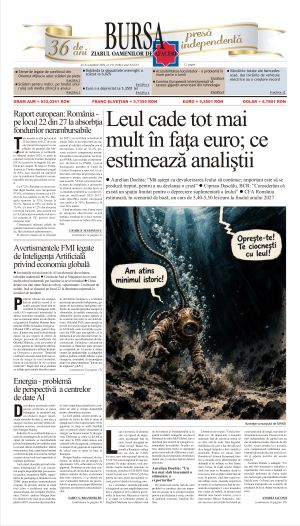
On September 30, Parliament rejected the Mureşan government, and on October 1, the Ministry of Finance rejected the banks' offers. On October 2, S&P maintained the rating, and on October 5, bank demand rose to nearly two and a half times the amount offered. On October 6-the day after Luca Niculescu was designated-the euro hit a record high of 5.3527 lei.
Thursday's auctions took place on the same day Luca Niculescu began consultations with the PSD, PNL, and UDMR; banks submitted their offers without knowing the outcome of those talks. Luca Niculescu spoke of "adhering to the commitments Romania has made regarding its fiscal trajectory."
According to Agerpres, the PSD set two conditions: a "change in economic direction" and a "committed parliamentary majority, particularly from the PNL and UDMR." Prior to the meeting, PNL leader Ilie Bolojan had stated: "State spending must not increase." Following the meeting, Agerpres announced that the PNL is open to voting for the Niculescu government but does not intend to participate in governance alongside the PSD.
The PSD is demanding that the PNL take responsibility for the majority, while the PNL refuses to govern with the PSD. Consequently, the majority needed to vote on the 2027 budget-which underpins S&P's baseline scenario-does not yet exist.
Link to international markets
Oil prices have risen above $100 per barrel due to tensions in the Middle East, according to BURSA, and the National Bank estimates that inflation in Romania will increase by the end of the year.
On Thursday, the NBR maintained the monetary policy rate at 6.50% and the interest rate banks receive for depositing funds with the NBR at 5.50%. A bank can earn 5.50% risk-free at any time by depositing its funds with the NBR. As long as banks do not expect the NBR to lower the interest rate, no bank has motifs to lend to the state on a short-term basis at a rate below 5.50%. As long as high oil prices prevent the National Bank of Romania (BNR) from cutting interest rates, the cost of short-term state borrowing cannot decrease. For ten-year debt, the interest rate depends more on the budget and the country's credit rating-factors determined by government formation negotiations.
The European Central Bank raised interest rates on September 10 due to inflationary pressures stemming from the conflict in the Middle East; consequently, the yield on ten-year German bonds climbed to its highest level since 2009 last week, as reported by • BURSA• on October 7. Investors demand a rate from Romania equal to the Eurozone rate plus a risk premium; therefore, the rising cost of German borrowing spills over into the cost of Romanian borrowing.
However, during the same period, Romania's ten-year bond yield fell from 7.42% to 7.18%. This decline did not stem from German interest rates, which rose during those same days. Meanwhile, S&P affirmed Romania's credit rating.
The euro fell against the dollar to its lowest level since May 2025 due to the fiscal crisis in France, while the leu simultaneously dropped to a record low against the euro. The leu depreciated even against a currency that was itself weakening; therefore, the leu's decline cannot be explained by the weakening of the euro. On Thursday, the National Bank noted that government bond yields rose significantly in September "against the backdrop of the conflict in the Middle East as well as the domestic political situation."
What comes next
The Ministry of Finance is holding further bond auctions in October-on the 12th, 15th, 19th, 22nd, 26th, and 29th-along with a Treasury bill auction on October 29. Each auction will reveal the rates banks demand from the state as government formation negotiations progress; the requested yields will indicate whether the Ministry of Finance has grounds to adjust the interest rates for the Tezaur and Fidelis programs in November.
The National Bank is set to publish the minutes of Thursday's meeting on October 20, with the next monetary policy meeting scheduled for November 12. A date for the investiture vote for the Niculescu government has not yet been announced.
AUTHOR'S NOTE
This analysis was prepared with the assistance of artificial intelligence; I bear full responsibility for the analysis.
Florian Goldstein
























 Euro
Euro Dolar SUA
 Franc elveţian
 Liră sterlină
 Gram de aur































Reader's Opinion