English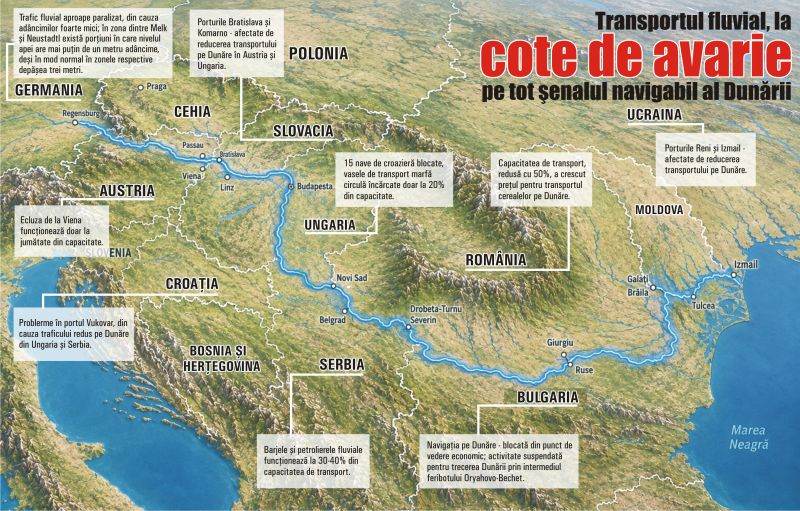
The Danube, the main road that connects German industry to the ports of Austria, the plains of Hungary, the refineries of Serbia, the silos of Romania and, finally, the Black Sea, has become this summer a succession of rapids, sandbanks, underloaded ships and ports where cargo is dwindling from one day to the next, according to data published in the European and international press, whether we are talking about Reuters, Associated Press or the news sites Tagesschau, Der Standard, ORF, ZDF Heute, RTS, Telex, BTA, Nova, Agerpres or we refer to the information published by the administrations on river traffic in the related states.
The persistent drought, extreme temperatures and lack of precipitation in the upper basin have lowered the river to historic or close to absolute record levels, transforming one of the most important European trade routes into a fragmented corridor, on which navigation is still legally possible, but becomes economically impossible.
The situation can no longer be described as a simple seasonal problem for river carriers. When a ship carrying a thousand tons can only load two or three hundred tons, the engine consumes almost the same, the crew costs the same, taxes remain, and the cargo must be divided between several ships. The sources cited claim that the price of transport per ton explodes, deliveries are delayed, stocks decrease, and the additional cost propagates from ports to refineries, combines, factories, gas stations and, ultimately, into the consumer's pocket. Especially since the Danube is not only transporting grain and tourists. The river also carries oil and oil products, coal, ores, fertilizers, construction materials, chemicals, machinery and raw materials at the beginning of entire industrial chains.
• River traffic almost paralyzed in Germany
The German press reports that in that country the upper reaches of the Danube are almost paralyzed in certain sectors, and cargo ships can only travel with greatly reduced loads. The lack of water is simultaneously affecting the Danube and the Rhine, the two major river axes on which German industry depends. Transport cannot simply be moved by rail or road: the railway infrastructure has limited capacity, modernization works are further reducing the available space, road transport is facing a shortage of drivers and trucks, and German bridges and roads have been accumulating investment delays for decades.
The example given by the German Economic Institute and taken from the cited sources is instructive: replacing ships carrying gasoline and diesel on the Rhine alone would require approximately 3,000 tankers every day. On the Danube, where the capacity of land alternatives is even lower, moving comparable volumes would be equally unrealistic. Especially since, according to the cited sources, in some sections of Germany the Danube has the lowest water level in the last 30 years. For example, between Melk and Neustadtl there are sections where the water level is less than one meter deep, although normally in those areas it exceeded three meters, such as at Pochlarn.
• Austria closes part of the Vienna lock, Slovakia - no problems
From Germany, the crisis is spreading to Austria, where the first seven months of 2026 were the poorest in precipitation since the beginning of modern measurements, in the 20th century. According to information provided by ORF and Der Standard, cargo ships can no longer be fully loaded, operators are transferring volumes to trains and trucks where they can, and the administration of the navigable Danube has introduced special warnings for shallow waters, including the obligation to reduce speed and avoid waves and the suction effect. In the Vienna area, the closure of a sections of the Freudenau lock add a technical obstacle to an already natural crisis. Traffic continues on some sections, but the continuity of the corridor is compromised: a ship crossing Austria does not gain much if it gets stuck a few hundred kilometers downstream.
Slovakia benefits partly from the regularization produced by the Gabcikovo system, but even this advantage cannot restore a broken trade route upstream and downstream. The ports of Bratislava and Komarno are caught between Austrian difficulties and the near paralysis of the Hungarian sector. Even if there is no general administrative closure of the Slovak Danube, ships have to reduce their draft, wait and adapt their cargo to the most difficult threshold along the entire route. In river transport, the average depth of the journey matters less than the shallowest point. A single bottleneck can cancel the commercial capacity of hundreds of navigable kilometers.
• Maximum 20% of ship capacity on Hungarian Danube section
According to Hungarian media, the Danube in the neighboring country has gone from warning to record low flow. In Budapest, the level dropped from 39 centimeters on July 16 to 31 centimeters on the morning of July 28 and to 28 centimeters that same afternoon. Later values of 23 centimeters and even about 10 centimeters were reported, below the previous negative record from 2018. These levels do not represent the total physical depth of the river, but the position of the water relative to the local zero of the bride, but the economic significance is unequivocal: most cargo ships have stopped, and the few that continued to circulate carried only 10-20% of their usual capacity.
Around 15 cruise ships were stationed on the Hungarian section at the end of July. Cruise ships could no longer dock in Budapest normally, itineraries were being changed, and passengers were being transferred by coach. MAHART-PassNave had already reported an 18% drop in bookings since July, in an industry where international cruises typically bring around 600,000 passengers to Hungary annually. The losses do not stop with the ship operators: they reach hotels, restaurants, shops, museums, transport services and the Danube towns that live off each berth.
But the blow goes beyond tourism. The low flow of the Danube has affected the operation of the Paks nuclear power plant, which normally supplies almost half of Hungary's electricity. The shutdown of the reactors has forced the government in Budapest to look for more expensive imported energy, just as Hungarian businesses are facing more expensive transport and raw materials that are harder to source. The river crisis has thus become a logistics, energy and industrial crisis all at once.
• Croatia - problems in Vukovar, Serbia - river transport reduced by a third
In Croatia, the Danube levels have dropped to historic lows, and sandbanks have surfaced in the Opatovac area and other parts of the eastern course. Barges and river tankers crossing the Croatian-Serbian sector must comply with the same draft limitations that choke the entire middle basin. For Croatia, the direct effect on the national economy is smaller than in Hungary, Serbia or Romania, because the Danube sector is shorter, but the port of Vukovar and its connections to regional industry and agriculture depend on the continuity of the route to central Europe and the Black Sea. A Danube navigable only in fragments no longer functions as a commercial artery.
At the entrance to Serbia, in the Bezdan area, the level had reached minus 137 centimeters from the zero of the bride on August 1, only six centimeters from the absolute record of minus 143 centimeters. Hydrologists predicted a further drop of 10-15 centimeters and warned that no significant precipitation was expected for about 45 days. In places where convoys of six barges used to pass, in some areas only one could pass. Transport capacity was initially reduced by half, then to about a third of its usual level.
The effect on Serbia's supply was rapid: fuel imports fell in July to only 25% of the monthly target, while barges and river tankers were operating at 30-40% of capacity. Cargo is being transferred between barges to reduce draft, ships are being laid up, and ever smaller quantities are arriving at ports. Nautical tourism has almost completely stopped, passenger ships no longer normally arrive in Belgrade, and the cost of each ton transported is increasing even if the ship leaves almost empty. Downstream of the capital, the situation is somewhat better due to the effect of the Iron Gates system, but the local advantage cannot compensate for the bottleneck in Vojvodina and Hungary.
The water crisis has also hit Serbia's energy sector. The output of the Iron Gates hydropower plant has reduced at exceptionally low levels, with values reported ranging from about 20% to a third of normal production, depending on the time of assessment. Serbia must therefore simultaneously manage the reduction of river fuel imports and the collapse of hydropower production. It is the combination that shows most clearly how false is the impression that the reduction in the river's water flow would only represent a difficulty for sailors.
• Bulgarian navigation on the Danube, economically blocked
In Bulgaria, the Danube is setting negative records almost from one day to the next. In Ruse, the level dropped from minus 69 centimeters on July 21 to minus 87 centimeters on July 30, minus 88 centimeters on July 31, minus 89 centimeters on August 1 and minus 92 centimeters on August 3. Authorities have identified five critical sectors near Svishtov, Somovit and the islands of Belene, Batin and Vardim. In some of these areas, only ships with a draft of no more than 1.90 meters could pass, and for the common Romanian-Bulgarian sector, Serbian operators were already indicating a practical draft of approximately 1.50 meters.
Bulgarian navigation was not officially stopped, but it was described as economically blocked by the press in the neighboring country. Ships remain near the shore because traveling with a tiny load no longer covers the costs. The Oriahovo-Bechet ferry was suspended, and on July 28 the cruise ship "Viking Ullur” ran aground near Vidin. All 186 passengers and 52 crew members were evacuated. The incident did not cause any casualties, but it became the image of a river on which even tourism with specially adapted ships is starting to be a lottery.
• Reduced activity for Romanian Danube ports
In our country, the river transport crisis has been felt since the entrance of the Danube at Baziaş, where the flow rate dropped to 1,500-1,550 cubic meters per second at the beginning of August, less than a third of the usual July average. Forecasts indicated 1,450 cubic meters per second between July 31 and August 5 and the possibility of a drop to 1,400 cubic meters per second, close to the historical minimum since 1985. Up to Călăraşi, the contribution of Romanian and Bulgarian tributaries only raised the flow rate to approximately 1,750 cubic meters per second, insufficient to restore normal navigation conditions.
The Lower Danube River Administration (AFDJ) recorded yesterday morning a river water level of minus 165 centimeters at Calafat, minus 106 centimeters at Cetate, minus 148 centimeters at Gruia, approximately minus 160 centimeters at Giurgiu and minus 213 centimeters at Cernavodă. A new decrease of up to eight centimeters was anticipated at Giurgiu, and up to three centimeters at Cernavodă. We note that AFDJ issued an opinion on the existence of a force majeure case on July 17, caused by the flow below the multi-annual average and the degradation of navigation conditions.
Under these conditions, shipowners were forced to reduce by at least half the load of river transport vessels, and even barges - from 1000 tons to 500 tons and even less -, in order to avoid reaching the river bottom in shallow areas.
On the Romanian-Bulgarian common sector, ships must reduce their load, wait, tranship cargo or abandon the voyage. Each such decision directly affects Romanian ports and the chains that depend on them. For grain exporters, a reduction in river capacity in the middle of the agricultural season means queues, delays, contractual penalties and higher tariffs. In fact, the price of grain transport has increased from 55 lei to 53 lei per ton. For importers of petroleum products, ores, coal or fertilizers, it means lower stocks and costs that are transferred to the industry. For Danube ports, it means fewer tons handled, fewer operations and lower revenues. For Constanţa, it means a weakening of the flow that connects the Central European hinterland to the Black Sea.
The intervention of the Romanian authorities on the Bala branch, where approximately 180 kilograms of explosives were used to remove a rock formation and direct a larger volume of water towards the Old Danube, shows the exceptional scale of the situation. The operation aims both to support the water supply of the Cernavoda power plant and to improve the water circulation on the navigable route.
• Limited activity in the Ukrainian ports of Reni and Izmail
Downstream, the ports of the Republic of Moldova and Ukraine depend on the branches of the Danube and on access to the Black Sea, but the volumes that reach here are conditioned by all the thresholds crossed in Germany, Austria, Slovakia, Hungary, Croatia, Serbia, Bulgaria and Romania. Giurgiulesti, Reni and Izmail have become important nodes for regional trade and, after the outbreak of the war in Ukraine, for Ukrainian exports. Any reduction in navigability on the Danube lower limits the alternative capacity offered to Ukrainian ports, makes grain transportation more expensive and puts additional pressure on rail, road and sea routes in the region.
The damage is not measured only in idle ships. It multiplies throughout the economy. A barge loaded 20% in Hungary or 30% in Serbia means more trips for the same quantity, more fuel consumed per ton transported, higher tariffs and longer delivery times. A raw material that does not arrive on time can stop a production line worth dozens of times the cost of the cargo. A cruise ship that does not dock takes with it the income of local restaurants, guides and traders. A hydroelectric power plant producing at a fifth of capacity and a nuclear reactor that must be reduced or shut down push energy prices up just when the industry needs more expensive logistical alternatives.
Precedent shows the scale of the risk. The 2018 drought caused losses in the billions of euros in Germany alone and reduced industrial production. In the current crisis, the Danube is affected almost simultaneously along its entire route, and the rail and road networks do not have the capacity to absorb the lost volumes. Romania, Serbia, Hungary, Austria and Germany are not facing seven separate crises, but the same logistical crisis at seven different points.
The Danube is not officially closed, but this formulation risks hiding the reality. A waterway on which most ships are stationary, while the others are operating at 10%, 20% or 30% of capacity, is open mainly on paper. From Germany to the mouths of the Danube, the river has lost a major part of its commercial function in a few weeks, and Europe is discovering that the resilience promised in strategies cannot be transported on an empty barge.
• The Rhine, the industrial artery between Germany, the Netherlands and Belgium, choked by low waters
The Danube crisis is doubled in western Europe by the collapse of the Rhine levels, the continent's most important commercial waterway and the essential link between the ports of Rotterdam and Antwerp, the oil terminals in the Amsterdam-Rotterdam-Antwerp region and the major industrial centers in Germany, France and Switzerland. According to the German media - Tagesschau and ZDF Heute - at Kaub, the critical point between Mainz and Koblenz, the water level has dropped to around 25-29 centimeters, in the area of the negative record of 2018. Below 40 centimeters, according to the cited sources, efficient commercial navigation becomes extremely difficult.
Ships continue to circulate as long as safety allows, but only with a fraction of their normal load. On the critical sector at Kaub, some ships are operating at around 20% of capacity. A tanker barge that could carry over 2,000 tonnes can now only load around 1,200 tonnes in Duisburg and only around 460 tonnes in Kaub. The price for transporting a tonne of cargo from Rotterdam to Karlsruhe rose from around 45 euros at the end of June to 60-70 euros in July, and the pressure continues as quotas fall.
Replacing river transport of petrol and diesel on the Rhine would require around 3,000 tankers per day, an impossible solution given the shortage of drivers, limited rail capacity and deteriorating road infrastructure.
The chemical, steel, energy and building materials industries are most at risk. BASF, Covestro and Evonik risk delays or shortages of raw materials, and Thyssenkrupp has already reduced production due to supply difficulties. Economic experts estimate, according to the sources cited, that the current Rhine flow crisis could reduce Germany's economic growth by about 0.2 percentage points.
The effect is transmitted to Rotterdam and Antwerp. Ships in seaports can unload oil, petroleum products, ores, coal, chemicals or containers, but the evacuation of goods to the interior of the continent becomes slow and expensive. Cargo accumulates in terminals, shallow water surcharges increase and barge traffic is unbalanced. Rotterdam risks becoming a wide-open maritime gateway to a river route narrowed by drought.
The Dutch economy is more protected than German industry, because the lower Rhine is deeper and many companies are located directly in the seaports. However, an ABN AMRO study shows that 30 consecutive days below the critical threshold could lead to a cumulative reduction of around 24% in river freight transport in the Netherlands over the next two months, with the strongest effect on international traffic. Belgium is feeling the pressure through the port of Antwerp-Bruges, the petrochemical complexes and the river connections to the Rhine basin: goods destined for Germany have to be stored longer, redirected or transported at higher costs.
The precedent from 2018 remains the major warning. Then, the low waters of the Rhine reduced German industrial production by approximately 1.5% in a single month, cut about 0.4% of Germany's GDP and caused losses to carriers estimated at approximately 2.8 billion euros. If current rates are maintained, the Rotterdam-Antwerp-Ruhr-southern Germany axis may once again transform a hydrological drought into a European industrial shock.



























 Euro
Euro Dolar SUA
 Franc elveţian
 Liră sterlină
 Gram de aur