English

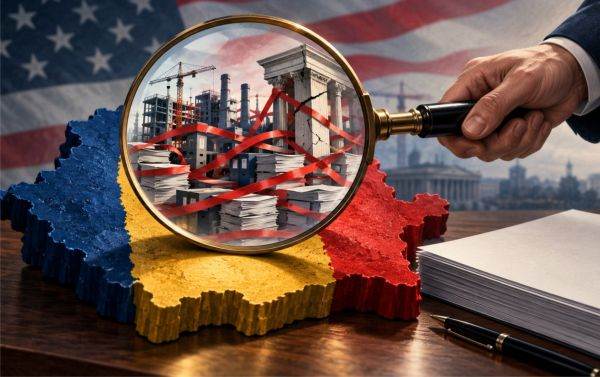
Romania seeks investors but greets them with hastily changed laws, unpredictable taxes, stifling administrative procedures, corruption, and court rulings whose enforcement triggers further costly proceedings-this is the uncomfortable picture painted by the US State Department's 2026 report on Romania's investment climate. Published recently on the State Department's website, the document comes to public attention at a critical moment for the country's economic credibility: S&P Global Ratings is scheduled to review Romania's sovereign rating today, October 2. Romania enters this assessment holding a BBB- rating-the lowest tier of investment-grade status-and a negative outlook.
While the US report does not issue a verdict on the rating or announce a downgrade, it once again highlights the vulnerabilities that make defending Romania's credibility difficult: weak institutions, unpredictable decision-making, persistent deficits, and challenges in translating European funds into actual development. The timing-with the document's release coinciding closely with the S&P review-lends particular weight to these findings. Across the report's 33 pages, the US describes a country with strong arguments for attracting capital, yet one that erodes its own advantages through the way it is governed. Its strategic location, membership in the EU and NATO, natural resources, educated workforce, and competitive wages are explicitly acknowledged. Information technology, the automotive industry, energy, defense, industrial manufacturing, healthcare, and financial services offer opportunities; however, problems arise when an investor moves beyond the country's attractive pitch and attempts to actually build a business. That is when they enter a system where rules can change before the investment even begins to yield returns.
Data regarding the business environment paints a picture that starkly contradicts the official narrative about Romania's attractiveness. The report cites the January-February 2025 Eurobarometer survey: 90% of Romanian businesspeople view corruption as widespread, compared to a European average of 63%. Furthermore, 62% believe that public officials favor their own family members or friends. When asked about obstacles encountered in their operations, 96% point to tax levels, 91% to rapid changes in legislation and policies, 84% to the complexity of administrative procedures, and 72% to corruption. While these are perceptions reported by respondents, the figures reveal just how deeply mistrust has taken root in the relationship between the business sector and the state.
• Missed deadlines, difficult procedures
The report's most damning finding concerns the gap between legal obligations and the conduct of the authorities. Romania has regulations governing public consultation and mandates a 30-day window for submitting comments on draft legislation affecting the business environment. However, the report indicates that these deadlines are routinely bypassed, as there are no effective sanctions for non-compliance. Consultations and impact assessments remain limited, while legislative changes are adopted hastily through extraordinary procedures. For a company calculating its investment over a ten- or twenty-year horizon, such a practice means its financial plan is also at the mercy of the Government's next "emergency" measure.
The energy sector offers the most visible example. The State Department identifies this sector as particularly vulnerable to frequent and unexpected legislative changes, including those regarding taxation. The report reviews the taxation of windfall revenues, price interventions, and the construction tax introduced in April 2025-set at 0.5% of the net value for targeted private structures and 0.25% for certain state-controlled assets. A key observation is that much of the sector's legislation was adopted with inadequate public consultation, on a fast-track basis, or without sufficient impact assessments. In a sector where projects require massive capital and investment recovery takes years, unpredictability can become a decisive cost factor.
Financial dealings with the state do not always offer certainty, either. The cited document notes delays in reimbursing tax incentives promised to foreign companies and warns that the availability of budget funds can affect the payment of state aid. For projects funded by the EU, investors often have to cover expenses upfront, while reimbursement is very slow. The result is clear: the company ends up financing the time lost due to administrative delays. A facility that looks attractive on paper can end up tying up liquidity and pushing the project toward additional borrowing.
• The State Department criticizes the duration of court commercial proceedings
The judicial system adds to the picture of investor uncertainty. According to the U.S. document, while local authorities recognize property and contractual rights, enforcing them in court can be a lengthy, costly, difficult, and unpredictable process. Foreign companies report a lack of commercial expertise in certain courts, and inconsistent case law remains a major concern. Even securing a favorable ruling can be followed by enforcement issues and further proceedings. For an investor, a right vindicated after years of litigation may be worth far less than a right honored in a timely manner.
Regarding insolvency, the report notes complaints from investors and creditors alleging that some liquidators lack sufficient incentives to expedite proceedings and that certain decisions may have served external interests. These are allegations attributed to the parties making them, not a blanket condemnation of the profession. However, their inclusion in a document aimed at U.S. investors demonstrates that confidence is also tested when a business needs to be restructured or wound down.
The anti-corruption section is equally uncomfortable. The State Department acknowledges Romania's progress but also describes the weakening of certain investigative and enforcement mechanisms. The report notes the impact of rulings regarding the statute of limitations for criminal offenses, citing a figure of 9,635 indictments and/or convictions overturned between 2022 and 2025. While this figure is not presented as referring exclusively to corruption cases, it appears within an analysis of factors that have hindered the fight against corruption. The document also discusses the consequences of curtailing the powers of DGA police officers and limiting the authority of the ANI (National Integrity Agency) following a Constitutional Court ruling in May 2025.
• State-owned companies unattractive to investors due to government decisions
Regarding state-owned companies, the assessment directly criticizes how the political leadership manages the economy. The report cites official statements noting the existence of over 1,500 public enterprises and the historic losses-totaling 14 billion lei-incurred by many of them; this figure is not presented as an annual loss for 2026. However, the U.S. side highlights discretionary appointments, the reliance on interim management, and the incomplete implementation of governance rules. Furthermore, the report notes that successive governments have extracted dividends from profitable state-owned companies to bolster the budget, observing that while the state covers its immediate needs, the enterprises' capacity to invest may be compromised.
The report also identifies areas of strength. The banking system is described as stable, well-capitalized, and profitable. At the end of 2025, the non-performing loan ratio stood at 2.69%, the solvency ratio at 23.66%, and the return on equity at 18.38%, according to National Bank of Romania (BNR) data cited in the document. Romania maintains a largely open investment regime and allows for the repatriation of profits after tax payments. These advantages make the institutional diagnosis even harder to ignore: the economy possesses resilience, yet the administration erodes part of its potential.
In conclusion, according to the State Department, the country has much to offer capital but requires investors to shoulder too much of the cost associated with state dysfunction. Overnight tax changes, delayed payments, interminable procedures, and inconsistent law enforcement add up to an economic bill footed by investors-a cost ultimately reflected in the prices paid by end customers.
























 Euro
Euro Dolar SUA
 Franc elveţian
 Liră sterlină
 Gram de aur