English

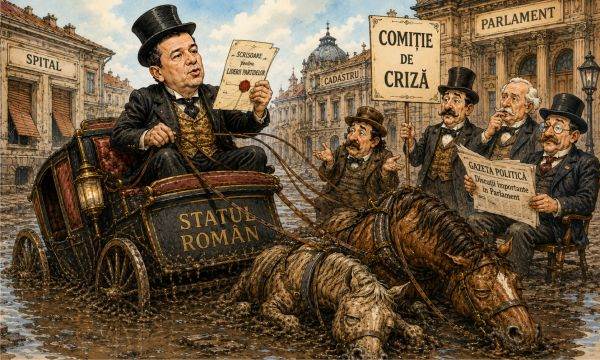
Our country is in a critical situation, and Sorin Grindeanu, the president of the Chamber of Deputies and, by a happy political coincidence, the president of the Social Democratic Party, yesterday took up the pen to officially announce, through a letter addressed to the leaders of the parliamentary political parties, what Romanians had already found out firsthand: the state has blocked, hospitals no longer have enough people, fuel is getting more expensive, IT systems are crashing, real estate transactions are getting bogged down, and the billions from the PNRR are waiting patiently on the border between promise and impossibility. The situation is serious, but not desperate, because, when institutions no longer function, Romanian politics always has the ultimate solution at hand: the establishment of a committee. Or a committee, as my uncle Iancu would have said. A committee whose head or president would be none other than the "honorable", "esteemed" Sorin Grindeanu.
"Romania is going through a period in which the government gridlock is affecting the state's capacity to respond to the country's urgent problems," writes Sorin Grindeanu at the beginning of the letter. An accurate, clear and almost courageous observation, if it did not come from the very center of the political system that produced the gridlock. But let's not be grumbling. The important thing is that the diagnosis has been made. The patient is not responding, the administration's pulse is barely felt, European funding is in the waiting room, but political doctors are still discussing who will occupy the main office and who has the right to hold the stethoscope. The PSD president informs us that "there are essential areas in which the lack of decisions already produces serious effects." In other words, the lack of decisions produces effects, an administrative discovery worthy of being recorded in the Official Gazette. Until now, it was probably believed that indecision is a superior form of prudence, that postponement is a public policy and that a gridlocked government can lead the country through its simple decorative existence. Reality, this eternal opponent of government programs, however, had the impudence to intervene.
In support of the above statement, Sorin Grindeanu gives the example of children's hospitals, where the hiring freeze has begun to threaten the functioning of critical departments. "If we do not urgently supplement, through legislative measures, the staffing scheme in Health, the staff shortage in critical areas, the latest example being the ICU Department at Marie Curie Hospital, will lead to the irremediable degradation of hospital services," warns the PSD leader.
"Irremediable" is a difficult word, even for a political letter. It means that we are no longer talking about a small budgetary inconvenience, about two signatures lost in a ministerial corridor or about an organizational chart that must be walked from one office to another, but about vital medical services that risk being compromised. Sick children, however, do not know the subtleties of budget balance, they do not know that hiring is blocked in the name of great fiscal principles and they cannot wait for the installation of a Government with full powers. They have this deeply unadministrative impatience to need doctors and nurses right now.
The real estate market is not feeling any better either. The platforms of the National Agency for Cadastre and Real Estate Advertising have been affected by cyber attacks, and activity in the field has been blocked. The digitalization of the Romanian state has thus shown its full efficiency: where, in the past, the citizen was stopped by a file with a rail, now he can be stopped instantly by an unavailable computer system. This is progress, without a doubt. The queue at the counter has been replaced by the server error, and the clerk who said "come back tomorrow" has been modernized into an automatic message that no longer specifies when to come back.
On top of this technological achievement comes the deadline of July 31. "If we do not adopt a transitional legislative measure by July 31, all real estate transactions will have a 21% VAT rate applied. Which will deepen the crisis in the construction sector," warns Sorin Grindeanu.
The deadline was, of course, known, but Romanian politics has a special relationship with the calendar: they ignore it while there are months left, they contest it when there are weeks left, and they declare it a national emergency when there are a few days left. Only then do responsibility, mobilization, and a call to unity appear. If the deadline had been dealt with in advance, the drama would have been lost, and the extraordinary session would have risked becoming a banal one, which, it must be admitted, does not serve anyone from a rhetorical point of view.
And fuels are stubbornly increasing in price without waiting for the political crisis to be resolved. "If we do not put the fuel price compensation mechanism back into operation, we will have a new explosion of prices for Romanians," writes the president of the Chamber of Deputies. The explosion is for Romanians, the compensation is for the budget, the explanations are for the press, and the responsibility, being a very sensitive political commodity, is kept in a cool place and away from light. The citizen will pay at the pump the cost of the time lost by those who represent him, but he will be able to have the satisfaction that his price increase was foreseen in an official letter.
Faced with these dangers, Sorin Grindeanu proposes "the establishment of a crisis committee at the level of Parliament, formed by representatives of all parliamentary groups". Here, finally, is the solution! When the Government cannot govern, the Parliament will form a committee that will discuss how the Government could be helped to govern without, for the time being, a Government with full powers. It is an institutional architecture of such finesse that only Romanian political practice could conceive it.
However, let no one think that it is a committee in the rigid, regulatory and boring sense of the word. Grindeanu clarifies the matter carefully: "I emphasize that this is strictly an informal working group and not a classic parliamentary procedure.”
In other words, there is an official crisis, official problems, official deadlines, official billions and official effects on citizens, but the group that will seek solutions will be informal. A happy reconciliation between solemnity and lack of responsibility. If things go well, the committee will be proof of political maturity. If things go badly, it was not even a committee, but only an informal working group, a responsible conversation between concerned people.
This group would be "to identify and prepare, on an emergency basis, the amendments and legislative solutions necessary to unblock these situations.” It is comforting to learn that solutions exist and can be identified. All that remains is the small mystery of why they were not identified before the situations needed to be "unblocked.”
The fruit of the discussions will form the basis of the "extraordinary session of Parliament that I intend to convene next week," writes Sorin Grindeanu, who, by the way, announced yesterday, in a press conference, that we will have this session on July 27, during which the elected representatives will have to adopt the urgent measures and legislative projects assumed through the PNRR, which, according to the letter, "will bring Romania over 3 billion euros."
Three billion euros is, without a doubt, a convincing argument. Not so convincing that the projects would have been adopted on time, but convincing enough to be invoked now, when the need for urgency can be presented as proof of responsibility.
From the letter of the President of the Chamber of Deputies, we also note that the said informal committee or group would function "exclusively until the installation of a Government with full powers." Until then, the state will be kept alive by amendments prepared informally and adopted extraordinarily. After the installation of the Government, the committee will be dissolved, the crisis will be declared over, and the parties will resume their usual activity of preventing the next crisis by ignoring its early signs.
We have a letter since yesterday. We will have a committee. Then, an extraordinary session. Therefore, the crisis can rest easy: it has entered the parliamentary circuit and, with a little luck, will soon receive a registration number.












 Euro
Euro Dolar SUA
 Franc elveţian
 Liră sterlină
 Gram de aur