English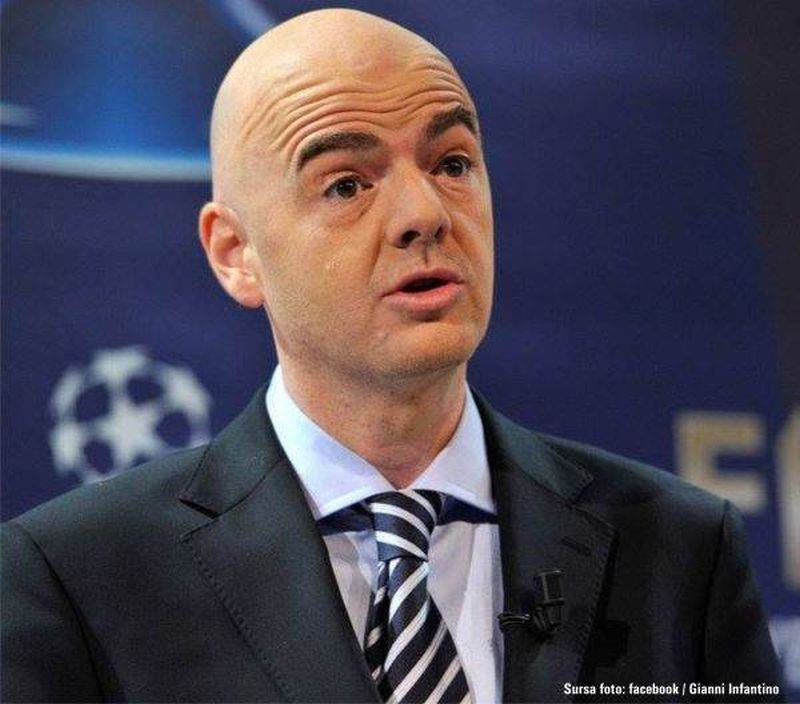
Contested within his own organization, the leader of the world forum is trying to gain the support of the Trump administration, while UEFA is preparing a legal offensive against the controversial FIFA Forward Enterprise project. There are times when power is not lost through a vote, but through the disappearance of trust. Gianni Infantino seems to have entered such a stage. After almost a decade in which he consolidated his authority over FIFA by expanding competitions, increasing revenues and a careful policy of building alliances, the president of the world forum is today facing the most serious challenge of his mandate. The project to create the FIFA Forward Enterprise - a commercial structure intended to capitalize on the economic assets of FIFA and the World Cup - has opened an unprecedented rift between the organization's leadership and a significant part of the football world.
In this context, the information published by the New York Post, confirmed by the BBC, according to which Infantino is trying to obtain the support of the US administration, including through a meeting with Secretary of State Marco Rubio, is more than a simple diplomatic episode. They suggest that the FIFA leader is trying to compensate for the loss of domestic support with external political support, a strategy rarely seen in the history of the organization.
• An idea that united the opponents
The controversy started with FIFA's intention to transfer the commercial rights of its main competitions to a distinct company and to allow the attraction of private capital by selling shares. From an economic point of view, the project could be presented as a way to accelerate the development of football and generate additional resources. From an institutional point of view, however, many federations and confederations saw this initiative as a dangerous precedent: transforming the most valuable asset of world football into a financial instrument over which private investors could exercise significant influence. The backlash was so strong that FIFA abandoned the project before it could even enter the implementation phase. However, the withdrawal of the proposal did not end the dispute. On the contrary, it fueled questions about how such a large-scale initiative could have been prepared without real consultation with the main players in world football.
• /When allies begin to disappear
According to sources quoted by the American press, close to the FIFA leadership, Gianni Infantino's attempt to approach the Trump administration has a pragmatic objective: to protect his own position. One source quoted by the New York Post states that the approach "is purely about protecting his position", while another claims that the FIFA leader feels increasingly isolated and is looking for personalities capable of providing him with public legitimacy. The strategy is not accidental. In recent years, the relationship between Infantino and Donald Trump has gone far beyond the usual protocol between a head of state and the head of a sports federation.
• A relationship built on mutual interests
The organization of the 2026 World Cup in the United States, Canada and Mexico has strengthened the closeness between the two. During the final tournament, Infantino constantly praised the contribution of the American administration, and Donald Trump frequently associated his image with the success of the competition. The symbolic moment of this relationship was the ceremony in December 2026, when the FIFA President awarded Donald Trump a FIFA Peace Prize, accompanied by a personalized trophy and a commemorative medal. At the same time, the international press reported that there were discussions around the FIFA Forward Enterprise project regarding the participation of investors close to the Trump family, information that amplified suspicions about the closeness between political power and the leadership of world football.
• Two words that say more than a statement
In this context, Donald Trump's answer to the press's questions had an impact disproportionate to its simplicity. Asked if Gianni Infantino had consulted him before launching the commercial project, the American leader initially answered with a surprising "Who?", and after the journalist repeated the question, he limited himself to a dry "No". Later, Trump stated that he had not discussed with Infantino the controversy surrounding the FIFA Forward Enterprise. In politics, such answers are sometimes worth more than an official statement. They can suggest delimitation, caution or simply a refusal to become a party to a conflict that risks producing unpredictable effects. According to the same sources, after the scandal broke, direct contacts between the two have become considerably rarer, and Trump would no longer answer the FIFA president's phone calls.
• Europe raises its tone
In parallel with the deterioration of relations In his standoff with Washington, Gianni Infantino is facing the strongest European opposition since taking office. UEFA and CONCACAF have publicly rejected the FFE project, and the European organization has gone so far as to call for the resignation of the FIFA president and a profound reform of the way the institution is managed. Several national federations have already announced that they will not support Infantino in the March 2027 elections. Finland and Wales have officially expressed this position, and the British press estimates that England could adopt the same decision. If this common front extends to other European and South American federations, Gianni Infantino's re-election could become uncertain for the first time.
• Legal offensive
However, the conflict has gone beyond political statements. According to The Telegraph, UEFA has officially notified FIFA that it is preparing legal action in connection with the FIFA Forward Enterprise project. In the document sent to FIFA's management, the European organization requests the preservation of all documents, electronic messages and information related to the project, warning that any deletion, modification or destruction of them may constitute destruction of evidence and may attract legal sanctions. The notification explicitly mentions, among others, Arsène Wenger, the director of global football development, the general secretary Mattias Grafström and the chief operating officer Kevin Lamour, who are considered to be persons who could hold documents relevant to possible proceedings. By its tone and content, the document represents one of the harshest institutional confrontations between UEFA and FIFA in recent decades.
• The only favorable voices
In contrast to the wave of criticism, Paolo Zampolli, the United States special envoy for global partnerships and close to Donald Trump, appreciated Infantino's decision to withdraw the project. In his opinion, the aim of the reform was not to protect a small circle of rich clubs and federations, but to extend economic benefits to all 211 FIFA member federations. The statement remains one of the few public positions favorable to the current FIFA president at a time when the number of challengers seems to be growing by the day.
• A fight for control of the world's most valuable sports product
Beyond the person of Gianni Infantino, the dispute raises an essential question: who should control the economic future of world football? In recent years, FIFA has increasingly evolved from the model of a sports federation to that of a global corporation, with billions of dollars in revenue, extremely valuable commercial rights and a political influence that goes far beyond the borders of sport. The FIFA Forward Enterprise project was the clearest expression of this transformation. The violent reaction it generated, however, demonstrates that a significant part of the football world considers this evolution to have gone too far. Gianni Infantino's attempt to find support in Washington shows that the stakes are no longer just saving a commercial project, but even the political survival of the person who runs FIFA. If until recently he was perceived as the man who controlled world football almost without opposition, today the FIFA president seems to be discovering that the influence built around money and political connections can become fragile when the organization's trust begins to erode. After all, the current crisis is not just about Gianni Infantino. It is about FIFA's governance model and the balance between commercial interests, political influence and the values that football claims to represent.
















 Euro
Euro Dolar SUA
 Franc elveţian
 Liră sterlină
 Gram de aur