 English


How Much and Why Did the NBR Revise Its Forecast?
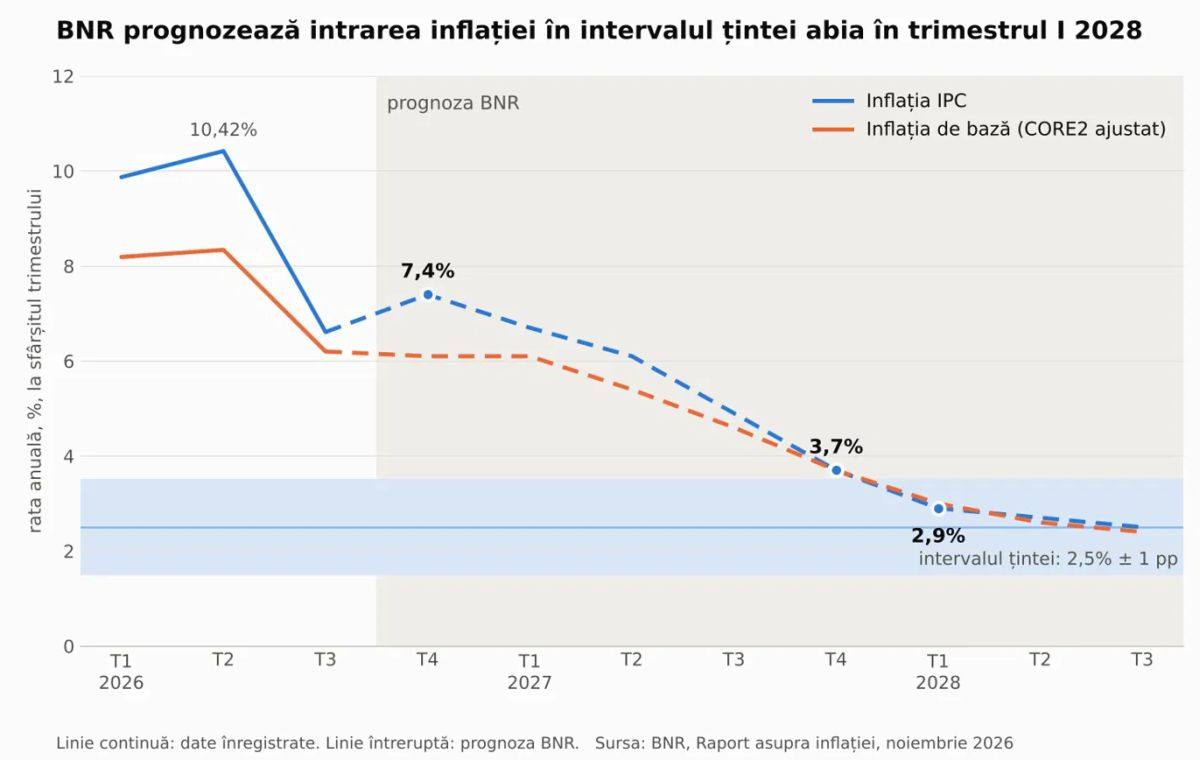
Annual inflation fell from 10.42% in June to 6.61% in September, according to the report, because the price increases recorded in the third quarter of 2025 dropped out of the annual calculation. Those increases had resulted from the liberalization of electricity prices and increases in VAT and excise duties.
In October, annual inflation rose again to 6.94%, as BURSA reported.
The NBR attributes the renewed increase to energy prices and the leu. Oil prices rose after the conflict in the Middle East intensified again and Russia restricted its fuel exports. Heatwaves and drought pushed up electricity prices. The leu depreciated.
Of the 1.3-percentage-point upward revision to the December forecast, 1.1 percentage points stem from the prices of fuels, electricity and natural gas, according to the governor's presentation.
Why Is the NBR Keeping Interest Rates Unchanged Despite Raising Its Core Inflation Forecast?
The NBR forecasts core inflation of 6.1% in December 2026, compared with 5.4% in its August forecast, and 3.7% in December 2027, compared with 3.1%. The NBR measures core inflation using the adjusted CORE2 index, which excludes administered prices, fuels, vegetables, fruit, eggs, tobacco and alcoholic beverages.

According to the NBR, the core inflation forecast has risen because companies are passing higher energy costs on to prices, while the weaker leu makes imports more expensive. Services prices are the slowest to decline.
The NBR also writes that core inflation is being sustained by inflation expectations, which it has revised upward, and by wage increases from previous years, which companies are passing on to prices with a delay, especially in services, even though wages are now rising more slowly.
Nevertheless, the NBR Board of Directors left the monetary policy rate unchanged at its November 12 meeting. The governor explained the decision by referring to the output gap, meaning the difference between actual GDP and the level of GDP the economy can produce without generating price pressures. The gap is negative, meaning that the economy is operating below that level because demand is insufficient to utilize its full productive capacity. To reduce demand even further, "you need very strong arguments,” the governor said.
The report did, however, revise the output gap upward, mainly because the National Institute of Statistics (INS) revised the GDP data series for 2018-2025.
What Is Happening in the Economy?
Household consumption declined further in the second quarter of 2026. The NBR attributes the decline to falling purchasing power and reduced lending.
Investment increased, particularly investment financed by European funds, as the deadline for meeting the targets under the National Recovery and Resilience Plan (NRRP) approaches. Foreign direct investment performed poorly.
The current account deficit remained large, even though the budget deficit narrowed. The governor said the NBR has two possible explanations, which it has not yet substantiated: imports related to investment and relatively strong exports.
The leu underwent two or three corrections this year, linked to the political crisis. The governor believes the exchange rate is now in an equilibrium range.
What Could Change the Forecast?
The NBR states that its projection depends strictly on the assumption that international energy markets gradually normalize. The projection uses information available through October 29. The governor said that oil cost more than $100 per barrel when the forecast was prepared, but its price has since fallen to $90. If that price holds, the forecast would change, he said.
The NBR considers risks relatively balanced in the short term but tilted to the upside over the medium term. The central bank identifies four sources of risk:
1. External environment: geopolitical conflicts and higher financing costs;
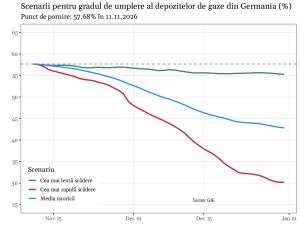
2. Energy and food prices: the duration of the energy shock, security risks in the Black Sea region, low gas inventories in Europe and drought;
3. Administrative and fiscal decisions: the timetable for increasing fuel excise duties and liberalizing the gas market, possible new social solidarity measures, absorption of NRRP funds and fiscal consolidation;
4. Labor market: the new public-sector pay law.
The governor said that, regarding commodity prices, his colleagues had mainly identified upside risks, whereas he would have included risks in both directions, because it is unclear what will happen to energy prices.
The NBR expects inflation to decline as energy becomes cheaper and the demand shortfall takes effect. The NBR assesses monetary conditions-the combined effect of real interest rates and the leu exchange rate on the economy-as more accommodative in the fourth quarter of 2026 than it estimated in August. According to the NBR, real interest rates on new loans and deposits have a stimulative effect. The NBR expects monetary conditions to become restrictive again from the first quarter of 2027. The next interest-rate decision is scheduled for the January 19, 2027 meeting.






















 Euro
 Dolar SUA
 Franc elveţian
 Liră sterlină
 Gram de aur



























Reader's Opinion