English


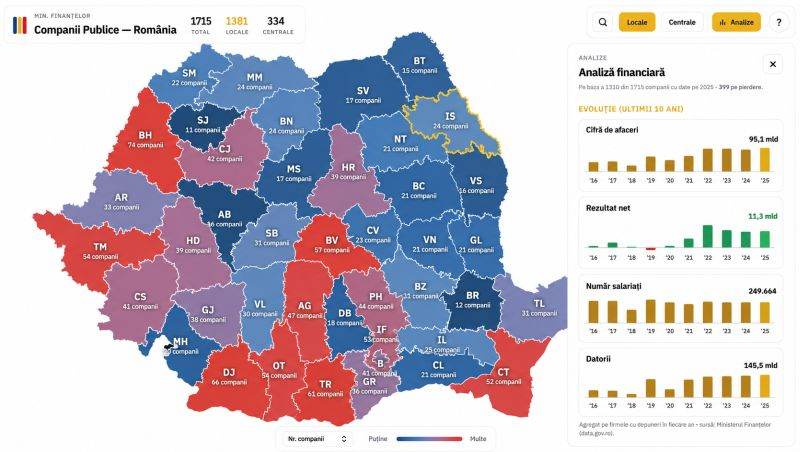
Most public companies in Romania reported a cumulative turnover of 95 billion lei and cumulative debts of 145.5 billion lei for 2025, almost as much as the budget deficit last year, which amounted to 146.03 billion lei, an amount that represented 7.65% of the Gross Domestic Product, as of December 31, 2025, says Cosette Chichirău, former USR parliamentarian, current local councilor in Iaşi, from the Romania, Equity, Community, Honesty Party.
In a post on her official Facebook page announcing that she has launched an application through which any citizen can check the financial situation of public companies in our country, Cosette Chichirău states: "We have data on 1,715 companies - 1,381 local (owned by local or county councils) and 334 central - of which 1,310 submitted financial statements for 2025. All the figures below refer to these 1,310 companies, but in the application we have history for the last 10 years. In 2025, 399 companies lost money, with a cumulative loss of 4.41 billion lei, and 845 companies made a profit, with a cumulative profit of 15.72 billion lei. The cumulative net result of the portfolio exceeds 11.3 billion lei, and the total debts of the portfolio are 145.5 billion lei. Loss-making companies are mainly local - 329, compared to 70 power plants. (...) It would seem that overall it is not so bad. But when we look at the details, we see that most of the profits come from three companies (Hidroelectrica, Romgaz, Nuclearelectrica) which add up to approximately 57% of the entire portfolio profit. The biggest losses are also from energy (Complexul Energetic Oltenia and Electrocentrale Craiova have together losses of 2.2 billion, approximately half of all losses). And this is because energy prices have exploded. If we look at a year with normal energy prices, the picture changes completely. In 2019, the entire portfolio was at a loss: −1.55 billion lei. 473 companies were at a loss and lost 7.2 billion together. It was compensated with profits from others, but not enough. In other words: today's profit does not come from a state that manages its companies well, but from a wave of energy prices. When the wave passes, we are left with a portfolio that structurally loses money”.
He also offers solutions for the Government, dividing the state's asset portfolio into three categories, each with a different problem.
"First of all, the strategic companies (...), Hidroelectrica, Romgaz, Nuclearelectrica, to which are added the energy and gas transport, the airports, the ports, they produce almost all the profit and support all the rest. The Government's job here is to protect them: professional management selected on competence (no politically appointed interims), zero use as a source of employment or party contracts, and reinvestment of profits. One poorly managed company and the entire portfolio goes into the red. Then, the "forgotten dead", meaning approximately 125 companies that are officially inactive - in bankruptcy, liquidation or dissolution - but still appear in the state portfolio, and some still have employees (3,209 in total). The Government's job here is the simplest and cheapest: to effectively close them down. It makes no sense for the state to own dead companies on paper for years. Clean up. Then we have the "bleeding middle". Almost 400 companies are losing money, with 66,000 employees, most of them local. Here the Government must separate two things that are now mixed up: companies that provide a real public service - rail transport, metro, district heating, and which may have justified losses, but must be subsidized transparently and managed much more efficiently, and relic companies, with no public purpose, which must be merged or closed. Each loss-making company should have a clear plan: it is reformed, subsidized transparently, or closed,” argues Cosette Chichirău.
In fact, she shows that the Bologna government, through the Deputy Prime Minister for Reform, Oana Gheorghiu, carried out a pilot project on 22 companies, which, unfortunately, only means 1% of the total portfolio of public companies. Therefore, Cosette Chichirău believes that an overview is urgently needed, which the application she created would provide.





















 Euro
Euro Dolar SUA
 Franc elveţian
 Liră sterlină
 Gram de aur