English


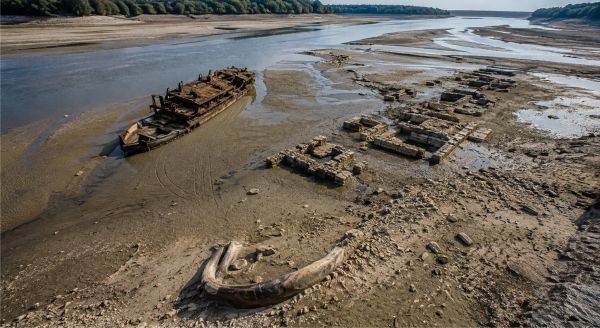
The exceptionally low levels of the Danube, caused by drought and heat waves affecting Europe this summer, have brought to the surface remains that have been hidden underwater for decades or even millennia. Wrecks of German ships from World War II, the foundations of a Roman bridge built under Emperor Constantine the Great, and Ice Age mammoth bones are among the discoveries brought back to light by the receding waters. The phenomenon offers archaeologists a rare research opportunity, but it also represents a new signal about the extent of the drought affecting one of Europe's main waterways.
• The Danube reveals what it has hidden for decades
The Danube, Europe's second-longest river, is going through a period of extremely low flows this summer. Data recently presented by AFP, based on information provided by the European Copernicus observatory, shows that in July average flows fell to record levels on important stretches of Europe's major rivers. In the case of the Danube, around two-thirds of the segments monitored recorded in July the lowest flows for this month since the European monitoring system began collecting such data in 1992. Similar situations have been reported on the Rhine, Rhone and Po. However, the retreat of the water also has an unusual effect. As the riverbed becomes visible in areas that are normally under water, objects and buildings that have been abandoned for a long time are coming to the surface. Some are linked to Europe's modern history, others belong to much more distant historical periods.
• German Fleet Wrecks Resurface
One of the most spectacular images comes from near the town of Prahovo, Serbia. There, the very low level of the Danube has made the wrecks of German ships that were sunk in the river during World War II visible again. The ships were part of a German fleet that arrived in the area during Nazi Germany's retreat from the Balkans. To prevent their use by opponents, the vessels were deliberately sunk in the Danube. For decades, the wrecks remained largely hidden underwater. Now, some of them have begun to be visible again, transforming certain parts of the river into a landscape that resembles an archaeological site rather than a European trade artery. Reuters and other international publications have reported on the reappearance of the wrecks in the context of the current drought. The phenomenon is not without risks. War wrecks can be accompanied by ammunition or other hazardous materials, making the simple withdrawal of water a safety issue.
• A Roman bridge built during the time of Constantine the Great
In Bulgaria, the Danube River offered archaeologists another surprise. The extremely low water level revealed parts of the foundations of a Roman bridge associated with Emperor Constantine the Great. The construction was part of Rome's imperial infrastructure and was one of the most important engineering works carried out in this part of Europe. For specialists, the moment is a rare one. Under normal conditions, the remains are underwater and difficult to research. However, the withdrawal of the river allows the examination of some constructive elements that can provide information about construction techniques, the dimensions of the infrastructure and how the Roman Empire organized its communications in the Danube area. The discovery also shows how old the relationship between the Danube and the economic and military infrastructure of Europe is. The river was not just a natural border. Throughout history, it has been a thoroughfare for transport, trade, migration and military operations.
• Mammoth bones brought back to light
In other parts of the Danube, the receding waters have also brought to the surface the remains of prehistoric animals. Among them are bones attributed to mammoths that lived in the region during the Ice Age. The discoveries are important for researchers because they provide clues about the fauna and natural environment of this part of Europe thousands of years ago.
Thus, the same drought that reveals shipwrecks from the 20th century can reveal, a few kilometers away, traces of a world that disappeared long before the emergence of modern civilizations. The Danube thus becomes a layered archive of the continent's history.
• From ancient Rome to the Second World War
The succession of discoveries is unusual precisely because of their diversity. In a single period of extremely low water, traces of completely different eras can be observed: Roman remains, medieval constructions, commercial and military wrecks, but also prehistoric remains. In Croatia, for example, the retreat of the waters allowed obse rving the wreck of the Hungarian freighter Fulton, sunk in the Danube. At other points on the river, various structures and objects that are normally covered by water have become visible. For the public, the images are spectacular. For the authorities, however, the situation is more complicated.
Historical objects can be damaged by exposure to air, and some of the wrecks can pose risks. In addition, the return of water can hide the remains again before specialists can complete their research.
• A temporary window for archaeologists
Low water levels offer researchers what can be considered a temporary archaeological window. Sites that are normally inaccessible become visible for a short time. Specialists can take measurements, document structures and analyze objects that would otherwise require expensive underwater operations. The problem is that this window can be very short. A change in the hydrological regime, a few days of precipitation or an increase in upstream flows can cover the remains again. In addition, exposure to air and rapid variations in humidity can accelerate the degradation of certain materials, especially wood, textiles or some metal components. For this reason, archaeologists must quickly take advantage of the periods when the river level allows access to these vestiges. Perhaps the most unusual consequence of the drought, however, is the transformation of the Danube into a true time capsule. As the water recedes, the river shows what it has hidden. War wrecks speak of Europe of the last century. Roman bridges speak of the period when the Roman Empire controlled the region. Mammoth bones refer to a prehistoric world, long before the emergence of states and cities. All these historical layers are now temporarily located in the same landscape. It is an unusual spectacle, but one that comes with a price.



























 Euro
Euro Dolar SUA
 Franc elveţian
 Liră sterlină
 Gram de aur