 English
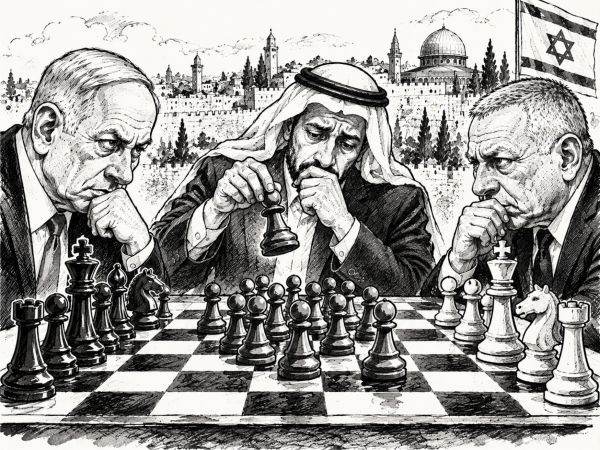
Preliminary results from Israel's parliamentary elections, following the conclusion of the count for in-person votes yesterday, with only 650,000 absentee ballots left to be verified and tallied today, reveal a political paradox of historic proportions. Arab political factions, which set out to play a decisive role in ousting Benjamin Netanyahu from power, now find themselves in a position to determine who will lead Israel, yet any choice they make risks compromising them in the eyes of their own electorate.
With 19 of the Knesset's 120 seats, the Arab parties hold, at least in arithmetical terms,the key to the future parliamentary majority. However, each of the three options available to them supporting Netanyahu, backing former Israeli military chief Gadi Eisenkot, or abstaining carries a hidden political trap.
According to preliminary results reported by N12, Channel 14, The Jerusalem Post, and The Times of Israe, following the count of in-person votes, Prime Minister Benjamin Netanyahu's camp has secured 53 seats, while the political bloc formed around former Israeli Chief of General Staff Gadi Eisenkot is credited with 48 seats. The two Arab political factions, the Joint List and Ra'am, are set to hold a combined total of 19 seats, making them, at least within the current parliamentary configuration, the pivotal players upon whom the formation of the next government could depend. Neither Netanyahu nor Eisenkot reaches the 61-seat threshold required for an absolute majority in the Knesset. The incumbent Prime Minister is short by eight seats, while his main opponent lacks 13. Consequently, the 19 Arab-held seats no longer represent merely a significant parliamentary presence; they have become a potential deciding factor in Israel's political future.
At first glance, this situation might appear to be a triumph for Arab political representation. In reality, however, it threatens to become one of the most difficult dilemmas Arab parties have ever faced within Israeli politics. Regardless of the path they choose, they risk being accused by their own constituents of either legitimizing the continuation of Israeli military policies in Gaza, supporting a former commander of the Israeli army, or plunging Israel into yet another political crisis.
• The first scenario: supporting Netanyahu, who is associated with the destruction of Gaza
The first option, supporting Benjamin Netanyahu, could carry the highest reputational cost for the Arab parties. Netanyahu is the Prime Minister under whose leadership Israel waged the war in the Gaza Strip, a conflict that caused immense destruction, massive loss of life, and a humanitarian crisis of significant proportions.
For a large segment of the Arab electorate in Israel, Netanyahu represents not only the political leadership responsible for the military operations in Gaza but also the embodiment of a hardline nationalist agenda, linked to his governing partners, Itamar Ben-Gvir and Bezalel Smotrich. Under these circumstances, a potential vote by Arab lawmakers that allows Netanyahu to remain in power could be interpreted as providing political legitimacy to the man his critics hold responsible for the devastation in Gaza. Opponents of such a move might accuse the Arab parties of sacrificing solidarity with the Palestinians in exchange for potential political or administrative gains within Israel.
The electoral cost could be devastating. The Arab factions would leave themselves open to the accusation that, despite calling for the removal of the Netanyahu government, they ultimately became the very political force that ensured its survival.
• Second scenario: supporting Eisenkot, the former commander of the Israeli army
At first glance, the alternative seems obvious: if the stated goal of the Arab parties is to oust Netanyahu, then their 19 parliamentary seats could be used to install a government led by Gadi Eisenkot. Arithmetically, the 48 seats held by the Eisenkot camp, combined with the 19 seats held by the Arab parties, would create a majority of 67 lawmakers, six more than the required threshold. Politically, however, the equation is far more complex.
Gadi Eisenkot is no ordinary opponent of Netanyahu. He served as Chief of the General Staff of the Israel Defense Forces (IDF) from 2015 to 2019 and played a significant role in Israel's political and security leadership during the war that erupted following the Hamas attacks on October 7, 2023. Consequently, supporting Eisenkot could be framed by the Arab parties' detractors as an endorsement of a representative of the Israeli military establishment. Arab parties could thus find themselves in the paradoxical situation of having to explain to their own voters why, in order to remove the incumbent prime minister from power, with the destruction of Gaza, they decided to support a former chief of the Israeli army. Furthermore, potential parliamentary cooperation would not automatically entail the inclusion of Arab parties in a governing coalition. Eisenkot and his allies, for their part, would have to decide whether they are prepared to accept political dependence on Arab votes within a society deeply polarized by the war.
• Scenario three: abstention - a move that could turn Arab parties into scapegoats
There is a third option: for the Arab political factions to refuse to support either side. In terms of political consistency, this might appear to be the easiest choice to justify. The Arab parties could argue that they are unwilling to legitimize either the continuation of Netanyahu's rule or the installation of an executive led by a former IDF commander; however, such a decision could carry severe political consequences.
Given that, according to preliminary results, neither of the two main camps holds the 61 seats required for a majority, the Arab parties' refusal to support a governing arrangement could contribute to a prolonged parliamentary deadlock.
Israel could face protracted negotiations, attempts to lure lawmakers away from the opposing camp, the reconfiguration of alliances, or, ultimately, the prospect of fresh elections. And in an already tense political climate, the Arab parties could become the targets of a blame game from both sides. In other words, even the refusal to make a choice could be transformed into a political decision for which the Arab parties might be held accountable.
However, there is a crucial constitutional distinction: an abstention does not automatically render the formation of a government impossible. In the Israeli parliamentary system, the investiture of an executive may depend on the balance between votes in favor and votes against, rather than strictly requiring 61 affirmative votes in every scenario. Consequently, the conduct of Arab parliamentarians could influence the outcome, even through abstention, depending on the specific configuration of the vote.
• Leader of the Joint List issues anti-Netanyahu statement
Despite this dilemma, the political message conveyed by representatives of the Joint List remains one of firm opposition to the current administration. Yousef Jabareen, a leader of the Joint List, stated yesterday, as reported by Israeli media, "We will do everything in our power to send the Netanyahu, Ben-Gvir, and Smotrich government home."
This statement clearly outlines the political objective of the bloc: the removal of the current governing coalition. It does not, however, clarify the means by which this goal is to be achieved.
Voting against Netanyahu is not automatically equivalent to voting in favor of Eisenkot; yet, refusing to participate in a governing majority can, under certain circumstances, produce results that run counter to one's stated intentions.
This is the fundamental contradiction that the political representatives of the Arab community will have to navigate during post-election negotiations.
• Mail-in voting may clarify the situation
All the scenarios mentioned above must be viewed in light of the fact that the results are still preliminary. According to reports in the Israeli press, approximately 650,000 "special" ballots, cast by voters who did not vote under standard conditions at their local polling stations, remain to be verified and counted. These include, among others, military personnel, reservists, diplomats, hospitalized patients, individuals with disabilities, detainees, and voters who were temporarily away from their place of residence.
In Israel, such ballots are handled via a "double-envelope" system, which allows for the verification of a voter's eligibility and prevents multiple voting, while simultaneously ensuring the secrecy of the individual's vote.
Counting these ballots could alter the final distribution of parliamentary seats, including the balance between the two main political blocs and the representation of Arab parties.


























 Euro
 Dolar SUA
 Franc elveţian
 Liră sterlină
 Gram de aur






























Reader's Opinion