 English
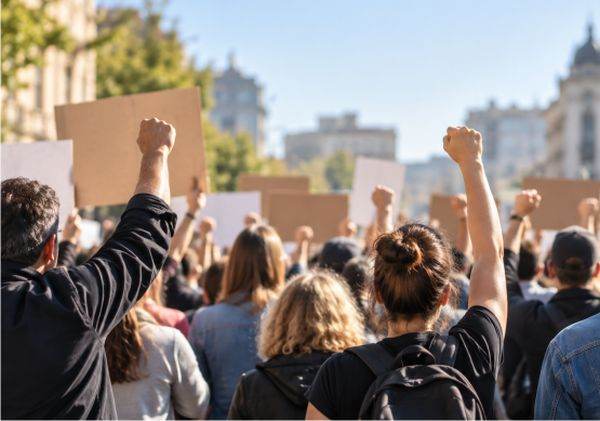
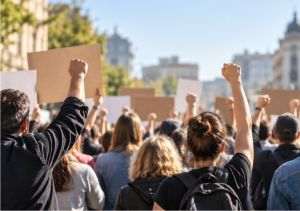
On the streets, discontent wears faces that electoral statistics struggle to capture. There are young students who can no longer afford their rent, teachers working in underfunded educational institutions, and pensioners watching their personal income evaporate amidst daily price hikes in shops and pharmacies. While these situations do not automatically coalesce into a unified movement, they explain why diverse grievances reflect a shared sense of distrust across Europe: national governments tout achievements that a significant portion of the population fails to perceive in their own standard of living.
France offers the most striking illustration of this tension. According to the Ministry of the Interior, approximately 410,000 people took part in the demonstrations on October 24, while the CGT (General Confederation of Labour, France's most powerful trade union) estimated the number of protesters at around 800,000. Le Monde describes the marches as largely peaceful, though some cities saw clashes albeit on a smaller scale than the previous weekend. During that earlier period, groups of young people had wreaked havoc, targeting luxury boutiques, small grocery stores, pharmacies, and businesses owned by small and medium-sized entrepreneurs in cities including Paris, Marseille, Reims, and Nantes. Furthermore, ten days ago, violent youths stormed French state institutions, damaging historic buildings, an act exemplified by the arson attack on the town hall tower in Limoges. The distinction between social grievances and the violence occurring on the fringes of demonstrations is essential to understanding these events.
The figure of 1,314 people detained on October 24, as reported by French authorities, remains significant. It highlights the scale of the police intervention, though it does not establish the individual guilt of those detained. Acts of destruction and attacks must be investigated, and responsibility must be determined on an individual basis. At the same time, the number of detentions does not address the underlying concerns such as education funding or purchasing power that brought people to the streets in the first place.
In Brussels, the protests on October 24 centered on issues regarding educational conditions and funding. Reuters reports the use of tear gas and notes both attempts by some participants to set fires and an incident in which a protester was struck by police officers. The police reported five administrative detentions and four arrests. These actions call for distinct forms of accountability: grievances do not justify aggression, and wearing a uniform does not exempt one from the obligation to uphold the law.
In Italy, the mobilizations brought together various grievances concerning the cost of living, education, and opposition to war and rearmament. Citing the Italian police, Euronews reports nine arrests and the temporary detention for questioning or processing of another 371 individuals during protests held on Saturday across eight cities. Among those taken in by the police were 110 minors. Their presence illustrates how early social conflict enters the lives of a generation still searching for its place in society. In Albania, opposition to the government led by Edi Rama has once again brought thousands of people to the streets of Tirana, where public buildings were attacked and police deployed tear gas. According to Euronews, these demonstrations are part of a series of confrontations that began in mid-October. Demands regarding education, coupled with allegations of corruption, have transformed the protest into a direct confrontation with the authorities.
In Spain and Portugal, the grievances have highlighted other pressing issues. In Madrid, pensioners have called for the protection of the public system and for income levels that keep pace with rising prices. In Lisbon, access to housing has taken center stage. Housing carries a distinct political weight: when one's income no longer covers the rent for a decent living space, personal independence is deferred, starting a family becomes more difficult, and professional mobility is constrained. In Spain, this conflict has already entered the electoral arena, following the parliamentary rejection of government housing measures, snap elections have been called for November 29, as reported by Reuters. Thus, an issue experienced individually by millions has evolved into a struggle for power.
In Sofia, a protest on October 20 put forward a different demand: a state capable of defending its citizens and their interests. Young Bulgarian doctors have called for decent wages and better working conditions; according to the BTA news agency, recent graduates are working under immense pressure for monthly earnings ranging between 700 and 1,000 euros. Their demands also included transparent rules for access to specialized training.
Against this European backdrop, the announced schedule of mobilizations keeps the pressure on governments: new demonstrations have been announced in France for Saturday, October 31, along with trade union action on November 5; a strike is set for November 11 in Spain, and a general strike for November 20 in Italy. These actions have been announced, the course of which may yet evolve; they demonstrate that the demands do not simply vanish once the crowds disperse at the end of a weekend packed with protests.
It is premature to label all of this a continental uprising. No news agency, television network, radio station, or newspaper has presented any evidence of a unified command structure or a common agenda shared by all these protest movements. Nevertheless, the governments in the affected nations are compelled to address grievances that the mere maintenance of public order cannot resolve. The police may clear a blocked street or protect shops and small businesses, but issues such as access to housing, trust in institutions, and the quality of education require political decisions.
The situation in Serbia shows that protest can reach the ballot box and succeed. The broader picture remains fluid: some movements will secure concessions, others may fragment, and the prevailing discontent could be harnessed by candidates with vastly different agendas. For those in power, the warning is already clear enough: an empty public square does not equate to a society at peace. People return home still facing the same bills, the same rents, and the same lingering questions, they may well bring with them into the voting booth at the next election.





















 Euro
 Dolar SUA
 Franc elveţian
 Liră sterlină
 Gram de aur




























Reader's Opinion