English

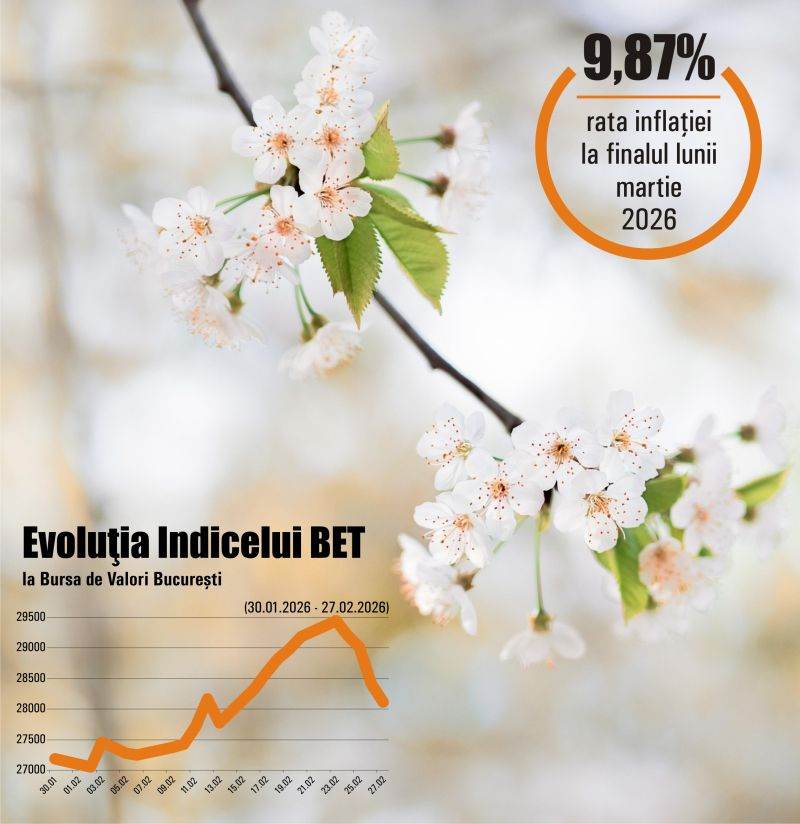
The beginning of spring found the Romanian economy at a point of maximum tension between internal fiscal consolidation, persistent inflationary pressures and the external shock generated by the Middle East crisis, which reactivated global energy risks and quickly transmitted effects on the fuel market, on production costs and on inflation expectations. If February was the month in which the Government tried to combine economic recovery with budgetary discipline, March became the month in which the Executive was forced to test this construction under stress conditions: the Brent barrel rose on international markets to almost $117, after being below $60 in January, and the American WTI oil exceeded the $100 threshold, in the context of the effective blockade of the Strait of Hormuz by Iran and the interruption of a fifth of the world's supply of oil and liquefied natural gas. Added to all this was the increase in inflation, which reached 9.87% last month, which led the Government to adopt protective measures for domestic gas consumers, for transporters, for farmers and to protect the prices of basic foods.
Also last month, with a three-month delay due to disagreements within the governing coalition regarding stimulus packages for certain sectors of activity and the social package, the Government managed to adopt the state budget, which sets a deficit target of 6.2% of GDP for the end of this year. The state budget law and the state social insurance budget law passed the Parliament, after tense sessions in the joint budget-finance committees of the two Chambers of the Legislature, and were declared by the Constitutional Court to be in accordance with the provisions of the country's fundamental act, after the objections raised by the AUR parliamentarians were rejected.
The adoption of the two budget laws and their entry into force were also accompanied by a reduction in the budget deficit to 1% of Gross Domestic Product at the end of March 2026, compared to 2.3% of GDP, as recorded in March 2025. Moreover, last month, Moody's Ratings completed its periodic review of Romania's credit profile, reconfirming the country's solid medium-term economic growth potential and resilience to external shocks, with a negative outlook. The agency explicitly acknowledges that fiscal consolidation measures, including the VAT increase from 2025 and the public spending freeze in 2026, have started to have effects, pushing the deficit on a downward trajectory, with an estimated correction of almost 2 percentage points this year.
At the end of March, it can be said that our country enters the second quarter with a clearer macroeconomic structure than at the beginning of the year, but also with greater risks: dependence on external financing, price pressure, energy vulnerability and the need to demonstrate that fiscal discipline can be maintained without stifling the economic recovery.
• Protective measures taken in light of the Middle East conflict
The first major pressure of the month came from the energy sector. The escalation of the Middle East conflict quickly changed the calculation data for the economy, as the increase in oil prices no longer represented just a market evolution, but a direct risk for inflation, for transportation, for agriculture, for the food industry and for the purchasing power of the population. Under these conditions, the Government declared, by emergency ordinance, a crisis situation on the crude oil and petroleum products market, namely gasoline and diesel, for the period 1 April-30 June 2026, with the possibility of successive extensions for periods of no more than three months, as long as the causes that determined the crisis persist. The measure was designed as a flexible intervention framework, allowing for the periodic assessment of the impact and the adjustment of decisions depending on market developments.
In the area of natural gas, the Executive tried to avoid the full transmission of external shocks to household consumers, maintaining the capped price for gas for the period 1 April 2026-31 March 2027. Furthermore, the Government decided to oblige natural gas producers in our country to market the quantities intended for the population and thermal energy producers for population consumption at the price of 110 lei/MWh. The intervention takes place at the producer level, not at the end consumer level, so that suppliers purchase gas at a predictable cost, exposure to regional market volatility is reduced, and external shocks are limited before they reach the household bill. Transporters received a support measure directly calibrated to the increase in the price of diesel. The government extended until the end of the year the state aid scheme to compensate for the increase in the price of diesel, through partial compensation of the excise duty, with a budget of over 650 million lei and over 6,200 eligible economic operators. The compensation is applied differently: 40 bani per liter for diesel purchased between October 1 and December 31, 2025, 65 bani per liter for the period January 1-March 31, 2026 and 85 bani per liter for the period April 1-December 31, 2026, for which the value of 1,954.29 lei per 1,000 liters is also mentioned. Payments are made from the budget of the Ministry of Finance, within the budget allocated to the scheme, and companies must have a special account with the Treasury for subsidies and transfers. In addition, the Ministry of Finance and the Ministry of Transport are to analyze market conditions and the economic context on a quarterly basis, with the possibility of changing the amount of state aid.
For farmers, the Government has adopted the mechanism of reducing the excise duty on diesel used in agriculture, allocating 620 million lei from the budget of the Ministry of Agriculture for 2026. The money is intended for payments related to state aid for the period July-December 2025, and for 2026 the difference in excise duty returned to farmers in the form of reimbursement is 2.697 lei/liter. The reduced excise duty rate was set at 106.72 lei/1,000 liters, representing the conversion of the minimum European rate of 21 euros/1,000 liters, at the exchange rate of 5.0821 lei/euro established on October 1, 2025. The subsidy covers the difference between the standard excise duty of 2,804.29 lei/1,000 liters and the reduced rate applicable to the agricultural sector, and payments are processed through APIA. In economic terms, the measure is important not only for farmers, but also for food prices, since the cost of fuel goes directly into mechanized work in the plant, livestock and land improvement sectors.
The pressure of energy prices on food has led the Government to extend until June 30, 2026 the capping of the commercial mark-up on basic foods, maintaining the mechanism introduced by GEO no. 67/2023. The list of products targeted includes plain white bread, drinking milk, bulk cow's milk, plain yogurt, flour, cornmeal, eggs, sunflower oil, fresh chicken and pork, fresh vegetables and fruits, potatoes, sugar, sour cream, butter and mayonnaise. The government thus tried to limit the combined effect of rising energy prices, transport costs and food inflation on the basic consumer basket, at a time when the annual inflation rate has returned to growth.
• State budget, built on 1% economic growth
The adoption of the state budget represented the second big moment of March. Romania entered the budget year with a delay of almost three months, and the 2026 state budget law was voted by Parliament only on March 20, with 319 votes "for", 104 votes "against" and one abstention. The state social insurance budget law was adopted with 314 votes "for", 105 votes "against" and 12 abstentions. The process was marked by five days of debates and a deadlock in the coalition, generated by the dispute between the PSD and the PNL on the subject of an amendment regarding aid for vulnerable persons. The political compromise consisted of moving one billion lei to the Ministry of Labor, from the Ministry of Justice, and postponing the payment of salary compensations won by magistrates in court. Subsequently, the AUR challenged the budget package at the Constitutional Court, but the CCR rejected the objections on March 26, and the state budget law was published in the Official Gazette on March 27 and entered into force.
The 2026 budget is built on an estimated economic growth of 1%, a nominal GDP of 2,045.2 billion lei, a deflator of 6.1%, an increase in the average net monthly wage by 5.5% and an average annual inflation forecast at 6.5%. Total revenues of the general consolidated budget are estimated at 736.5 billion lei, and expenditures at 864.3 billion lei, respectively 42.3% of GDP. The budget deficit is projected at 127.7 billion lei, equivalent to 6.2% of GDP. In parallel, the fiscal-budgetary ceilings establish a deficit of 6.2% of GDP in 2026 and 5.1% in 2027, personnel expenses of 8.2% of GDP in 2026 and 7.9% in 2027, as well as a public debt ceiling of 62.5% of GDP at the end of the year.
The budget construction shows an attempt to keep current expenses under control without sacrificing investments. Personnel expenses are estimated at 168.3 billion lei, or 8.2% of GDP, compared to 167.7 billion lei and 8.8% of GDP in 2025, which indicates a decrease in share in the economy, even if the nominal value remains almost unchanged.
Expenditure on goods and services is estimated at 105.3 billion lei, or 5.2% of GDP, and those with social assistance at 249.2 billion lei, respectively 12.2% of GDP, down from 13.1% of GDP in 2025. The most visible pressure comes from the interest area, which increases from 50.5 billion lei in 2025 to 60.8 billion lei in 2026, reaching approximately 3% of GDP.
In other words, the cost of public debt begins to consume an increasing amount of budgetary space, at a time when the state needs resources for investment, social protection and defense.
Investments are presented as the main pillar of economic policy for 2026. The total volume of investments reaches approximately 164 billion lei, almost 25.8 billion lei more than in 2025, which raises their share to over 8% of GDP, compared to 7.2% in the previous year. European funds exceed 110 billion lei, i.e. approximately two-thirds of total investments. Post-accession non-reimbursable external funds are estimated at 51.3 billion lei, up 42% compared to 2025, PNRR grants at 41.4 billion lei, up 43%, PNRR loans at 12 billion lei, and advances through the SAFE instrument at over 6 billion lei. In addition, national funding programs, including those in defense, reach 56.8 billion lei. The budget thus tries to maintain investments at a high level, but does so with a strong dependence on European funds, PNRR and loans.
• Moody's maintains our country rating
The last month of the first quarter also brought good news: the financial rating agency Moody's Ratings completed its periodic review of Romania's credit profile, reconfirming the country's solid medium-term economic growth potential and its resilience to external shocks. Moody's confirms that the fiscal measures adopted since July 2025 have had a positive impact on Romania's budgetary outlook. As a result of these decisions, the budget deficit is on a clear downward trajectory: from a peak of 9.3% of GDP in ESA terms in 2024, the agency estimates a reduction to 8.2% in 2025 and to 6.3% of GDP at the end of 2026.
Although government debt is forecast to reach 62.9% of GDP in 2027 and stabilize at around 65%, Moody's believes that Romania maintains a debt-solvency capacity that remains robust. However, the agency notes potential risks to the prospect of a further reduction in the deficit beyond 2026 and a stabilization of the debt burden at a level corresponding to the Baa3 rating.
The Ministry of Finance continued, in parallel, to play on two levels: fiscal consolidation and financing of state needs. Minister Alexandru Nazare announced that the budget deficit in the first quarter fell to 22 billion lei, compared to over 44 billion lei in the same period in 2025, which means a reduction from 2.3% of GDP to 1% of GDP. At the same time, the deficit target of 6.2% of GDP for the end of the year was reaffirmed as a central objective, amid the commitment to reduce the deficit below 3% of GDP by 2030.
In the area of domestic financing, the FIDELIS program continued to show the population's appetite for government securities, especially for long maturities. In the first three months of 2026, the three FIDELIS editions attracted subscriptions of over 4.07 billion lei, through 45,234 orders. The donor-investor component exceeded 270.20 million lei, through 6,540 orders.
The fact that the population is massively subscribing to long-term bonds indicates, on the one hand, trust in the state as a debtor, and, on the other hand, that government bonds remain a haven for savings in an environment with high inflation and still attractive interest rates.
The Ministry of Finance also marked an important step in the OECD accession process by obtaining the Formal Opinion of the Committee for Economic Analysis and Development. The assessment focused on the existence of a solid macroeconomic policy framework, the capacity of the financial system to withstand shocks, the compatibility of structural policies with economic performance and the efficient functioning of institutions. From a political and economic perspective, this opinion supports the Government's narrative regarding external credibility, but does not eliminate internal pressures: the deficit remains high, public debt is approaching sensitive thresholds, and inflation has returned to growth.
• Increased food and service prices play a decisive role in driving up inflation
The INS inflation data were probably the most important macroeconomic signal of March. The annual inflation rate rose to 9.87%, from 9.31% in February, confirming that energy shocks and domestic pressures were not absorbed, but began to be reflected in prices again. Services continued to lead the price increases, with an annual advance of 11.05%, followed by non-food goods, which rose by 10.89%, and food products, by 7.67%. Consumer price index in March compared to February was 100.78%, indicating a monthly increase of 0.78%, and the inflation rate since the beginning of the year, reported in December 2025, reached 2.3%. The average rate of change of consumer prices in the last 12 months, April 2025-March 2026, compared to the previous 12 months, was 8.5%.
The harmonized indicator of consumer prices confirms the same direction. The HICP increased in March by 0.92% compared to February, to 100.92%, and the annual rate calculated on the basis of this indicator was 9% compared to March 2025. The average of the last 12 months indicated an increase of 7.6% compared to the previous similar interval. These data are essential because they show that inflation is no longer just a problem related to administered prices or statistical effects, but remains at a high level across broad components of consumption. Services, with an increase of over 11%, indicate persistent domestic pressures, while non-food goods reflect both energy and fuels, as well as production and transport costs.
The NBR anticipated this deterioration in the inflation picture, warning that the annual inflation rate would accelerate in the period March-June 2026 above previously anticipated levels, mainly as a result of higher fuel prices, driven by the significant increase in oil and natural gas prices amid the conflict in the Middle East. The central bank had already revised upwards its inflation forecast for the end of 2026, to 3.9%, compared to the previous estimate of 3.7%, and estimated a moderation to 2.7% by the end of 2027. But the March data show that the path to returning to the target range remains difficult, especially if energy prices remain at high levels and if higher fuel prices propagate through supply chains.
Also in March, the General Council of the National Committee for Macroprudential Supervision within the NBR maintained the countercyclical capital buffer rate at 1%, amid intensifying geopolitical risks, especially in the context of the resurgence of conflicts in the Middle East. The decision shows that the central bank considers the banking system sufficiently liquid and solvent to support access to financing for eligible borrowers, but also that the accumulation of capital reserves remains necessary in an environment of increasing systemic risk. In other words, the central bank is not blocking lending, but it is not relaxing its vigilance either.
• Gross minimum wage increased from July 1, 2026
On the social front, the Government decided to increase the gross minimum wage per country guaranteed in payment to 4,325 lei per month starting from July 1, 2026, compared to 4,050 lei currently. The measure has a double meaning: on the one hand, it tries to partially compensate for the loss of purchasing power generated by inflation, and, on the other hand, it adds pressure on companies' wage costs, at a time when energy, fuel and financing are already more expensive. In an economy with inflation of almost 10%, the increase in the minimum wage can support consumption, but it risks fueling, through costs, part of the inflationary pressures if it is not accompanied by productivity and the stabilization of energy prices.
March also brought a change in vision regarding the role of the state in the economy. The government adopted a draft emergency ordinance to protect national interests in strategic areas, through which the state could use economic instruments to maintain and capitalize on strategic industrial capacities when the operators that own them face financial difficulties. Areas covered include the extractive industry, steel, aluminum, cement, chemicals, defense industry, information technology, maritime and port industry, electricity, gas, crude oil and fuel transportation, as well as the production, distribution and storage of gas, electricity, thermal energy, crude oil and fuels. The regulatory act also provides for the state's preemptive right over assets or participations and intervention mechanisms when the operation of strategic infrastructure is affected or there is a risk of their being affected. In the context of the energy crisis and geopolitical tensions, this direction shows a return of the state as a protective economic actor, not just as a regulator.
The same logic also applies to the changes regarding the Authority for the Administration of State Assets and the takeover of receivables on state-owned companies or on private companies declared of strategic interest. Basically, the Government wants to clarify the mechanisms through which the state can manage public and strategic receivables, especially in situations of insolvency or forced execution, and to prevent the loss of assets relevant to the national economy. It is a direction that can be justified by geopolitical and industrial risks, but which will depend on the concrete way of application, because the line between protecting strategic interest and discretionary economic interventionism is a very fine one.




















 Euro
Euro Dolar SUA
 Franc elveţian
 Liră sterlină
 Gram de aur