English

The middle of the calendar spring found the Romanian economy in a transitional stage between the fiscal consolidation started at the beginning of the year and a new phase of economic interventionism determined by energy pressures, the need to accelerate strategic investments and the resurgence of internal political tensions. If the first quarter of the year was dominated by the Government's attempt to stabilize the budget deficit and limit the effects of the oil shock caused by the conflict in the Middle East, April became the period in which the Executive was forced to simultaneously manage inflationary pressure, high energy costs, social discontent and the deteriorating political climate.
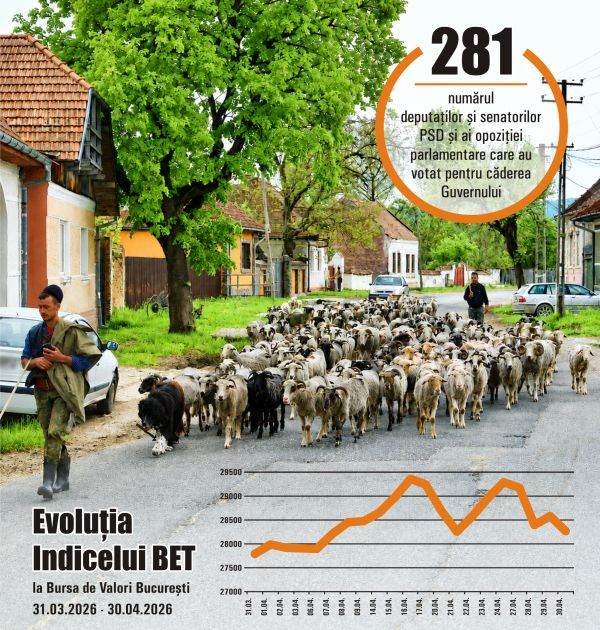
The domestic political scandal erupted when Deputy Prime Minister Oana Gheorghiu drew up an exploratory list containing 22 state-owned companies that would be listed on the Bucharest Stock Exchange. After that moment, the PSD decided to withdraw its ministers from the Government, and the Social Democratic deputies and parliamentarians signed and initiated together with the opposition parties a motion of censure against the Bolojan government. The motion was read in the plenary session of the Parliament on April 29 and was debated and adopted on May 5, at which point the fall of the Bolojan government was recorded and the onset of a political crisis that we are still in.
On the economic front, the Government continued to combine social protection measures with increasingly aggressive interventions in the energy market and with the acceleration of investments in infrastructure, energy and economic security. The temporary reduction of excise duty on diesel, the introduction of the solidarity contribution for oil companies, the reorganization of the state's strategic reserves, the restructuring of the electricity market and the expansion of the powers of the State Assets Management Authority have outlined a clear direction: the return of the state as an active economic actor in an unstable geopolitical and economic context. At the same time, April brought the first positive signals regarding the budget execution for the first quarter. The Ministry of Finance announced that the budget deficit for the first three months of the year was reduced to approximately 22 billion lei, equivalent to 1% of GDP, compared to over 44 billion lei and 2.3% of GDP in the same period last year. The government presented this development as the first visible effect of the fiscal consolidation measures adopted since the second half of 2025.
On this positive trend, Standard & Poor's maintained Romania's sovereign rating at BBB-/A-3, but with a negative outlook, stressing that the economy is going through a period of moderate growth and that the success of fiscal consolidation remains dependent on political stability and the continuation of structural reforms. According to the agency's estimates, Romania's economy is expected to grow by only 0.25% in 2026, with the growth rate gradually accelerating to an average of approximately 2.5% in the period 2027-2029. S&P also highlighted Romania's strategic advantage regarding its relatively low dependence on energy imports, estimated at approximately 30%, one of the lowest shares in the European Union.
In parallel, the National Bank of Romania continued to warn about inflationary risks generated by energy, fuels and geopolitical tensions. The NBR decided to maintain the monetary policy interest rate at 6.50% per year, the lending facility rate at 7.50% and the deposit facility at 5.50%, signaling that the disinflation process would remain difficult in a context dominated by the volatility of energy markets and the rigidity of prices in the economy.
At the end of April, the macroeconomic picture indicated an economy in a fragile balance: investments in energy and infrastructure were accelerated, the state was expanding its intervention mechanisms, the vulnerable population was receiving new support schemes, but all of this was taking place in a context characterized by persistent inflation, high energy costs, dependence on European funds and the reemergence of political instability.
• The state intervenes aggressively in the fuel market and expands control over energy
The first major direction of April was the continuation of state intervention in the energy market. Given that the conflict in the Middle East continued to keep oil prices at high levels, the Government decided to expand the protection mechanisms for the economy and the population. The executive adopted an emergency ordinance by which the excise duty on standard diesel sold on the domestic market was temporarily reduced by 30 bani per liter, respectively from 2,804.29 lei/1,000 liters to 2,504.29 lei/1,000 liters. The reduction was to be applied throughout the period of the declared state of crisis on the oil and fuel market.
The budgetary impact of the measure was estimated at approximately 0.61 billion lei, and the Government justified the intervention by the need to limit the chain effects of the increase in fuel prices on transport, agriculture, the food industry and inflation.
In parallel, the solidarity contribution applicable to operators who extract and market crude oil or energy products resulting from the processing of crude oil extracted in Romania was introduced. The contribution is activated when the price of Brent oil exceeds the threshold of 70 dollars/barrel and varies between 1.5% and 9.9%, depending on the level of international quotations. The Government estimates that this tax can bring additional revenues between 70 million lei and 650 million lei, depending on the evolution of the oil market. At the same time, the Executive introduced restrictions on changing pump prices: companies that sell fuel to the population can increase prices no more than once a day, until 12:00.
From an economic point of view, these measures show that the Government is trying to share the costs of the energy shock between the budget, oil companies and consumers, without allowing a complete liberalization of prices at a time when inflation remains high.
Also in April, the Executive accelerated the reorganization of the electricity market. Prime Minister Ilie Bolojan and the Minister of Energy, Bogdan Ivan, presented a comprehensive plan to eliminate speculative blockages in the electricity networks and accelerate strategic investments. According to the data presented by the Prime Minister, Romania had come to have technical approvals for connection for approximately 80,000 Megawatts (MW), almost ten times more than the daily needs of the Romanian economy, estimated at approximately 9,000 MW. Less than 10% of these projects had actually advanced towards implementation, which demonstrated the existence of a speculative market that blocks real investors' access to the electricity grid.
Therefore, the Executive proposed increasing the financial guarantees for obtaining access to the grid, following the model applied in Spain. The Prime Minister's Chancellery supported either the introduction of a fixed guarantee of 30 euros/kW installed, or a mixed formula that would combine 50% of the connection tariff with 20 euros/kW installed. At the same time, the Government proposed that the guarantees be deposited from the stage of requesting access to the grid and that abandoned projects would lose the full amounts established.
In parallel, the Ministry of Energy announced that by the end of 2027 Romania could introduce approximately 5,800 MW of new energy capacity into the system, of which approximately 3,600 MW from renewable sources and the rest from gas-fired plants. By the end of this year alone, investments of approximately 2,000 MW in solar energy, 350 MW in wind energy and approximately 2,200 MW in gas-fired power plants are estimated, including the Mintia, Iernut, Arad and Constanţa projects.
The Government has also shifted its focus to electricity storage, considered essential for reducing price volatility. By the end of 2026, approximately 1,500 MW of storage capacity financed through the PNRR and the Modernization Fund should be installed, and two other financing schemes, totaling 300 million euros, are prepared for the development of stand-alone storage parks.
In strategic terms, the Government reaffirmed its support for the Tarniţa and Frasin-Pângăraţi projects, as well as for units 3 and 4 at Cernavodă, considered essential for the stability of the energy system and for long-term energy security.
• Government expands social protection and the economic role of the state
Amid high inflation and rising living costs, the Government adopted in April a new "Solidarity Package", intended for pensioners, vulnerable families and children with disabilities. Approximately 3.1 million people and families were to benefit from these measures. For pensioners, the state introduced financial aid granted in two installments, in May and December 2026. Approximately 2.9 million pensioners with incomes of up to 3,000 lei were to receive differentiated support:
- 1,000 lei for pensions of up to 1,500 lei;
- 800 lei for pensions between 1,501 and 2,000 lei;
- 600 lei for pensions between 2,001 and 3,000 lei.
At the same time, the minimum inclusion income for vulnerable families was increased from an average of 273 lei to approximately 340 lei/family, and the educational incentive for children from disadvantaged families was doubled, from 133 lei to 265 lei.
For children with disabilities, social benefits were increased to 548 lei for severe disability and 397 lei for severe disability.
At the same time, the Government continued to expand the economic role of the state. The State Assets Administration Authority was reorganized and transformed as a specialized central body under the Government, with extended responsibilities regarding the management of state assets, including assets affected by international sanctions and assets in insolvency or foreclosure.
Also in April, the Executive approved the National Strategy of State Reserves for the period 2026-2030, a document that aims to strengthen the state's response capacity in situations of energy, food, military or humanitarian crisis. The strategy also provides for the establishment of water and food stocks for at least 400,000 people for six months and the development of storage infrastructure for energy products and critical materials.
In agriculture, the Government has prepared major investments in irrigation infrastructure and land improvements, through EIB financing estimated at up to 800 million euros. 69 projects with a total value of approximately 16.5 billion lei have been identified, intended to increase the resilience of agriculture to climate change.
By the end of April, Romania's economy had entered a new phase characterized simultaneously by fragile fiscal consolidation, persistent inflation, extensive economic interventionism, and political instability. The government was trying to stabilize energy prices, accelerate strategic investments, and protect vulnerable groups, but all of these objectives had to be financed in a context of modest economic growth, high financing costs, and increasing political pressures.
• Budget execution and domestic financing provide the government with first positive signals
Despite economic pressures, the government has tried to send signals of fiscal stability to investors and external financial institutions. The Ministry of Finance announced that the budget deficit for the first quarter fell to approximately 22 billion lei, equivalent to 1% of GDP, compared to over 44 billion lei and 2.3% of GDP in the same period in 2025.
The situation was also reflected by the reconfirmation by the rating agency S&P Global Ratings, on April 3, 2026, of the rating for Romania's government debt at BBB-/A-3 for long-term and short-term debt, while maintaining the negative outlook. The decision reconfirms Romania's inclusion in the investment-grade category and reflects, according to the agency, the authorities' continued efforts to consolidate fiscally, in the context of domestic and external economic challenges.
According to the agency's assessment, the budget deficit is estimated to be reduced to 6.5% of GDP in 2026 and 5.5% of GDP in 2027, compared to 7.7% in 2025, on the back of the fiscal adjustment measures already implemented. At the same time, investments financed from European funds continue to represent an important factor supporting economic growth. The report highlights the fact that the Romanian economy is going through a period of moderate growth, with an estimated advance of 0.25% in 2026, with the growth rate set to improve in the period 2027-2029, to an average of approximately 2.5%. At the same time, the agency highlights the existence of some risks, including those related to developments in international energy markets, inflationary pressures and the need to continue structural reforms, especially in the field of budget revenue collection. S&P's analysis also highlights Romania's strategic advantages, such as its low dependence on energy imports (around 30%), one of the lowest in the European Union. This factor provides a degree of protection against volatility in resource prices caused by international geopolitical conflicts. The negative outlook mainly reflects the risks associated with the implementation of fiscal consolidation measures and external economic developments. According to the agency, a possible improvement in the outlook could occur in the context of a significant reduction in deficits and a relaunch of economic growth. Also last month, the FIDELIS program continued to represent one of the main domestic financing instruments of the state. The new edition in April offered interest rates of up to 7.60% for lei issues and up to 6.40% for euro issues. In the first three months of 2026, the population subscribed over 4.06 billion lei in FIDELIS government bonds, which shows that the state continues to attract the population's savings in an environment characterized by high interest rates and economic uncertainty.
• BNR warns of inflation and external risks
In parallel with the interventions of the Executive, the National Bank of Romania continued to send signals of caution regarding the evolution of the economy and inflation.
The Board of Directors of the BNR decided in April to maintain the monetary policy interest rate at 6.50% per annum, to maintain the lending facility rate at 7.50% and the deposit facility rate at 5.50%. At the same time, the central bank maintained the current levels of reserves minimum mandatory requirements for lei and foreign currency liabilities of credit institutions.
The central bank indicated that, according to current assessments, the annual inflation rate will increase in the period March-June 2026 to higher values than previously forecast, mainly as a result of the anticipated influences arising from the increase in fuel prices, amid the considerable increase in oil and natural gas prices in the context of the war in the Middle East. These will overlap with the unfavorable base effects that will manifest themselves in the second quarter of 2026 on the energy segment, as well as the transitory direct effects exerted in the second semester of 2025 by the expiration of the electricity price cap scheme and the increase in VAT and excise rates, which are due to be exhausted in the third quarter of 2026 and thus lead to a steep downward correction of the annual inflation rate.
The NBR notes that uncertainties remain associated with the measures that will probably be adopted in the future in order to continue the budgetary consolidation beyond the current year in accordance with the Medium-Term Budgetary-Structural Plan agreed with the EC and the Excessive Deficit Procedure. According to the central bank representatives, our country will face uncertainties and high risks regarding the outlook for economic activity, implicitly the medium-term evolution of inflation, generated by the war in the Middle East and the current global energy crisis, through the effects potentially exerted, in several ways, on the purchasing power of consumers, as well as on the activity and profits of companies, including by affecting the dynamics of economies and inflation at the European/global level and the perception of risk towards the region, with an impact on financing costs.
In this context, the NBR notes that the absorption and maximum use of European funds, mainly those related to the PNRR, are essential for partially offsetting the contractionary effects of budgetary consolidation and the conflict in the Middle East, as well as for carrying out the necessary structural reforms, including the energy transition.
• The scandal of the listing of state-owned companies triggers the political crisis
The end of April was dominated by the rapid deterioration of the political climate. On April 16, the Government approved the report of an inter-ministerial committee led by the Deputy Prime Minister for State Reform, Oana Gheorghiu, a document containing the list of state-owned companies considered eligible for entering the listing procedure on the Bucharest Stock Exchange, a decision that provoked extremely harsh reactions from the opposition and unions in the energy and strategic sectors.
According to the report, 22 companies were selected, which were classified into six categories:
- Critical infrastructure: ELCEN, Oil Terminal, CFR SA;
- Strategic decision: MINVEST, REMIN, Avioane Craiova, ROMAERO;
- Transformation on the European model: CNCIR;
- Operational recovery: CFR Călători, Metrorex, TAROM;
- Merger and absorption: CFR Telecomunicaţii, Tipografică Filaret, CFR-SCLR Braşov;
- Orderly exit from the portfolio: Electrocentrale Grup, Petrotrans, CFR Marfă, Rofersped, CFR-ILRU, SAAF, SFT-CFR, SNCFR RA.
The executive argued that the listings are necessary to attract capital, accelerate investments and improve corporate governance. However, the PSD and the political opposition accused the government of preparing the "accelerated privatization” of strategic assets at a time of geopolitical and economic instability.
The political conflict quickly escalated. On 23 April, PSD ministers resigned from the Bolojan government, with the interim positions of these positions being taken over by PNL, USR and UDMR ministers, and in the following days, state secretaries also resigned, including the Secretary General of the Government. On 28 April, PSD and opposition parties filed a motion of censure against the Government, accusing the Executive of "accelerated sale of public assets” and "subordinating the strategic interests of the state to financial markets”. The motion was read in the plenary session of Parliament on 29 April, in an extremely tense political climate, marked by union protests and disputes regarding the listings of state-owned companies.
The political crisis intensified on 5 May, when the motion of censure was adopted, an event that opened a new period of uncertainty at a time when the economy was already facing external pressures and the difficulties of fiscal consolidation. The motion passed with 281 votes "for", 4 "against", 3 annulled. The executive thus loses the support of the Parliament, but remains interim, with limited powers, for 45 days. 431 parliamentarians were present in the room, out of a total of 464, and 288 votes were validly cast.
The fall of the Government had a reaction in the leu-euro exchange rate, the national currency immediately devaluing, despite the efforts of the central bank to maintain the exchange rate below 5 lei for an euro. In the first days after the adoption of the motion, the euro reached almost 5.3 lei, after which it stabilized on the interbank market around 5.2 lei.


















 Euro
Euro Dolar SUA
 Franc elveţian
 Liră sterlină
 Gram de aur