English


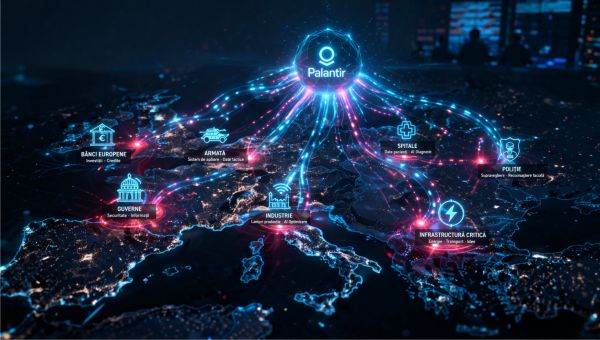
The massive bet of the most important European financiers on the American technology giant Palantir is taking on increasingly controversial proportions, despite a growing wave of concerns about human rights, European security and even the future of democracy on the continent, reveals a journalistic investigation published yesterday by the website Follow the Money (FTM), an investigation carried out in collaboration with publications from several European countries.
The cited source shows that, in a tense context, in which technology is becoming a geopolitical tool, over 100 banks, asset managers, insurers and pension funds in Europe increased, at the end of 2025, their holdings of Palantir shares by almost 70% compared to the previous year, reaching a cumulative value of at least 27 billion dollars.
The American company, founded in 2003 by billionaire Peter Thiel and entrepreneur Alex Karp, is one of the global leaders in data analysis and artificial intelligence, with applications ranging from health and police to military operations. Its software processes huge amounts of data in near real-time and is also used on the battlefield to identify targets. This technological power has attracted massive European capital, but it has also brought serious accusations, according to the cited source, which shows that Palantir has been criticized for collaborating with the US agency Immigration and Customs Enforcement (ICE) in combating illegal migration and for its ties to the Israeli army. Moreover, Amnesty International has accused the company since 2020 of failing to comply with its human rights due diligence obligations, and consultancy firm MSCI recently gave it a score of just 2 out of 10 in the "civil liberties” and "human rights concerns” sections.
Despite these alarm bells, investor appetite has not only not diminished, but has exploded, according to the journalistic investigation, which mentions that Norges Bank increased its stake by 60%, to 29 million shares, valued at $5.1 billion at the end of 2025, while Amundi reached investments of almost $3 billion, Legal & General at around $2.5 billion, and Barclays and Deutsche Bank at around $2 billion each. BNP Paribas exceeds the $1 billion threshold. Profitability has been spectacular: the total value of the holdings almost quadrupled in a single year, amid the explosive growth of shares in 2025, even though in 2026 they suffered a correction of around 15%. However, experts cited by Follow the Money warn that this race for profit could have serious consequences. Tara Van Ho, associate professor at St. Mary's University in Texas, warns that "when there are credible concerns about human rights abuses involving Palantir, financial actors have a responsibility to use their influence over Palantir to try to change its behavior.” Moreover, his warning is stark: "if Palantir chooses not to change, then ways must be identified to end that relationship.”
Nevertheless, large financial institutions continue to invest, often citing the fact that they are executing client orders, although experts and the UN emphasize that this justification does not exonerate them from human rights responsibilities.
The concerns do not stop there. Palantir's close ties to the US political and security establishment fuel fears about geopolitical influence, the cited source shows, specifying that the CIA was one of the company's early investors, and Palantir has access to sensitive US intelligence data. Moreover, co-founder Peter Thiel supported Donald Trump's campaign, and about 150 of Trump's 1,500 appointees own shares in the company. Palantir has also secured huge government contracts, including one with the US military worth potentially up to $10 billion.
In this context, former MEP Sophie in "t Veld warns, according to Follow the Money, that the separation between politics and business is becoming illusory: "They can no longer be seen as separate entities. Trump and JD Vance, on the one hand, and Peter Thiel, Alex Karp and Palantir, on the other, are interconnected: economically, politically and ideologically and move in the same circles.” Her conclusion is stark: "It is one club, with one anti-democratic agenda, in which America becomes the dominant force to which the rest of the world submits.”
This perspective is shared by other European officials. German parliamentarian Konstantin von Notz told the cited source that the increase in investments is "in direct contradiction with the values that Germany and Europe represent," while italian economist Francesca Bria, an expert on innovation, digital policy and information technology, warns that "these entities are building a post-democratic order, led by a small group of tech oligarchs who do not want to defend liberal democracy, but to dismantle it”.
According to the expert from Italy, "public contracts and access to critical state infrastructure are the tools through which they impose American dominance over the world; Europe is the next target”.
Moreover, the increasing dependence of European governments on Palantir technology in critical areas - defense, intelligence, health and law enforcement - amplifies the risks, the source cited claims. In Germany, the use of Palantir is banned at the national level, but its tools are used in some states, and the army has issued warnings about data security.
In Denmark, intelligence services are seeking to divest the company, while Switzerland has repeatedly rejected offers of collaboration. However, investments continue to flow.
Palantir has denied all of the above allegations. Company spokesman Nikolaj Gammeltoft told Follow the Money that "Palantir takes these allegations of fundamental rights violations seriously” and that the company's mission is to support Western democracies. He calls the idea that the company contributes to anti-democratic trends "absurd.” But critics are not convinced. Francesca Bria goes further and states that "Palantir is not a private company in any relevant sense; it is an arm of the American national security state, a private instrument of geopolitical power.” In her opinion, "when European governments buy its tools, they are not just buying software; they are giving up sovereignty.”
Finally, perhaps the harshest conclusion belongs to the expert from Italy: "Palantir has made itself indispensable, and that is exactly the goal. When you invest in it, you are financing the war on European democracy.”
From the above it emerges that, in the pursuit of profit and cutting-edge technology, Europe risks becoming not only dependent, but vulnerable in a geopolitical game in which the stakes are no longer just economic, but deeply political and ideological.



















 Euro
Euro Dolar SUA
 Franc elveţian
 Liră sterlină
 Gram de aur