English


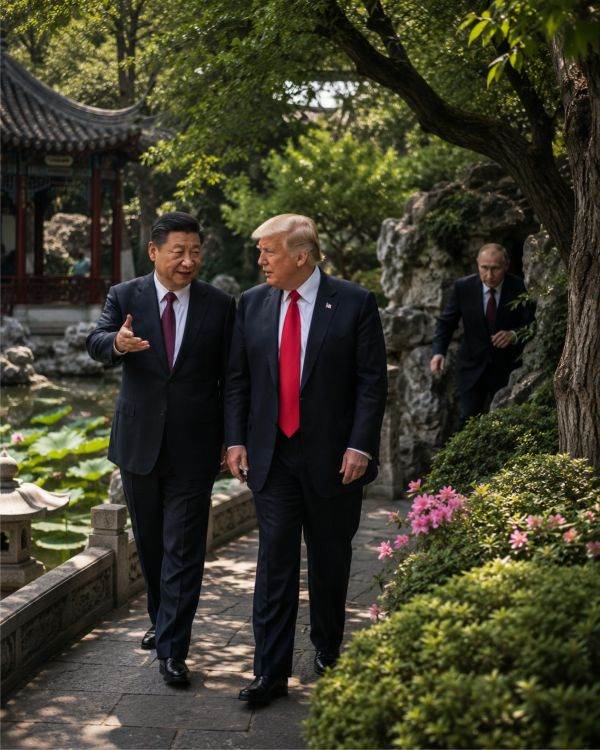
Vladimir Putin's visit to Beijing, on May 19-20, only four days after the summit between Donald Trump and Xi Jinping, indicates the transformation of the Chinese capital into a point of convergence for two of the most important geopolitical crises of the moment: the war in Ukraine and the tensions between the US/Israel and Iran.
The succession of these meetings suggests more than just a busy diplomatic agenda. Beijing comes to concentrate, within a very short interval, dialogue with Washington and strategic contact with Moscow, at a moment when the two security issues - the Ukrainian one and the Iranian one - are in phases of intensification and growing interdependence.
The Trump-Xi summit had as its central theme the stabilization of American-Chinese bilateral relations, but also Washington's attempt to obtain Beijing's support for reducing the risks around Iran and the Strait of Hormuz.
Only a few days later, Putin's arrival in China for discussions regarding bilateral relations, economic cooperation and key international and regional issues shows that Beijing functions simultaneously as an indispensable interlocutor for both rival camps.
This overlap gives China a new role, broader than that of a simple regional actor or global economic partner.
China begins to appear as the pivot through which the two major axes of conflict of the present intersect: the Russia-Ukraine confrontation, indirectly supported by the West, and the American-Israeli tensions with Iran and its regional network of allies.
In Russia's case, dependence on China has intensified after the invasion of Ukraine in 2022, given that Western sanctions drastically reduced Moscow's options.
In the US case, the appeal to Chinese influence over Iran shows that even Washington recognizes, even tacitly, Beijing's capacity to influence critical security equations outside East Asia.
From here results a structural change in the international system. If until recently regional conflicts could be treated relatively separately, they now tend to be connected through the major powers that have simultaneous access to all relevant parties. Beijing becomes precisely this intersection space: the place where, directly or indirectly, both Ukraine and Iran, and the balance of power relations between Washington and Moscow are discussed.
The fact that Putin's visit also coincides with the marking of 25 years since the Sino-Russian Treaty of Friendship from 2001 adds a symbolic dimension, but the calendar suggests a deeper strategic significance.
China is no longer just an actor that reacts to crises, but one around which crises begin to organize themselves diplomatically.
The major risk is that this concentration of negotiation channels in a single capital could accelerate what could be called the globalization of conflicts.
At the moment when the Ukrainian issue, American-Chinese competition and the confrontation with Iran touch in the same center of power, the possibility of systemic propagation of tensions grows.
Regional conflicts no longer remain isolated, but become parts of a common architecture of pressure, negotiation and deterrence.
Beijing is not yet the arbiter of the world, but it becomes increasingly clear the place where the main lines of global disorder meet.
China not only participates in contemporary conflicts through economic and diplomatic influence, but begins to connect them to each other.


















 Euro
Euro Dolar SUA
 Franc elveţian
 Liră sterlină
 Gram de aur